
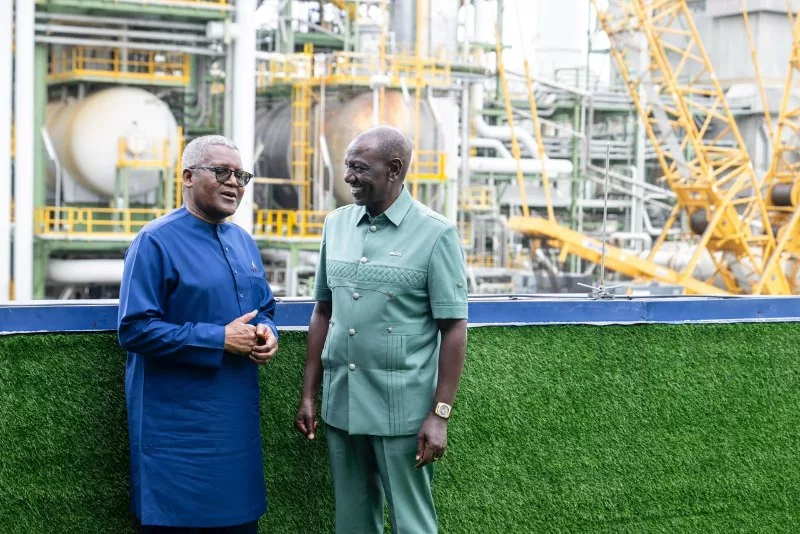
The planned groundbreaking of the Sh2 trillion Dangote East Africa Refinery in Lamu will go ahead on Wednesday despite a court order preserving the status quo on land at the centre of a dispute with local residents.
Energy and Petroleum Cabinet Secretary Opiyo Wandayi confirmed the government would proceed with the September 30 ceremony, even as 133 residents challenge the project in court and demonstrations over compensation continue in Lamu.
Speaking in Mombasa on Tuesday, Wandayi said Kenya was moving ahead with the refinery project.
“Soon Kenya will provide a route for imported products as well as finished products. We will be launching the Dangote refinery in Lamu tomorrow,” he said.

The statement came a day after the Malindi Environment and Land Court declined to stop the planned groundbreaking.
Justice Jane Onyango instead directed parties to maintain the existing status quo on LR No. 13061, in the Hindi/Manda Magogoni area, until October 14, when the application will be heard between the parties.
The order covers activities on the disputed land. It affects actions such as clearing, excavation, fencing, demolition and construction on the occupied portions of the property.
But importantly, the judge did not grant the residents’ request to stop the September 30 groundbreaking.
The court also declined to certify the application as urgent and directed the respondents to file their responses before the October 14 hearing.
What the court order means
The distinction matters.
The court has not cancelled the refinery project or blocked Wednesday’s ceremony. Instead, it has preserved the position on the disputed parcel while the underlying land claims are considered.
Dangote Group has also confirmed that the ceremony will proceed.
The company told Reuters that the ruling does not halt the groundbreaking but could affect activities at the site while the case is pending.
This means Wednesday’s event can go ahead, but construction-related activity on the contested portions of LR No. 13061 remains subject to the interim court order.
The legal battle will therefore continue after the cameras leave Lamu.
Residents demand compensation
The case was brought by Salim Tima Swale and 132 other residents of Chandavai.
The residents say their families have lived on and used parts of the disputed land for generations.
They argue that their interests were not properly recognised during the land acquisition process and are seeking compensation and protection of what they describe as community and customary land rights.
Court papers cited by The Star say residents claim the land includes homes, farms, livestock areas, mosques, shrines and family graves. They also allege that earlier site clearance damaged crops, trees and other property. These remain allegations before the court and have not been determined.
The applicants have also asked the court to recognise them as interested parties in the acquisition process and are seeking damages over alleged violations of their property and administrative rights.
Their position is that development can proceed, but affected communities should first have their land rights, compensation and resettlement concerns addressed.
Protests add pressure
The court dispute has coincided with protests in Lamu.
Residents demonstrated on Tuesday as preparations for the groundbreaking entered their final stage. Reports said police deployed tear gas during clashes with protesters, while the demonstrations centred on demands for compensation.
The protests highlight the wider challenge facing the project: how to push ahead with one of Kenya’s biggest proposed energy investments while resolving concerns from communities living around the development site.
The dispute is now before the court, which is expected to hear the application on October 14.
Project moves closer to construction
The legal challenge comes as physical preparations for the refinery gather pace.
On September 26, the Port of Lamu received the MV Da Yang, carrying about 2,930 metric tonnes of heavy construction machinery for the project. The arrival was one of the clearest signs yet that preparations had moved beyond announcements and into physical mobilisation.
The proposed refinery is designed to process up to 700,000 barrels of crude oil a day.
Dangote has said the Lamu facility is expected to cost between US$15 billion and US$16 billion, with completion targeted for 2030.
The project is intended to serve Kenya and regional markets, with possible crude supplies from Kenya and other parts of East and Southern Africa.
But there are questions beyond the land dispute.
Reuters has reported that Kenya currently has no commercial oil production, meaning securing a reliable crude supply will be an important issue for a refinery of the proposed size.
That makes the Lamu project more than a construction story. Its success will depend on resolving land concerns, securing financing, building supporting infrastructure and establishing dependable crude supply arrangements.
For now, the immediate timetable remains unchanged.
The groundbreaking is scheduled for Wednesday, September 30.
The land dispute, however, will continue into October.
And the next significant test comes on October 14, when the court is due to hear the residents’ application.
You may also like
Category: Business
Related Video: What Dangote’s proposed Lamu oil refinery could mean for East Africa
Related Explainer: Kiharu Technical College September Intake 2026: Courses, Skills and New Opportunities
About the Author
Maureen Onyango is a journalist passionate about storytelling, life coaching and spiritual lessons. She studied at the Kenya Institute of Management and enjoys telling stories that inform, inspire and empower communities.
 Facebook
 Twitter / X
 WhatsApp
 LinkedIn
 Telegram
 Reddit