
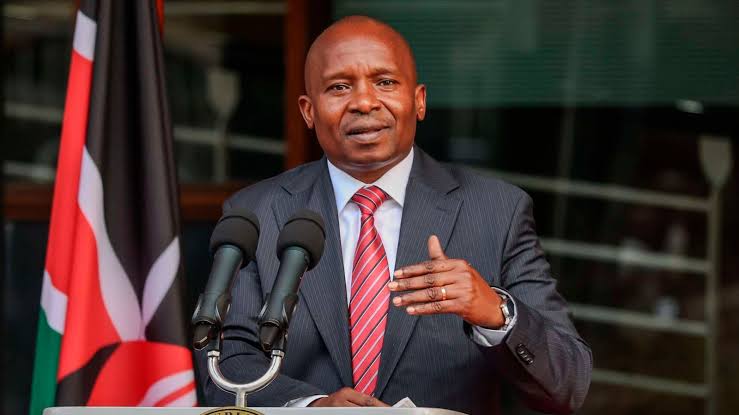
Kenya is set to re-inspect alcohol manufacturing premises across the country as the government widens its crackdown on illicit and unsafe drinks.
Deputy President Kithure Kindiki has directed enforcement and regulatory agencies to check whether manufacturers are still meeting licensing, health, safety and quality requirements.
The order marks a shift from targeting only illegal brewing sites to also checking the compliance of established alcohol manufacturers.
Kindiki issued the directive on Tuesday, September 29, after meeting Interior Cabinet Secretary Kipchumba Murkomen, Inspector General of Police Douglas Kanja and heads of regulatory and enforcement agencies.

“I have directed enforcement and regulatory agencies to re-inspect manufacturer premises to ascertain the current state of compliance with all applicable standards and regulations,” Kindiki said.
Premises found operating without the required licences or failing to meet applicable standards could be closed, according to the government.
The move comes days after Kindiki announced a renewed campaign against what he described as “poisonous” alcoholic drinks, particularly those containing harmful substances.
Government moves beyond illegal brewing dens
The latest directive puts the entire production chain under fresh scrutiny.
Authorities will be expected to establish whether manufacturers remain compliant with the conditions under which they were licensed.
The multi-agency operation brings together security agencies and regulators with different responsibilities in the alcohol market.
These include the Kenya Bureau of Standards (KEBS), Kenya Revenue Authority (KRA), Anti-Counterfeit Authority and the National Authority for the Campaign Against Alcohol and Drug Abuse (NACADA).
Kindiki said intelligence-led operations were already disrupting illicit supply networks and shutting down unlicensed manufacturing establishments.
“Intelligence-led multi-agency sting operations are progressively dismantling cartels, disrupting supply chains and incapacitating unlicensed manufacturing establishments,” he said.
The government also plans to provide more equipment and resources to enforcement and regulatory agencies.
The inspections are expected to cover the production and distribution chain, with the aim of keeping non-compliant products away from consumers.
A public health problem, not just a policing issue
The renewed crackdown comes amid longstanding concerns about alcohol and substance abuse in Kenya.
NACADA's 2022 National Survey on the Status of Drugs and Substance Use found that about 1.36 million people aged 15 to 65 were affected by alcohol addiction nationally.
The Central region recorded an alcohol-use-disorder prevalence of 9.9 per cent in the survey, equivalent to about 337,700 people in the age group surveyed.
The findings also showed a particularly high prevalence of potable-spirit use in the region.
Kindiki has linked the renewed campaign to concerns over the health of young people and the wider social impact of harmful alcohol.
But the government is now presenting the response as more than an enforcement exercise.
It is also proposing a major expansion of public rehabilitation services.
Every county could get a public rehab centre
Kindiki said the national and county governments will work together to establish and operate at least one public rehabilitation centre in every county within the next year.
Each centre is estimated to cost about Sh60 million.
If one facility is established in each of Kenya's 47 counties, the projected construction cost would be about Sh2.82 billion.
“The national and county governments will partner to build and operate at least one public rehabilitation centre per county within the next one year,” Kindiki said.
The proposal would expand access to treatment for people already affected by alcohol and drug dependence rather than concentrating the government's response solely on stopping production and sales.
There is already an example of county-run rehabilitation services.
Nyeri County operates the Ihururu Treatment and Rehabilitation Hospital, a 90-bed facility that was accredited as a rehabilitation centre by NACADA in 2023. County records say it has treated clients from different parts of Kenya.
The proposed nationwide network would therefore need to address not only construction but also staffing, accreditation, treatment capacity and long-term operating costs.
Counties and national government to discuss licensing
Kindiki has also given Interior CS Kipchumba Murkomen 14 days to convene a sector forum with the relevant Council of Governors committee.
The forum will examine how alcohol trade and consumption are licensed and regulated, as well as how national and county governments can work together on rehabilitation services.
A special Intergovernmental Budget and Economic Council meeting is also expected next month to discuss the economic and social effects of alcohol and drug abuse.
The involvement of counties is significant because alcohol licensing and enforcement involve both levels of government.
The planned discussions could therefore determine how responsibilities are shared, particularly around licensing, inspections, enforcement and rehabilitation.
Crackdown follows fresh concerns in Mt Kenya
Kindiki's latest action follows a renewed public campaign against illicit alcohol in parts of the country, particularly the Mt Kenya region.
On September 25, he said he would lead a fresh campaign against harmful alcoholic drinks after concerns were raised by elders and residents.
He later convened the multi-agency meeting involving the Interior ministry, KRA, KEBS and other agencies.
The government has also reported recent seizures and arrests during operations targeting illicit alcohol.
However, the scale of the problem means enforcement alone is unlikely to address all aspects of alcohol dependence.
Closing an illegal outlet may remove one source of supply. It does not, by itself, provide treatment for someone already dependent on alcohol.
That is why the proposed rehabilitation programme is becoming an important part of the government's latest approach.
What happens next
For manufacturers, the immediate issue is compliance.
Premises will face fresh scrutiny over licences and applicable standards. Those found outside the law could face enforcement action, including closure.
For consumers, the government says the goal is to reduce the availability of unsafe alcoholic products.
And for people struggling with dependence, the proposed county rehabilitation centres could eventually provide a wider public treatment network.
But much will depend on implementation.
The government will need to establish how the proposed Sh2.82 billion network will be funded, where facilities will be built, who will operate them and how treatment will be sustained after construction.
The first immediate test will come with the planned sector forum within 14 days.
For the alcohol industry, meanwhile, a nationwide re-inspection means licences and compliance will once again be under the microscope.
You may also like
Category: News
About the Author
Maureen Onyango is a journalist passionate about storytelling, life coaching and spiritual lessons. She studied at the Kenya Institute of Management and enjoys telling stories that inform, inspire and empower communities.
 Facebook
 Twitter / X
 WhatsApp
 LinkedIn
 Telegram
 Reddit