
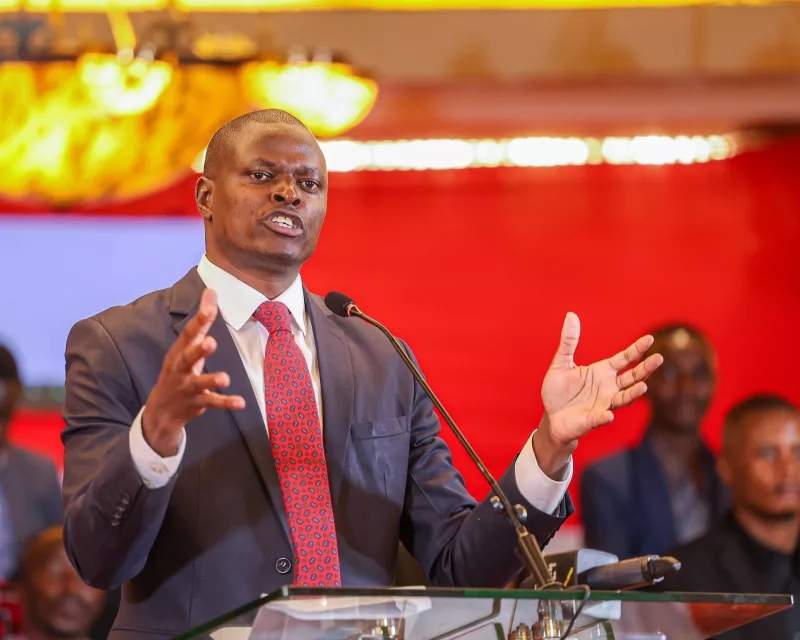
People's Party of Kenya leader Ndindi Nyoro has called for full disclosure of the shareholders behind the proposed Dangote-linked oil refinery in Lamu, adding a new transparency question to one of the largest investment projects currently being promoted by President William Ruto's government.
Speaking during engagements in Nakuru County, the Kiharu MP said Kenyans should be told who owns the proposed refinery if the project proceeds.
Nyoro said Kenya should welcome major investors, including Nigerian industrialist Aliko Dangote, while ensuring that investment deals are transparent and businesses are protected from improper interference.
“Wakenya wanataka wajue who are the shareholders of Dangote refinery even ikijengwa pale Lamu,” Nyoro said.

He also made allegations suggesting government officials seek ownership interests in investments.
Those are Nyoro's political allegations and have not been established as fact.
No evidence presented in the reports reviewed establishes that President Ruto personally owns or has demanded shares in the proposed Lamu refinery.
What is the Lamu refinery?
President Ruto has publicly promoted plans for a major oil refinery and petrochemical complex in Lamu.
During his address to the United Nations General Assembly, Ruto described a proposed facility capable of processing approximately 700,000 barrels of crude oil per day at an estimated investment of around $16 billion.
The government has presented the project as part of a strategy to transform Kenya from an importer of refined petroleum products into a regional processing and industrial hub.
Dangote's involvement has featured prominently in public discussion surrounding the project.
But a project of that size involves several distinct questions: who develops it, who finances it, who owns equity, who supplies crude oil and what guarantees or infrastructure the government provides.
Those details are not interchangeable.
Why ownership matters
Nyoro's demand focuses specifically on equity ownership.
Knowing the ultimate beneficial owners of a large strategic project can be important for several reasons.
It allows the public to understand whether the investment is entirely private, includes state ownership or involves other investors.
It can also help identify potential conflicts of interest.
But transparency requirements need to be applied to established corporate structures rather than speculation.
The fact that a politician demands disclosure does not itself establish that ownership is being concealed unlawfully.
The government's response and formal project documentation will therefore be important.
Investment versus accountability
Nyoro's comments highlight a tension Kenya will repeatedly encounter as it seeks very large foreign investments.
Major investors want speed, regulatory certainty and protection from political interference.
The public wants transparency where projects involve strategic infrastructure, public land, government guarantees or other state resources.
Those objectives do not necessarily conflict.
Transparent agreements can actually reduce political risk for investors because they make it more difficult for future governments to claim contracts were secretly negotiated or improperly awarded.
The refinery proposal is especially significant because of its enormous scale.
A $16 billion investment would be equivalent to more than Sh2 trillion at recent exchange rates.
A 700,000-barrel-per-day refinery would also be very large by African standards.
That makes questions about financing, ownership, crude supply, environmental approvals and supporting infrastructure unavoidable.
Questions still requiring answers
Before construction begins, several issues need greater clarity.
Who will own equity in the project?
How much will each investor contribute?
Will Kenya's government or state corporations own a stake?
Will taxpayers provide guarantees?
Where will the refinery obtain its crude oil?
What port, pipeline, storage and power infrastructure will be required?
And what environmental and community approvals will be necessary in Lamu?
Nyoro's intervention does not answer those questions.
It puts one of them — ownership — more firmly into public debate.
The government's strongest response would therefore be documentary rather than political: publish the ownership and investment structure once it is finalised.
Until then, claims about undisclosed shareholders should remain clearly identified as political allegations rather than established facts.
You may also like
Category: Business · Related Topic: Social Health Authority (SHA)
Related Video: What Dangote’s proposed Lamu oil refinery could mean for East Africa
Related Explainer: EXPLAINER: How can one mother give birth to five babies? The science behind Kenya’s rare quintuplets
 Facebook
 Twitter / X
 WhatsApp
 LinkedIn
 Telegram
 Reddit