
For nearly half a century, crude oil arrived at Kenya's coast, entered a refinery in Changamwe and emerged as petrol, diesel, kerosene, jet fuel, liquefied petroleum gas and other petroleum products for Kenya and the wider East African market.
Then, on September 4, 2013, the refining stopped.
The Kenya Petroleum Refineries Limited complex in Mombasa never resumed commercial crude processing. More than 13 years later, the facility that once symbolised Kenya's industrial ambitions primarily serves as a petroleum storage and distribution facility.
Now Kenya is preparing for something considerably bigger.

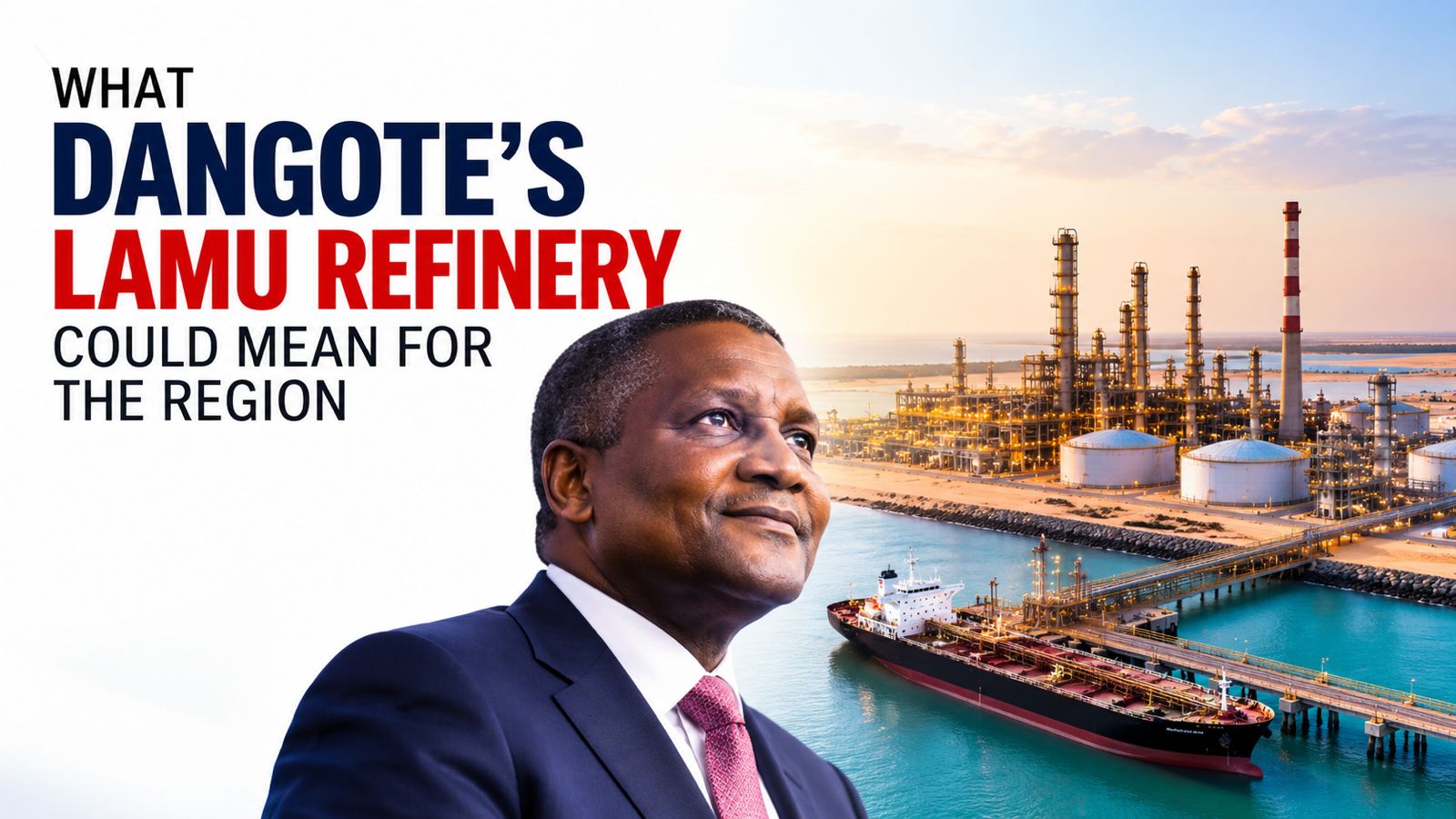
A proposed Dangote refinery in Lamu is planned to process about 700,000 barrels of crude oil a day, potentially making Kenya a major petroleum-processing centre for East and Central Africa. Recent reporting puts the investment at roughly $15 billion to $16 billion, although estimates have varied as the project has developed. Engineers India has also secured a contract worth more than $450 million for engineering and project-management work.
But before celebrating the return of oil refining to Kenya, Changamwe offers an important lesson.
This is the story of why Kenya stopped refining oil — and what must be different if Lamu is to avoid becoming another enormously expensive industrial monument.
A refinery built for East Africa
What Kenyans commonly call the Changamwe refinery began life as East African Oil Refineries Limited.
Shell and BP established the company in 1960 to supply petroleum products to the East African region. Its first refinery complex was commissioned in 1963, the year Kenya gained independence.
A second refining train followed in 1974.
The complex included crude distillation, hydrotreating, catalytic reforming and bitumen-production units.
For decades, this was an important part of Kenya's petroleum supply system.
Government petroleum policy says that between 1963 and 2013, refining crude at KPRL helped reduce Kenya's requirement for imported finished petroleum products by roughly 30 to 40 per cent.
The ownership also changed over time.
The refinery became Kenya Petroleum Refineries Limited in 1983. Shell and BP-linked private interests eventually gave way to India's Essar Energy, which acquired a 50 per cent stake in 2009.
There were ambitions to modernise it.
Essar wanted to increase processing capacity from roughly 1.6 million tonnes annually to four million tonnes — equivalent to about 79,000 barrels per day — by 2018.
That transformation never happened.
September 4, 2013: The refinery goes quiet
KPRL officially stopped refining crude oil on September 4, 2013.
It was not simply because Kenya had run out of crude to process.
The fundamental problem was economics and technology.
The refinery had become old and comparatively inefficient.
An Auditor-General report later said operations ceased because of technological limitations, changing market economics and the refinery's lack of sufficient secondary processing capabilities to optimise production, particularly fuel oil.
Modern refineries do much more than boil crude oil and separate it into basic fractions.
More sophisticated secondary processing allows operators to convert lower-value heavy products into higher-value fuels demanded by the market.
Changamwe increasingly lacked the configuration required to compete efficiently.
Oil marketers also complained about its products.
A proposed $1.2 billion modernisation was considered, but consultants concluded that the upgrade was not economically viable and the plan was abandoned.
That was effectively the end.
Rather than invest more than a billion dollars trying to transform an ageing refinery, Kenya increasingly imported finished petroleum products.
Kenya bought the refinery — but did not restart it
Essar subsequently sought to leave the business.
In 2016, the Kenyan government bought Essar's remaining 50 per cent shareholding for approximately $5 million, giving the state complete ownership of KPRL.
But government ownership did not mean refining would return.
KPRL instead found a new purpose.
The huge tank farms, land and petroleum infrastructure remained valuable even when the refining units were not.
In 2017, KPRL entered an arrangement with Kenya Pipeline Company for use of its storage facilities.
Then, in October 2023, the National Treasury transferred its entire KPRL shareholding to KPC, making the former refinery a wholly owned subsidiary of the pipeline company.
Today, KPRL provides roughly 484 million litres of additional petroleum storage capacity to KPC.
The refinery complex itself remains idle.
When Energy Cabinet Secretary Opiyo Wandayi visited Changamwe in September 2024, the government was explicit: there were no plans to revive refining there. The infrastructure would instead be developed around storage and related petroleum activities, including LPG.
Changamwe therefore did not completely die.
Its purpose changed.
Enter Dangote — on a completely different scale
That history matters because Kenya is now preparing to return to refining through Lamu.
But comparing Changamwe directly with the proposed Dangote facility can be misleading.
The two projects belong to radically different industrial eras.
The old Changamwe refinery processed roughly 5,000 to 9,000 metric tonnes of crude daily during operations, according to Kenya's National Petroleum Policy.
The proposed Dangote complex is designed for approximately 700,000 barrels per day.
That places Lamu in an entirely different category.
It is not being conceived primarily as a replacement for the refinery Kenya lost in 2013.
It is intended as a regional-scale industrial complex.
President William Ruto has said the refinery would target markets including Kenya, Ethiopia, South Sudan, Uganda, Tanzania, Rwanda, Burundi and the Democratic Republic of Congo.
That distinction is critical.
Kenya alone does not need 700,000 barrels of refining capacity every day.
For the economics to work as envisaged, Lamu must sell enormous volumes beyond Kenya's borders.
Changamwe versus Lamu
| Changamwe KPRL | Proposed Dangote Lamu refinery |
|---|---|
| Commissioned in 1963 | Greenfield modern project |
| Expanded in 1974 | Proposed capacity about 700,000 barrels/day |
| Eventually technologically dated | Designed around modern refining technology |
| Primarily served Kenya/East Africa | Explicitly targeting East and Central African markets |
| Upgrade of ageing plant judged uneconomic | New-build refinery rather than rehabilitation |
| Government/private ownership history | Dangote-led investment with financing/equity structure still developing |
| Refining stopped in 2013 | Groundbreaking planned for September 30, 2026 |
| Now principally petroleum storage | Proposed refining and petrochemical complex |
The biggest difference, therefore, isn't simply capacity.
It is the business model.
Changamwe became an ageing domestic and regional refinery struggling to compete against imported finished petroleum products.
Lamu must operate as an export-oriented industrial platform from the beginning.
But Lamu faces a problem Changamwe didn't solve: crude
Building a refinery is only one side of the equation.
It needs crude oil every day.
A 700,000-barrel-per-day refinery operating at high utilisation could require well over 200 million barrels of crude annually.
Kenya currently does not produce anything approaching that quantity.
Commercial production from the South Lokichar fields in Turkana is only now being revived, and even projected Kenyan production would represent only a fraction of the crude required by a refinery of Lamu's proposed scale.
Consequently, substantial volumes would have to be imported unless regional production changes dramatically.
Analysts have already identified crude supply and financing as major challenges for the project.
Lamu's deep-water port helps.
Large tankers could bring crude from international suppliers, while refined products could leave by ship or eventually move through regional transport infrastructure.
But the refinery must obtain that crude at internationally competitive prices.
A refinery does not become commercially viable merely because it is enormous.
The second test is the regional market
The proposed capacity also creates another question.
Who buys all the fuel?
East Africa currently imports substantial quantities of refined petroleum.
That creates an obvious opportunity.
Instead of importing petrol, diesel, jet fuel and other finished products from refineries thousands of kilometres away, the region could potentially import crude and refine more of it locally.
That could retain more industrial value within Africa.
But neighbouring countries cannot simply be assumed to become customers.
Uganda is pursuing its own refinery ambitions.
Tanzania has its own ports and petroleum infrastructure.
International refiners will continue competing for the East African market.
Countries will buy from Lamu when its landed products are competitive in price, quality and reliability — not simply because the refinery is located in Africa.
This is one of Changamwe's strongest lessons.
National pride cannot compensate indefinitely for poor refining economics.
Then there is the $16 billion question
Lamu also has to pass perhaps the most important test of all: financing.
The projected investment is enormous.
Recent reporting places the project around $15 billion to $16 billion, although different figures have appeared during its development.
The engineering work is becoming more concrete.
Engineers India Limited has disclosed a contract worth more than $450 million connected to project management and engineering for the planned refinery and petrochemical plant.
That is significant progress.
But engineering contracts and groundbreaking ceremonies are not the same thing as achieving full financial close for a multibillion-dollar refinery.
The eventual capital structure matters enormously.
How much will Dangote contribute?
How much will lenders provide?
Will Kenya take equity?
Will other East African governments participate?
Will there be government guarantees?
What infrastructure will Kenyan taxpayers finance?
And who ultimately carries the risk if project economics change?
Those questions should be answered before predictions about the refinery's eventual benefits are treated as certainties.
Lest we forget
Changamwe is not evidence that Kenya should never build another refinery.
That would be the wrong lesson.
For 50 years, KPRL played an important role in Kenya's petroleum economy. Even after refining ended, its tanks, land and other infrastructure retained enough strategic value that Kenya Pipeline Company eventually absorbed it.
The lesson is subtler.
A refinery survives only when its technology, feedstock, scale, financing and market remain competitive.
Changamwe's refining units eventually failed that test.
The proposed Dangote refinery starts with several advantages its predecessor never had: enormous scale, a greenfield design, a deep-water port, a regional rather than purely Kenyan market strategy and the experience of a developer that already operates a giant refinery in Nigeria.
But Lamu also starts with risks of its own.
It needs billions of dollars in financing.
It needs reliable crude supply.
It needs buyers across several countries.
It needs pipelines, storage, power, water, port infrastructure and logistics.
And it needs to remain commercially competitive against some of the world's most efficient refiners.
So as Kenya prepares to celebrate the return of refining, Changamwe deserves another look.
Its silent processing units tell a story worth remembering.
Building a refinery is an achievement. Keeping one economically viable for decades is the real test.
You may also like
Category: Business
Related Video: What Dangote’s proposed Lamu oil refinery could mean for East Africa
Related Explainer: Explainer: What happened to milk in Kenya?
 Facebook
 Twitter / X
 WhatsApp
 LinkedIn
 Telegram
 Reddit