
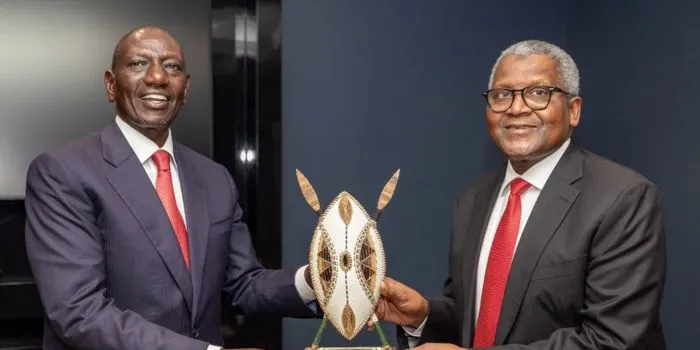
President William Ruto is set to tour Aliko Dangote’s massive oil refinery in Lagos on Friday, just days before Kenya breaks ground on a second refinery backed by the Nigerian billionaire in Lamu.
The visit will give Ruto a first-hand look at the industrial complex that Dangote has already built and is now expanding, as Kenya prepares to begin work on its planned 700,000-barrel-per-day refinery.
Dangote Group has confirmed that its president, Aliko Dangote, will host Ruto at the Lekki refinery.
The visit comes less than a week before the planned September 30 groundbreaking ceremony in Lamu.

It also comes as the two sides move from discussions about the project to the early stages of implementation.
From Lagos to Lamu
Ruto announced earlier this week that Kenya was ready to break ground on the Lamu refinery after meeting Dangote and Africa Finance Corporation chief executive Samaila Zubairu on the sidelines of the UN General Assembly in New York.
The discussions focused on financing and the final arrangements needed before construction begins.
Ruto said the project would strengthen Kenya’s energy security, increase local value addition and create more than 60,000 jobs.
“We are ready to break ground on the East Africa refinery in Lamu,” Ruto said, describing it as a project intended to strengthen regional energy security and create new economic opportunities.
The proposed facility is expected to process 700,000 barrels of crude oil a day and produce refined petroleum products and petrochemicals for Kenya and the wider East African market.
That capacity would make the Lamu plant larger than Dangote’s current operating capacity in Nigeria.
Why the Lagos visit matters
The choice of Dangote’s Lagos refinery as part of Ruto’s itinerary gives the visit a practical dimension.
The Lekki facility is already operating and has a current crude-processing capacity of about 700,000 barrels per day. Dangote is also pursuing an expansion that would take it to 1.4 million barrels per day.
The Nigerian refinery began operations in 2024 and has become a major source of refined petroleum products for the Nigerian market, while also supplying export markets.
The company says the expansion is expected to be completed by 2029.
For Kenya, the timing of Ruto’s visit means the President will see an operating version of the kind of large-scale refining and petrochemical complex the Dangote Group wants to develop in Lamu.
It also comes as the Nigerian company expands its refining ambitions beyond West Africa.
Engineers behind Lagos project brought into Lamu
Another significant development came this week when Engineers India Limited (EIL), an Indian state-owned engineering company, confirmed a contract worth more than US$450 million, roughly KSh58 billion, for the Kenyan project.
EIL will serve as the project's project management consultant and engineering, procurement and construction management consultant.
The company previously worked with Dangote on the Nigerian refinery at Lekki and is also involved in its planned expansion.
The new agreement therefore gives the Lamu project an engineering partner with experience on the Lagos facility.
It is important, however, to distinguish the EIL contract from the overall cost of building the Kenyan refinery.
The engineering and project-management deal is worth more than US$450 million. The proposed refinery and petrochemical complex itself has been estimated in recent reports at between US$15 billion and US$17 billion, depending on the source and project estimate.
A much bigger refining footprint
If both projects reach their planned capacities, Dangote's refining interests in Nigeria and Kenya would represent a combined 2.1 million barrels per day.
That figure would consist of 1.4 million barrels per day from the planned expansion of the Nigerian facility and 700,000 barrels per day from the proposed Lamu refinery.
The scale reflects Dangote's broader push to build a major refining and petrochemical business serving several African markets.
But the Lamu project remains at the beginning of its construction journey.
The September 30 event is a groundbreaking, not the start of commercial production.
The project will still have to move through construction, installation, testing and commissioning before it can supply fuel to the market.
What Kenya expects from the project
The Kenyan government has linked the refinery to its longer-term plan to reduce dependence on imported refined petroleum products.
Kenya currently relies heavily on imported fuel, with Mombasa serving as the country's main petroleum import and distribution gateway.
A large refinery at Lamu would create a second major petroleum-processing and export hub on the coast.
The government also expects the project to support petrochemical industries, create jobs and generate business for companies involved in construction, transport, logistics and related services.
Its location at Lamu is also significant.
The project would sit close to the Lamu Port development, giving it potential access to a deep-water maritime route and regional markets.
The wider ambition is for Lamu to become an important energy and logistics centre serving Kenya and landlocked countries in East and Central Africa.
Lamu residents want a stake in the project
The scale of the proposed investment has also brought local concerns into focus.
As preparations for the groundbreaking gather pace, residents and community groups in Lamu have called for greater inclusion in the project and resolution of outstanding land and compensation issues.
Those concerns are likely to become increasingly important as construction moves from planning to implementation.
For the government and Dangote Group, the challenge will therefore be not only to finance and build the refinery, but also to ensure that communities around the project see tangible benefits.
Groundbreaking set for September 30
Preparations for the ceremony are already under way in Lamu.
County officials have said senior government leaders and other dignitaries are expected to attend the event, with security and logistical arrangements being put in place.
Ruto's Lagos visit on Friday will come five days before that ceremony.
The sequence is striking: first, a tour of a refinery that is already operating; then, a groundbreaking for a much larger project that Kenya hopes will reshape its petroleum industry.
The real measure of the Lamu project, however, will come long after the cameras leave.
Kenya will ultimately have to demonstrate that the refinery can be built on schedule, attract the required financing, operate competitively and deliver the lower import dependence, jobs and regional energy benefits promised by its backers.
You may also like
Category: News · Related Topic: William Ruto
Related Video: Dolly Parton’s Family Announces Her Passing in Emotional Tribute
About the Author
Maureen Onyango is a journalist passionate about storytelling, life coaching and spiritual lessons. She studied at the Kenya Institute of Management and enjoys telling stories that inform, inspire and empower communities.
 Facebook
 Twitter / X
 WhatsApp
 LinkedIn
 Telegram
 Reddit