
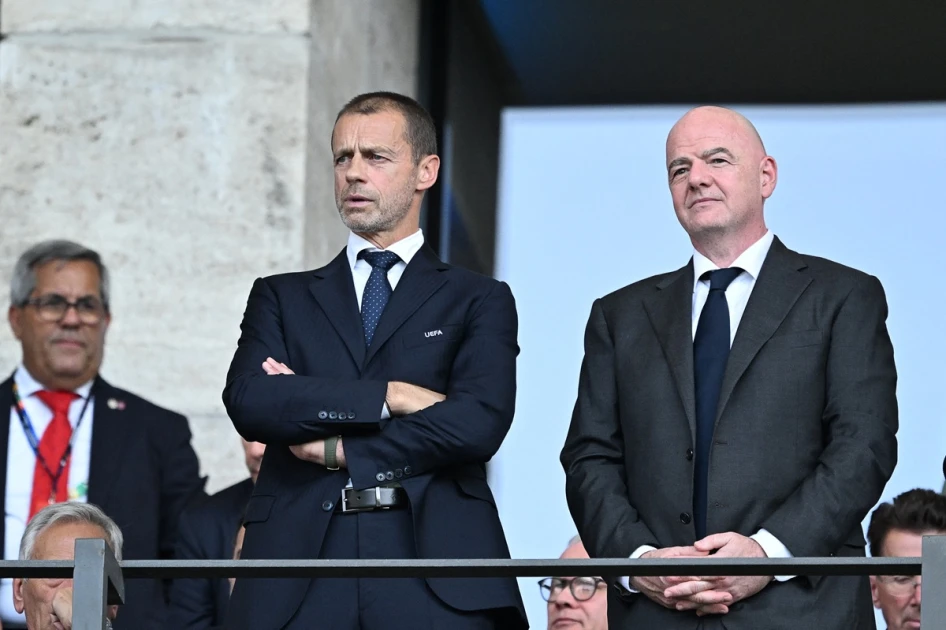
The fight over FIFA’s abandoned plan to bring private investors into the commercial side of the World Cup has moved into the courts — and is now colliding with Gianni Infantino’s bid for another term as FIFA president.
FIFA has accused UEFA of running a “misinformation” campaign and trying to influence the organisation’s presidential election by seeking access to documents linked to the failed FIFA Forward Enterprise (FFE) proposal.
The allegations were made in a filing opposing UEFA’s request for evidence in a US federal court in Florida.
UEFA is seeking documents as it considers possible legal action over the plan, which was abandoned by FIFA in July after strong opposition from several football bodies.

FIFA has asked the US court to reject UEFA’s request.
The latest dispute adds another layer to an increasingly public confrontation between European football and FIFA’s leadership.
From investment plan to courtroom fight
The FFE proposal was unveiled in July as a new FIFA-controlled commercial subsidiary that would manage major competitions and their commercial operations.
The original proposal allowed outside investors to take a minority stake of up to 20 per cent.
FIFA said the plan could unlock billions of dollars for football development and increase funding available to its 211 member associations.
But UEFA and other stakeholders objected to the way the proposal had been developed and questioned the idea of allowing private capital into a business built around football’s biggest competitions.
FIFA eventually withdrew the proposal after acknowledging that mistakes had been made in the process.
The world governing body said the project had created divisions within football and would no longer proceed.
The withdrawal, however, did not end the dispute.
UEFA later began seeking evidence through US courts as it considered possible legal proceedings concerning the proposal.
FIFA has now hit back, arguing that UEFA's case contains what it describes as false or misleading claims about the project and Infantino.
According to Reuters, FIFA also disputes UEFA's assessment of the value of the proposed commercial enterprise, saying its value would have exceeded $30 billion.
UEFA has not commented on the latest filing.
Election battle adds to the pressure
The legal dispute comes as Infantino prepares to seek a fourth term.
FIFA confirmed earlier this year that its 77th Congress, where the presidential election will take place, is scheduled for 18 March 2027 in Rabat, Morocco. Infantino has already declared that he will seek re-election.
FIFA says UEFA’s legal campaign is partly aimed at influencing that election.
That is an allegation from FIFA, rather than a finding by the US court.
The dispute has nevertheless become part of a much wider argument about how FIFA is governed and how much power should sit with its president.
Four of Europe's biggest domestic leagues — the Premier League, Bundesliga, Serie A and La Liga — recently called for major governance reforms at FIFA.
They have argued for greater involvement of football's wider stakeholders and clearer separation between FIFA's regulatory responsibilities and its commercial activities.
UEFA president Aleksander Čeferin has also said trust in FIFA's leadership remains damaged following the collapse of the FFE proposal.
A new fight over FIFA's billions
The row has now taken an unexpected financial turn.
UEFA and CONCACAF have proposed that FIFA distribute at least $10 million to each of its 211 member associations from its reserves during the 2027–30 cycle.
That would amount to about $2.1 billion.
The two confederations have argued that FIFA has sufficient reserves to make the payment without selling interests in its competitions.
They have also called for an independent assessment of FIFA's financial position.
Infantino has since indicated that he is open to considering increased funding for member associations.
In a letter to FIFA's membership, he said he would support the highest additional funding that could be responsibly provided.
But he stopped short of committing to the $10 million figure.
FIFA is expected to consider the issue further at its Council meeting on October 15.
Infantino defends the abandoned plan
Infantino has continued to argue that FFE was designed to generate more money for football rather than to benefit private interests.
FIFA's original proposal envisaged a new commercial entity that would remain under FIFA control while allowing minority private investment.
The organisation said the additional money would have helped increase development funding for national associations, including in less wealthy football markets.
That explanation has not ended the criticism.
The central dispute is now bigger than whether the FFE proposal survives.
It is about who should control football's most valuable commercial assets, how decisions are made inside FIFA, and whether its financial strength should be used directly to fund national associations.
Infantino still has support
Infantino is not facing opposition from every part of the football world.
The Confederation of African Football endorsed FIFA's response to the FFE controversy in August and reaffirmed its support for the organisation's leadership.
Saudi Arabia, which will host the 2034 men's World Cup, has also publicly backed Infantino following the collapse of the investment proposal.
That support contrasts sharply with the pressure coming from UEFA and several European football stakeholders.
The result is a growing divide over FIFA's future direction — with the abandoned World Cup investment plan now serving as the trigger for a much broader argument about money, governance and presidential power.
For now, the FFE proposal is off the table.
The fight over what happened behind it is not.
You may also like
Category: Sports
Related Video: What Dangote’s proposed Lamu oil refinery could mean for East Africa
Related Explainer: Kiharu Technical College September Intake 2026: Courses, Skills and New Opportunities
About the Author
Maureen Onyango is a journalist passionate about storytelling, life coaching and spiritual lessons. She studied at the Kenya Institute of Management and enjoys telling stories that inform, inspire and empower communities.
 Facebook
 Twitter / X
 WhatsApp
 LinkedIn
 Telegram
 Reddit