
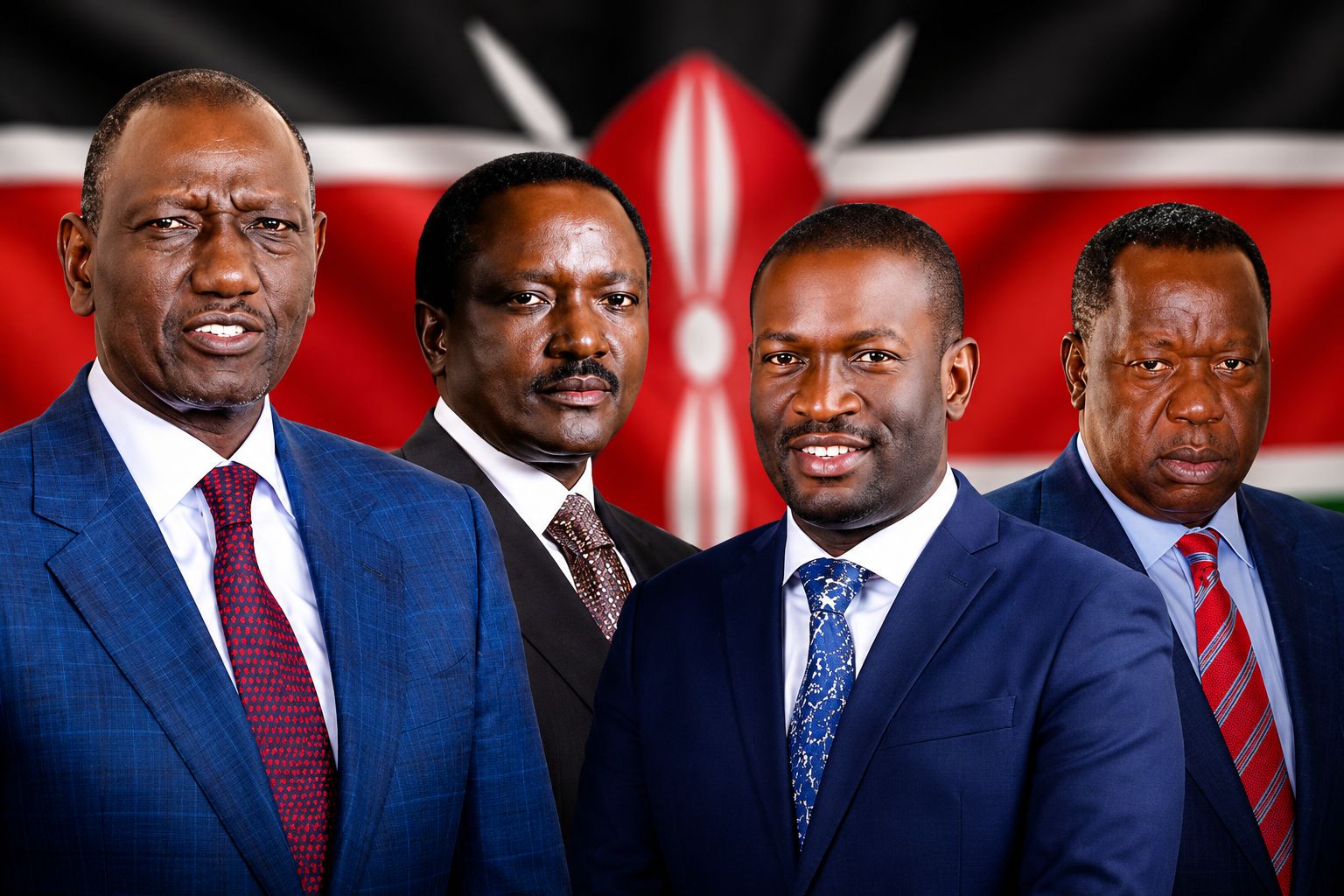
One year before Kenyans return to the ballot, President William Ruto enters the final stretch as the clear front-runner — but not yet as a president with an assured second term.
The latest opinion polls tell a consistent story on one point: Ruto is ahead of every individual challenger. Infotrak's June survey put him at 32 per cent, compared with 13 per cent for Kalonzo Musyoka and 12 per cent each for Edwin Sifuna and Fred Matiang'i. TIFA's June figures were lower for Ruto, at 24 per cent, followed by Sifuna at 15 per cent, Matiang'i at 14 per cent and Kalonzo at 13 per cent.
The newly reported Swiss Poll result, placing Ruto at 31 per cent and Kalonzo at 22 per cent, points in the same broad direction. But that survey should be treated cautiously until its full methodology, sampling and fieldwork details are independently available. The numbers are therefore better read as another indication of a fluid race than as proof that Kalonzo has suddenly surged to 22 per cent.
What is clearer is the size of the undecided and politically uncommitted electorate. TIFA found about one in five voters undecided, while Infotrak also recorded a substantial undecided bloc. That means the current standings are snapshots, not forecasts of the final result.
Ruto's advantage is therefore real, but it rests heavily on the opposition's fragmentation.
Kalonzo, Sifuna, Matiang'i and Rigathi Gachagua are drawing support from different constituencies, and their combined numbers cannot simply be added together. A voter supporting Sifuna today does not automatically become a Kalonzo voter if the two form a coalition tomorrow. Candidate appeal, regional interests, party machinery and the eventual running mate will all determine how much of the fragmented opposition vote can actually be consolidated.
That is why the opposition's search for a single candidate may be the most important political story of the next year.
Kalonzo has emerged as a serious contender for the opposition flag. In the recent WANTAM digital contest, he narrowly edged Sifuna, 50.2 per cent to 48.2 per cent, while Sifuna led the running-mate contest. But digital contests should not be confused with nationally representative opinion polls.
Sifuna, meanwhile, represents perhaps the most interesting emerging force. His support has risen sharply in the national polling, and his appeal among younger voters gives him something the older opposition figures may struggle to replicate. His rise also reflects a broader political mood in which generational change, accountability and dissatisfaction with established political arrangements are increasingly important themes.
The political environment around the numbers is equally important.
Ruto has the advantages of incumbency, state visibility and an increasingly broad political network. His strategy has also increasingly focused on preventing the opposition from forming a single formidable bloc. Opposition leaders, in turn, accuse his camp of trying to divide their ranks. That struggle is already shaping the campaign before the official campaign has fully begun.
Economic pressure and public dissatisfaction will also matter. Ruto must defend his record on the cost of living, taxation, jobs and public services while convincing voters that his government's policies are producing tangible improvements. The opposition's challenge is different: it must turn dissatisfaction with the government into a coherent alternative rather than simply a collection of anti-Ruto candidacies.
The role of former President Uhuru Kenyatta and the emerging coalition negotiations adds another layer. His political influence is increasingly being discussed as opposition parties explore ways of building a broader anti-Ruto alliance.
For now, therefore, Ruto is the favourite, but the race is far from settled.
The president has a lead without majority support. The opposition has numbers without a settled leader. And millions of voters have not yet made up their minds.
That leaves the 2027 contest at an intriguing point: Ruto's biggest advantage may be the opposition's inability to unite, while the opposition's biggest opportunity is that Ruto has yet to demonstrate that his current support can grow into a majority coalition.
With roughly a year to go, Kenya is not looking at a foregone conclusion. It is looking at a race whose decisive phase may be less about who is currently leading the polls — and more about who can build the broadest coalition when the choices finally become clear.
You may also like
Category: Politics · Related Topic: William Ruto
Related Video: What Dangote’s proposed Lamu oil refinery could mean for East Africa
Related Explainer: Kiharu Technical College September Intake 2026: Courses, Skills and New Opportunities
 Facebook
 Twitter / X
 WhatsApp
 LinkedIn
 Telegram
 Reddit