
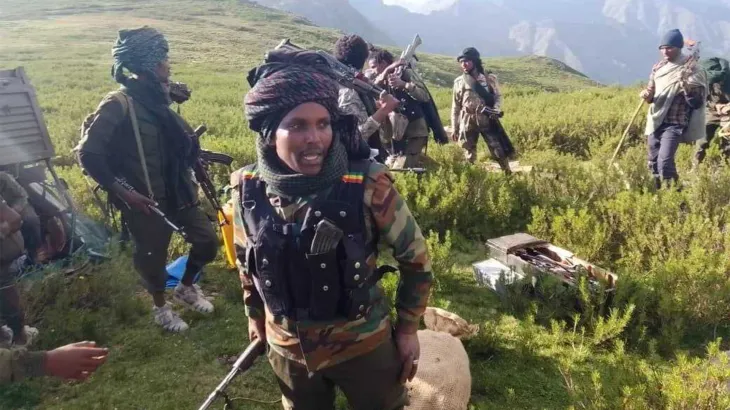
Fighting in Ethiopia has widened across parts of the north as the government confronts an extraordinary new alliance bringing together armed groups that previously fought on opposite sides of the country's devastating civil war.
Seven armed groups announced the formation of the Ethiopian Peoples' Forces Alliance for Survival, bringing together organisations from several regions in opposition to Prime Minister Abiy Ahmed's government.
Among the groups are forces linked to the Tigray People's Liberation Front and the Amhara Fano National Movement — movements whose constituencies were on opposing sides of the 2020–2022 Tigray war.
The alliance also includes armed organisations from Oromia, Afar and Benishangul-Gumuz.

Its formation comes as fighting has again intensified around Tigray and spread into neighbouring areas.
Old enemies, new alliance
The composition of the alliance demonstrates how dramatically Ethiopia's political landscape has changed since the Pretoria agreement ended the main phase of the Tigray war in November 2022.
During that conflict, Tigrayan forces fought the federal government while Amhara forces supported Addis Ababa in key theatres.
Relations have since shifted.
The federal government has fought Fano forces in Amhara, while tensions with Tigrayan authorities have again escalated.
The new alliance says it opposes what it describes as centralisation of power and marginalisation of Ethiopia's regions.
Its members have significant political differences and unresolved territorial disputes, meaning the durability of the alliance remains uncertain.
Fighting expands
Reports from northern Ethiopia indicate federal forces and armed groups have clashed across areas of Tigray, Afar and Amhara.
A TPLF official told Al Jazeera that federal forces had begun an offensive around southern Tigray and carried out strikes in several areas.
Independent verification remains difficult because communications restrictions and insecurity limit access to affected areas.
Claims from combatants should consequently be attributed rather than presented as independently established battlefield facts.
Pretoria agreement under pressure
The renewed violence raises questions over the future of the 2022 peace agreement that ended one of the world's deadliest recent conflicts.
The agreement halted large-scale fighting between the federal government and Tigrayan forces after a war associated with enormous civilian suffering, displacement and destruction.
But key disputes remained unresolved.
Tensions over territory, political authority, disarmament and the return of displaced people have persisted.
Some TPLF figures now argue that the agreement has effectively collapsed.
Eritrea factor
Relations between Ethiopia and neighbouring Eritrea have also deteriorated.
Eritrea fought alongside Ethiopian federal forces during the Tigray war but has since fallen out with Addis Ababa.
Ethiopia has accused Eritrea of supporting forces hostile to Abiy's government.
Eritrea denies those accusations.
That dimension increases concern that an internal Ethiopian confrontation could acquire a wider regional character.
For Kenya and the rest of the Horn of Africa, another major Ethiopian conflict would have serious consequences.
Ethiopia has a population exceeding 100 million and is central to regional trade, diplomacy and security.
Large-scale conflict could create new refugee movements, disrupt commerce and complicate already fragile security across the Horn.
The immediate question is whether the latest fighting remains fragmented or develops into a coordinated campaign against the federal government.
The new alliance says its objective is political change.
Whether groups with such different histories and interests can sustain meaningful military and political cooperation remains uncertain.
What is clearer is that the security situation has deteriorated sharply.
Less than four years after Ethiopia celebrated a peace agreement intended to end its northern war, the country again faces the possibility that several conflicts could merge into something much larger.
You may also like
Category: International
Related Video: What Dangote’s proposed Lamu oil refinery could mean for East Africa
 Facebook
 Twitter / X
 WhatsApp
 LinkedIn
 Telegram
 Reddit