
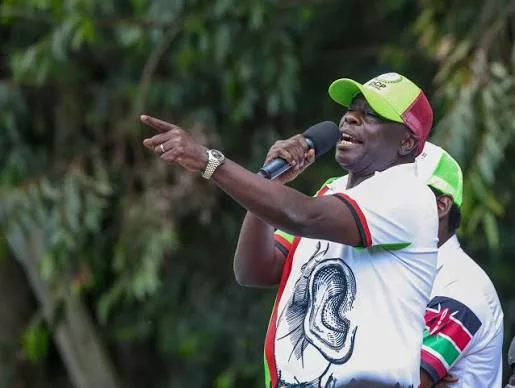
Former Deputy President Rigathi Gachagua says the opposition intends to borrow heavily from the Ol Kalou parliamentary by-election in its strategy for the 2027 General Election, with early voting, mass turnout and what he calls “protecting the vote” at the centre of the plan.
Speaking to Kenyans in Dallas, Texas, Gachagua said the experience of the July by-election had convinced him that supporters should not simply cast their ballots and leave.
Instead, he wants opposition supporters to arrive at polling stations before voting begins, complete voting early and remain vigilant through counting and transmission of results.
His most striking proposal is that almost everyone capable of remaining around polling centres should do so — including some pregnant women.

“We have agreed as a country it will be another Ol Kalou — voting and protecting the vote,” Gachagua told the Dallas gathering, according to the supplied transcript. Pasted markdown
The proposal builds on a strategy Gachagua has been promoting since his Democracy for the Citizens Party won the Ol Kalou parliamentary by-election.
DCP's Sammy Kamau Ngotho won the seat with 35,440 votes against UDA candidate Samuel Muchina's 5,450, according to results reported after the poll. IEBC said 41,656 of the constituency's 73,480 registered voters cast ballots, representing a turnout of about 57 per cent.
Queue from 3am, vote early
In Dallas, Gachagua offered unusually specific instructions about how he wants supporters to approach election day in 2027.
He said voters should begin assembling at polling stations at 3am, three hours before voting normally begins.
Young people would vote first, he said, before helping their parents and other older voters.
Gachagua's target is to have most supporters finished with voting by around 11am.
“People must be on the queue by 3:00 a.m. The voting will start at 6:00,” he said.
“The young people... will be the first at the queue. The young people, they'll vote. Then they'll assist their mothers and fathers to vote.”
He added: “We want the voting to be done by 11:00 a.m. Everybody will have voted.” Pasted markdown
Gachagua made a similar argument during his recent US engagements, saying supporters should be in queues from 3am on election day and later remain vigilant during counting and tallying.
‘Nobody will go home’
It is what Gachagua wants supporters to do after voting that forms the most controversial part of his strategy.
According to his Dallas speech, people aged above 60 would be allowed to return home after voting.
But he suggested most other supporters should remain.
“All others including women will remain,” Gachagua said.
He initially said pregnant women would be exempted, before narrowing that exemption to women whose pregnancies were four months or more advanced.
“Only women who are pregnant will go home. And only those whose pregnancy is four months and above,” he said.
Gachagua then recalled women refusing to leave during the Ol Kalou contest because they wanted to continue monitoring the process.
“We realised women are more lethal than even men,” he said, before declaring: “Nobody will go home again.” Pasted markdown
The remarks echo a vote-protection plan Gachagua unveiled after the Ol Kalou election. In July, he proposed mobilising hundreds of volunteers for individual polling centres and said even expectant mothers below a certain stage of pregnancy could remain as part of the effort.
Why Ol Kalou changed Gachagua's strategy
Gachagua portrays Ol Kalou as a political laboratory for 2027.
During the by-election, some residents remained around polling stations after voting amid tensions and suspicions about possible interference with the election.
The Kenya Human Rights Commission, which deployed observers during the election, reported that many voters remained at polling stations because they did not trust that their ballots would be secure after they left.
KHRC also documented serious problems during the poll, including violence, allegations of voter bribery and irregularities involving assisted voting. It warned that distrust of electoral institutions could have implications for the 2027 General Election.
IEBC, however, rejected Gachagua's claims that voters needed to personally protect ballots. Commissioner Hassan Noor Hassan said during the by-election that votes were already protected and that sufficient security personnel had been deployed.
That distinction is important.
Gachagua's “Linda Kura” strategy represents his political prescription for supporters. It does not replace the legal authority and responsibilities of IEBC, election officials and security agencies.
Any organised presence around polling stations in 2027 would have to comply with electoral laws and IEBC regulations governing conduct at polling centres.
Gachagua says polling-station results make rigging harder
The former deputy president's confidence also rests on how presidential votes are counted.
Gachagua told the Dallas meeting that Kenya's shift towards counting votes at polling stations had substantially reduced opportunities for manipulation compared with earlier elections when ballot boxes were transported elsewhere before counting.
He argued that opposition agents and supporters therefore need to concentrate on what happens at individual polling stations and constituency tallying centres.
“Nobody can steal a general election in Kenya,” Gachagua claimed.
His argument is that once results have been properly counted, documented and declared at lower levels, changing the overall result becomes considerably harder.
He also cited a recent court decision concerning the role of constituency results in presidential tallying as supporting his position. Pasted markdown
Gachagua alleges attempts to interfere with Ol Kalou vote
Gachagua went considerably further in Dallas, alleging that the government had deployed large numbers of police officers and other personnel to Ol Kalou in an attempt to influence the election.
He alleged attempts at voter suppression and the introduction of fraudulent ballots.
Those are Gachagua's allegations. The supplied transcript does not provide evidence establishing that the government or police attempted to rig the by-election.
What is independently documented is that the election was marred by violence and serious security incidents. Citizen Digital reported armed men travelling in unmarked vehicles, attacks on residents, journalists and political supporters, and the use of tear gas.
KHRC also documented violence and electoral irregularities during its observation of the contest.
Money will not be enough, Gachagua argues
A second lesson Gachagua says he drew from Ol Kalou concerns campaign spending and voter inducements.
In Dallas, he alleged that Ruto's administration poured billions of shillings into projects, cash and other benefits in the constituency but still failed to secure victory for UDA.
Gachagua claimed Sh1.5 billion was distributed in cash and Sh14.5 billion committed through projects, putting the total at Sh16 billion.
These figures are Gachagua's claims and are not substantiated by evidence in the supplied transcript.
He nevertheless argued that Ol Kalou demonstrated that voters could accept government development programmes or political benefits without necessarily changing their electoral preferences.
His colourful advice was: “It is foolish to bury an elephant with the tusks. First remove the tusks and then bury the elephant.” Pasted markdown
The broader political message is that Gachagua believes government projects and campaign expenditure alone will not guarantee Ruto re-election.
From one constituency to a national election
Scaling the Ol Kalou strategy to a presidential election would be a much larger undertaking.
Gachagua has previously proposed recruiting between 200 and 500 volunteers depending on the size of each polling centre.
That would require a nationwide organisation capable of recruiting, training and coordinating large numbers of people while also deploying formally accredited political-party agents.
It would also have to operate within election regulations and avoid confrontations with police or election officials.
The scale of that challenge helps explain another part of Gachagua's Dallas strategy: his insistence that opposition parties must eventually unite around one presidential candidate.
He says he is prepared to support another opposition leader unconditionally if he is not selected, arguing that splitting the anti-Ruto vote would undermine the entire strategy. Pasted markdown
For Gachagua, therefore, Ol Kalou is more than a by-election victory.
He is presenting it as a template for 2027: mobilise early, turn out in large numbers, finish voting quickly, maintain a lawful presence around the electoral process, document the results and ensure opposition agents follow the count from polling stations through the tallying process.
Whether that approach can be reproduced nationally — and how IEBC regulates political mobilisation around polling stations — is likely to become a significant issue as Kenya moves closer to the 2027 General Election.
You may also like
Category: Politics · Related Topic: 2027 Elections
Related Video: Murkomen Says Kenya Is Safe: “Stop Creating a Crisis” | Political Goons & Security Under Scrutiny
Related Explainer: Why the BCG Vaccine Leaves That Small Scar on Your Arm
 Facebook
 Twitter / X
 WhatsApp
 LinkedIn
 Telegram
 Reddit