
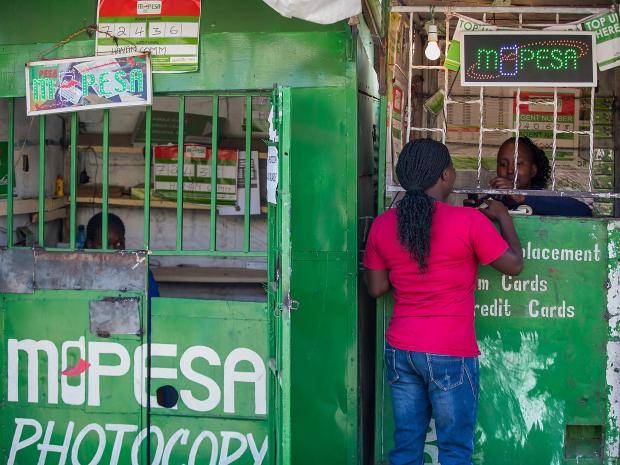
The average commission available per M-Pesa agent has fallen to an estimated record low of Sh9,353 a month as the rapid expansion of Safaricom's agent network intensifies competition for deposits, withdrawals and other transactions.
Safaricom had 333,011 M-Pesa agent outlets in the financial year ended March 2026, up from 298,890 a year earlier and almost double the approximately 173,000 recorded in 2020.
At the same time, calculations based on Safaricom's disclosed total agent commissions and the number of outlets show average annual commission per agent falling to about Sh112,244 — equivalent to approximately Sh9,353 per month.
That compares with estimated annual averages of Sh124,720 in 2025 and Sh144,355 in 2024.

The figures do not mean every M-Pesa agent earns exactly Sh9,353 each month.
Individual earnings vary substantially depending on location, transaction volumes, available float, shop operating hours and whether an outlet runs multiple tills.
The calculation instead illustrates how rapidly increasing agent numbers are spreading commission income across a much larger network.
From lucrative business to intense competition
M-Pesa agency was once regarded as an attractive small-business opportunity.
Agents earn commissions by facilitating services such as cash deposits and withdrawals.
A strategically located outlet with sufficient cash and electronic float can process hundreds of transactions and generate significant commission income.
But the network's success has produced its own challenge.
M-Pesa agents are now almost everywhere.
Shopping centres, estates, petrol stations, supermarkets and rural trading centres can have several agents operating within a short distance of each other.
That is convenient for customers.
For agents, it means more businesses competing for the same transactions.
The number of outlets has increased by more than 34,000 in just one year and by roughly 160,000 since 2020.
Operating costs have not disappeared
Falling average commission becomes more significant when measured against the costs of running an agency.
An agent may need to pay rent, staff salaries, electricity, security and other shop expenses.
The business also requires working capital.
M-Pesa agents must maintain both physical cash and electronic float so they can serve customers making deposits and withdrawals.
An outlet that repeatedly tells customers it lacks cash or float risks losing them to the agent next door.
That means money tied up in float must also be considered when calculating whether an agency is generating an attractive return.
For operators earning below the network average, M-Pesa commissions alone may increasingly be insufficient to sustain a standalone shop.
Agents diversify
That pressure helps explain why many outlets no longer rely exclusively on M-Pesa.
Agents increasingly combine the service with Airtel Money, agency banking, airtime sales, bill payments and ordinary retail businesses.
An outlet might simultaneously operate as an M-Pesa agent, bank agent, mobile-accessories shop and general retailer.
Diversification allows the operator to spread fixed costs such as rent and staffing across several income streams.
It also gives customers more reasons to visit the premises.
The trend reflects a maturing mobile-money industry.
M-Pesa itself remains enormous.
The service is deeply integrated into Kenya's economy and processes trillions of shillings in transactions.
But a successful platform does not automatically guarantee increasing profitability for every business operating at its edge.
More agents benefit customers
There is another side to the story.
The rapid expansion of the network has made mobile money extraordinarily accessible.
For customers, competition between agents means shorter travel distances and more choice.
Someone who cannot obtain cash at one outlet can often find another nearby.
A broad physical network also remains important even as digital payments increase because Kenya continues to operate a mixed cash-and-digital economy.
Agents are the bridge between those two systems.
When a customer deposits physical cash into M-Pesa, an agent converts cash into electronic value.
When a customer withdraws, the agent performs the reverse function.
Without sufficient agents and liquidity, mobile money would be considerably less useful.
Is M-Pesa agency still worth it?
That question increasingly depends on the business model.
A busy outlet in a transport hub, market or commercial centre can generate far more transactions than a small agent in a low-traffic area.
An agent operating several tills will also differ substantially from a single-till operator.
The Sh9,353 monthly figure should therefore not be read as a salary or guaranteed income.
It is an estimated network average derived from total commissions and the number of agents.
But the downward trend is significant.
The estimated annual average has fallen from Sh144,355 in 2024 to Sh124,720 in 2025 and Sh112,244 in 2026.
If agent numbers continue growing faster than commission income, pressure on individual outlets could intensify.
M-Pesa transformed Kenya by making financial services available almost everywhere.
Its next challenge may be ensuring that the businesses responsible for maintaining that physical network can continue making economic sense.
For aspiring agents, the lesson is increasingly clear.
Having an M-Pesa sign outside the shop is no longer enough.
Location, transaction volume, liquidity and additional sources of income may determine whether the agency remains a viable business.
You may also like
Category: Business
Related Explainer: Kenya’s short rains: What the 2026 forecast means for you
 Facebook
 Twitter / X
 WhatsApp
 LinkedIn
 Telegram
 Reddit