
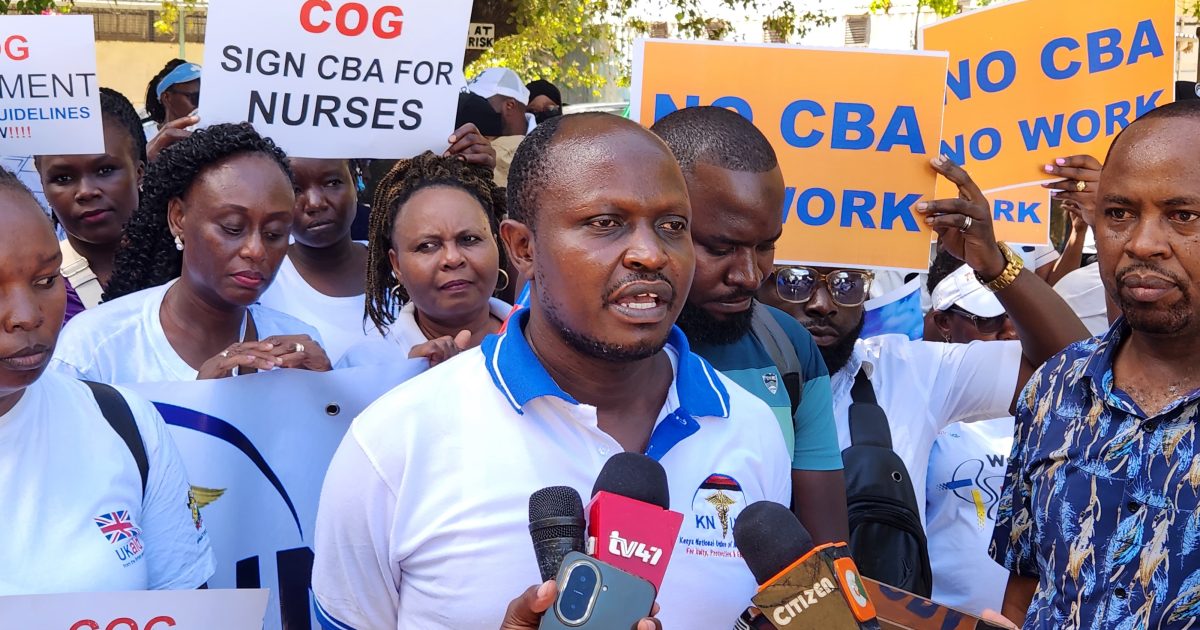
Kenya’s prolonged nurses’ strike is intensifying pressure on public hospitals, with health professionals raising alarm over maternal and newborn deaths recorded as disruption to essential services continues.
At least 83 maternal deaths and 513 perinatal deaths have been reported during the strike period, according to figures cited by health professional associations.
The figures do not establish that the strike directly caused each death. However, health professionals warn that reduced access to skilled maternity, newborn and inpatient care could increase the risk of preventable complications and deaths.
The strike, which began on July 29, entered its 37th day on Thursday as members of the Kenya National Union of Nurses and Midwives (KNUNM) demonstrated outside the Salaries and Remuneration Commission (SRC) offices.
The union is demanding a letter of no objection from SRC, which it says could help break the deadlock over implementation of outstanding employment agreements.
KNUNM Deputy Secretary-General Maurice Opetu accused SRC and the Council of Governors (CoG) of frustrating efforts to resolve the dispute.
KNUNM Secretary-General Seth Panyako maintained that nurses would remain on strike until their grievances were addressed.
“The nurses’ strike that commenced on 29th July is still on; it is still very active and energised and will go on until our demands are met,” Panyako said.
At the centre of the dispute is implementation of the 2017 Collective Bargaining Agreement, alongside career progression guidelines and other outstanding employment issues.
Maternal and newborn deaths raise alarm
Health professional associations say the continuing disruption is having serious consequences for patients.
Figures presented during a joint briefing showed that eight maternal deaths, 16 neonatal deaths and 55 perinatal deaths were recorded nationally between September 1 and September 3.
Another 22 maternal deaths, 44 neonatal deaths and 130 perinatal deaths were reported the previous week, while 75 maternal deaths and 458 perinatal deaths were recorded in August.
The data was attributed to the Every Woman Every Newborn, Everywhere dashboard.
However, health professionals warned that available statistics might not capture the full impact because some pregnant women may be giving birth outside health facilities as services remain disrupted.
Midwives Association of Kenya Vice-President Dr Eunice Atsali warned that some women were returning to deliveries in villages without access to the level of skilled care normally available in health facilities.
“Our women actually have gone back to giving birth in the village, which is concerning,” she said.
Hospitals struggle with admissions
The disruption extends beyond maternity services.
Patients requiring dialysis and other specialised treatment are also facing difficulties accessing care, while some public hospitals are struggling to admit patients.
Kenya Paediatric Association President Dr Supa Tunje said higher-level referral hospitals could not absorb all patients who would ordinarily receive treatment at lower-level public facilities.
Some hospitals have resorted to hiring nurses on a locum basis to maintain essential services.
Professional associations representing midwives, paediatricians, clinical officers and other healthcare workers are now calling for urgent intervention by the national government, county governments, SRC, CoG and the nurses’ union.
Kenya Clinical Officers Association Secretary-General Joseph Chibi warned that the continuing stalemate was putting patients at risk.
“It is time now that we are seeing mortalities rising among our mothers and other citizens of this country that can be avoided,” he said.
With neither side backing down, pressure is mounting on the government, governors, SRC and union officials to find a settlement and restore services across public health facilities.
You may also like
Category: Health
Related Video: What Dangote’s proposed Lamu oil refinery could mean for East Africa
Related Explainer: Ebola contact tracing: Why the 21-day window matters in Kenya’s response
 Facebook
 Twitter / X
 WhatsApp
 LinkedIn
 Telegram
 Reddit