
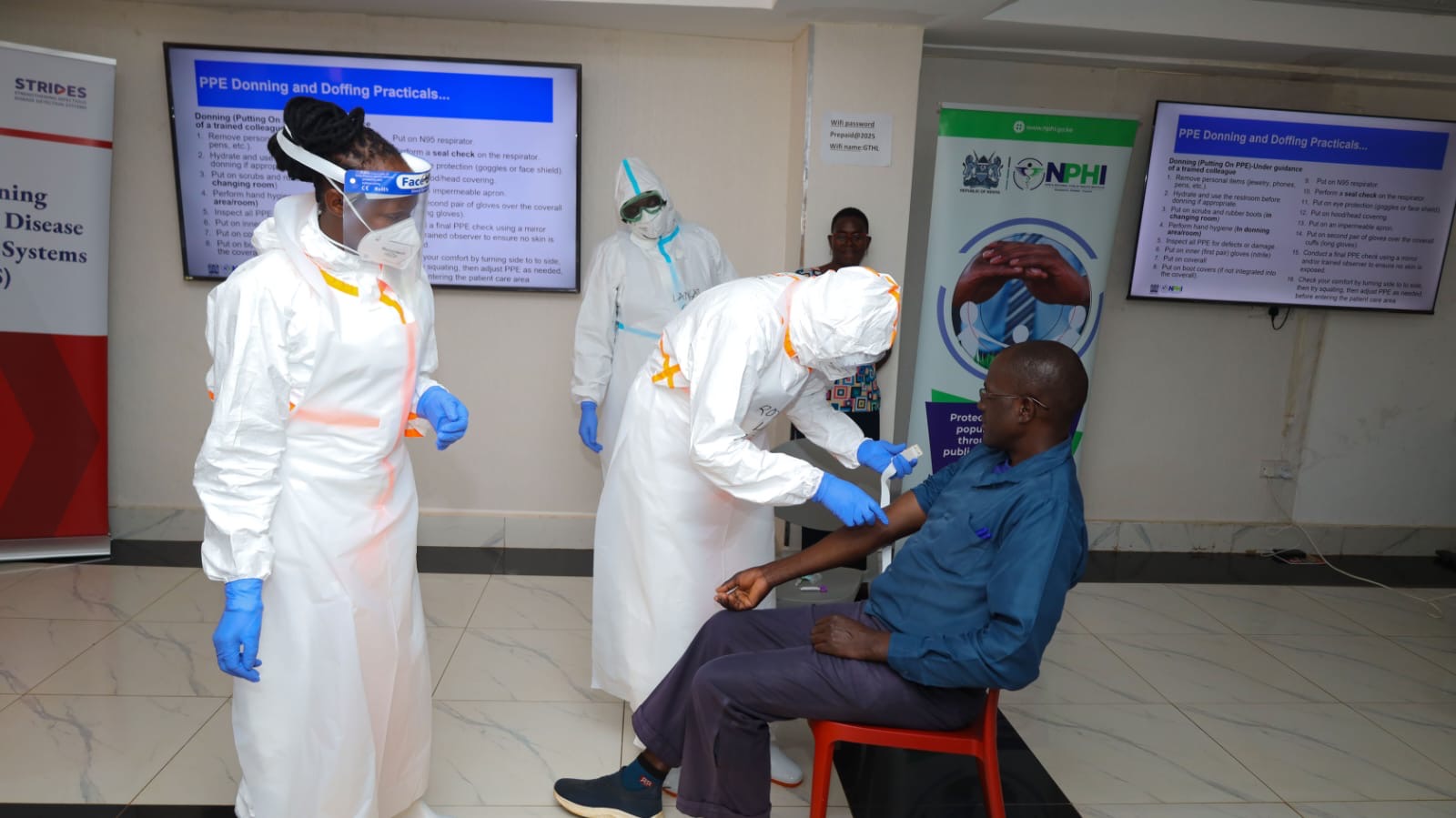
Kenya’s first confirmed Ebola case has triggered an urgent contact-tracing operation, with health authorities racing to identify people who may have been exposed to the deceased patient.
Health Cabinet Secretary Aden Duale said 28 contacts had been identified by Tuesday, including family members and health workers.
Authorities are also trying to locate 23 passengers and four crew members who were on the same flight as the patient after he travelled from Uganda to Nairobi on October 3.
But being placed on a contact list does not mean a person has Ebola.
The purpose of contact tracing is to find people who may have been exposed, monitor them during the period when symptoms could appear and act quickly if anyone becomes ill.
At the centre of that process is a number that health officials repeatedly use: 21 days.
Why 21 days?
The 21-day period comes from Ebola's incubation period.
The World Health Organization says Ebola symptoms can appear between two and 21 days after infection. A person infected with Ebola is not considered infectious before symptoms begin.
That is why health authorities monitor identified contacts for 21 days after their last known exposure.
This point matters.
The clock does not necessarily start when a person is first identified as a contact. If someone had several possible exposures over different days, health workers establish when the last relevant exposure occurred and count the monitoring period from there.
WHO's current recommendations for the 2026 Bundibugyo outbreak also call for contacts to be monitored daily for 21 days after their last known exposure.
If the 21 days pass without symptoms, that person can be cleared from follow-up based on the public health assessment.
How health workers find contacts
Contact tracing begins with reconstructing the movements and interactions of a confirmed patient.
Health workers may interview the patient if they are well enough to respond. If that is not possible, relatives, colleagues, caregivers and other people familiar with the person's movements can help investigators build a timeline.
They look at where the patient went, who they met and what kind of contact occurred, particularly after symptoms began.
The list can include family members, friends, colleagues, caregivers, health workers and other people who had relevant exposure. WHO describes contact identification, listing and follow-up as the main stages of the process.
In Kenya's current case, that work extends beyond the patient's family and hospital contacts.
The Ministry of Health is also trying to locate people who travelled with him on his flight to Nairobi.
What counts as an exposure?
Ebola is mainly transmitted through direct or close contact with the blood or other bodily fluids of an infected person.
Those fluids can include vomit, saliva, urine, faeces, sweat and other secretions. Contact with contaminated materials such as clothing or bedding can also present a risk when they carry infectious body fluids.
Handling the body of someone who has died from Ebola without appropriate protection is another recognised risk.
That is why safe and dignified burial practices are an important part of outbreak control.
The level of risk is not necessarily the same for everyone on a contact list.
Someone who had direct contact with an infected person's body fluids may have had a very different exposure from someone who was merely in the same setting.
Health workers therefore assess the nature and timing of each exposure rather than treating every contact as though they face identical risk.
Does sitting on the same plane mean you have Ebola?
No.
The fact that someone travelled on the same flight does not, by itself, mean that person was infected.
WHO says Ebola is not spread through ordinary airborne transmission in the way infections such as influenza are. Transmission is associated primarily with direct contact with blood or other body fluids of an infected person, particularly after symptoms develop.
That distinction is particularly relevant to Kenya's current tracing operation.
The passengers and crew are being sought so health officials can establish whether any of them had a relevant exposure and monitor them appropriately.
It is a precautionary public health measure, not a declaration that they have contracted Ebola.
What happens during the 21 days?
Once a person is identified as a contact, health workers follow their health during the monitoring period.
They may check for fever and other symptoms such as weakness, fatigue, muscle pain, headache, sore throat, vomiting or diarrhoea.
WHO advises contacts to report symptoms immediately and to follow instructions from health authorities during the monitoring period.
If symptoms develop, the response changes quickly.
The person is assessed and, where Ebola is suspected, separated from others while testing and appropriate care are arranged.
The purpose is to avoid allowing a possible new case to create another chain of transmission.
If that person is subsequently confirmed to have Ebola, health workers begin another round of contact investigation.
That is how contact tracing breaks transmission chains.
Why speed matters
Ebola is most dangerous to public health when a symptomatic person is in close contact with others without appropriate protection.
Finding contacts early gives health authorities a chance to monitor them before they become infectious and to act quickly if symptoms appear.
This is particularly important because early Ebola symptoms can resemble other illnesses.
WHO notes that Ebola can be difficult to distinguish clinically from diseases such as malaria, typhoid and meningitis without appropriate diagnostic testing.
That is why surveillance, laboratory testing, isolation of suspected cases and contact tracing are used together.
No single measure is enough on its own.
Why communities matter
Contact tracing is not simply a matter of health officials making telephone calls or visiting homes.
It depends heavily on people being willing to share information about where they have been and who they have interacted with.
WHO has repeatedly stressed the importance of community engagement during Ebola outbreaks. Fear, stigma or misinformation can make people reluctant to disclose contacts or report symptoms.
The organisation recommends working with community and religious leaders and providing clear, culturally appropriate information about the disease and the purpose of monitoring.
Confidentiality also matters.
Being listed as an Ebola contact does not mean someone has the disease. Publishing names or spreading rumours can expose people to unnecessary stigma and make others less willing to cooperate with health teams.
What Kenyans should do
The current response does not mean the public should panic.
Ebola is a serious disease, but transmission requires the kind of exposure health authorities are specifically trying to identify.
Kenyans should avoid direct contact with the body fluids of anyone suspected or confirmed to have Ebola and should not handle the body of a person who may have died from the disease.
Anyone who believes they have had a significant exposure should contact health authorities or seek medical advice promptly rather than waiting for symptoms to become severe.
For people who are officially identified as contacts, the most important step is cooperation with health teams.
The 21-day window is not a countdown to determine who will become sick.
It is a period of close surveillance designed to catch illness early.
In Kenya's current outbreak response, that window will help health authorities determine whether the imported case has resulted in any further transmission.
As of October 6, Kenya had confirmed one imported Ebola case, involving a Kenyan citizen who had travelled from the Democratic Republic of Congo through Uganda before arriving in Nairobi. The patient later died in hospital. No additional confirmed Kenyan case had been announced at the time of publication.
You may also like
Category: Explainers
Related Video: Gachagua’s explosive Ruto scorecard: Debt, taxes, State capture and a government ‘that has failed’
Related Explainer: Kenya’s short rains: What the 2026 forecast means for you
About the Author
Maureen Onyango is a journalist passionate about storytelling, life coaching and spiritual lessons. She studied at the Kenya Institute of Management and enjoys telling stories that inform, inspire and empower communities.
 Facebook
 Twitter / X
 WhatsApp
 LinkedIn
 Telegram
 Reddit