
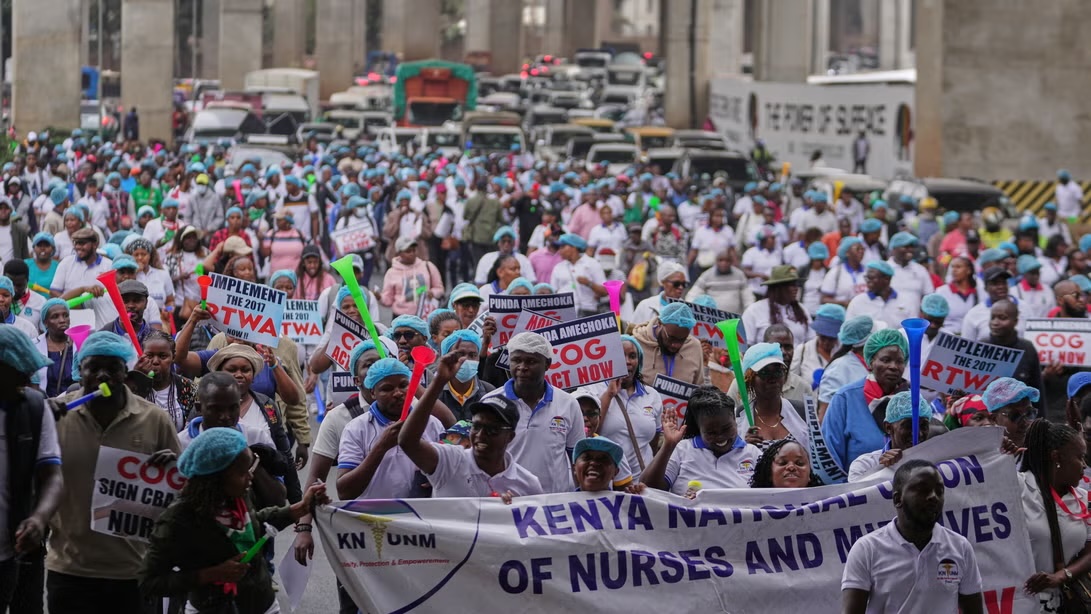
Kenya’s nurses have ended their nationwide strike after more than six weeks, opening the way for services to resume in public hospitals after one of the most disruptive health-sector disputes in recent years.
The Kenya National Union of Nurses and Midwives announced on Wednesday that members would return to work immediately, or within 24 hours, after reaching a return-to-work agreement with the Council of Governors.
The strike began on 29 July and lasted 43 days, according to AP. It disrupted maternity services, outpatient care and other essential services across the country.
But ending the strike does not mean the dispute itself has disappeared.
Under the agreement, the union and county governments have 45 days to conclude negotiations around implementation of the 2017 Collective Bargaining Agreement, which has remained at the centre of nurses’ grievances.
The deal also provides for the development of a model career guideline for nurses and addresses the employment of Universal Health Coverage workers on permanent and pensionable terms from 1 July 2026.
Council of Governors chairman Ahmed Abdullahi said negotiations had also produced proposed increases in risk and uniform allowances. The Star reported an additional Sh8,000 risk allowance and Sh5,000 uniform allowance.
The immediate question for patients, however, is how quickly hospitals can return to normal.
During the strike, accounts emerged of patients struggling to access care. The Kenya National Commission on Human Rights said last week that the dispute had become a national public health and human rights crisis. It noted reports of 79 maternal, neonatal and perinatal deaths between 31 August and 2 September, while explicitly calling for an independent investigation to determine their circumstances and whether the strike contributed to them.
That distinction matters. Deaths occurring during a strike cannot automatically be attributed to the strike without examining individual cases.
The settlement also came as doctors threatened to escalate the crisis.
Kenya Medical Practitioners, Pharmacists and Dentists Union secretary-general Davji Atellah said doctors were being overburdened because they could not perform both medical and nursing roles.
“We will not watch silently as the healthcare system we have dedicated our lives to serving is allowed to deteriorate,” he said.
For Kenya’s health system, the next 45 days may therefore prove as important as the strike itself.
The question is whether Wednesday’s agreement finally resolves commitments dating back to 2017, or merely postpones the next confrontation.
You may also like
Category: News
Related Video: What Dangote’s proposed Lamu oil refinery could mean for East Africa
Related Explainer: Ebola contact tracing: Why the 21-day window matters in Kenya’s response
 Facebook
 Twitter / X
 WhatsApp
 LinkedIn
 Telegram
 Reddit