
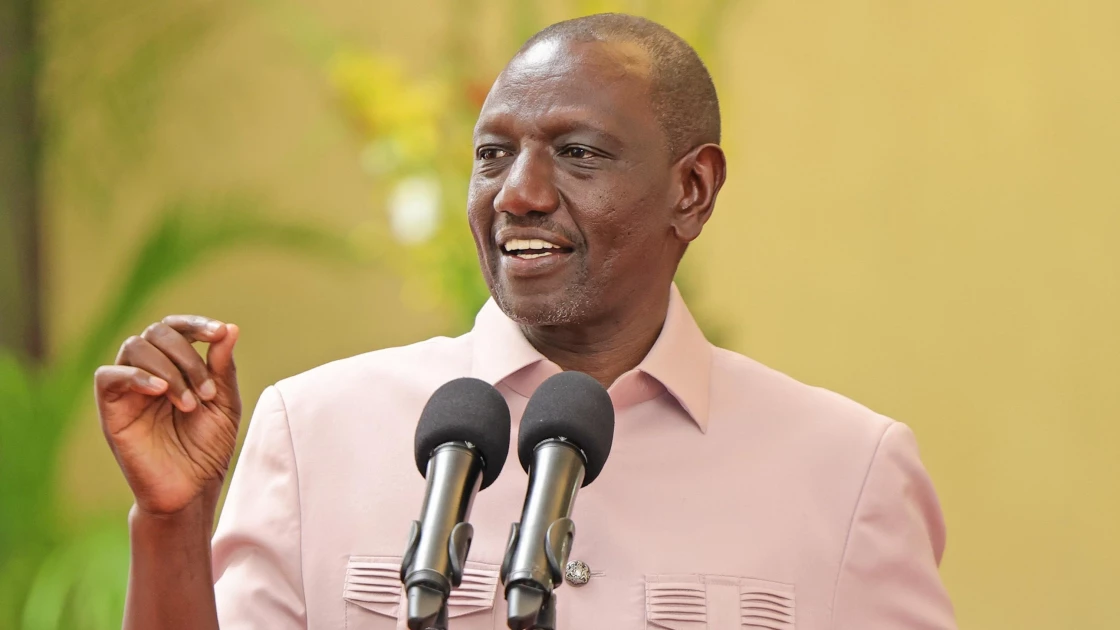
President William Ruto says Kenya's plan for a Sh2 trillion Dangote refinery in Lamu was driven by a lesson from the Middle East: a disruption far from Kenya can quickly become a fuel problem at home.
Speaking at State House in Mombasa on Thursday, a day after the refinery's groundbreaking in Lamu, Ruto said the project took shape after global fuel disruptions exposed Kenya's dependence on imported refined petroleum products.
He pointed to instability around the Strait of Hormuz, one of the world's most important oil shipping routes, as a wake-up call for Kenya to strengthen its energy security.
The President said he then sent officials to Nigeria to meet businessman Aliko Dangote and inspect his refinery.
Their assessment, he said, led to further studies on whether a similar facility could work in East Africa.
“We started experiencing challenges with fuel when problems arose in the Middle East,” Ruto said.
The refinery has now moved from an idea to a construction project.
Dangote and Ruto formally broke ground at Mokowe in Lamu County on September 30, with the facility planned to process 700,000 barrels of crude oil a day.
The $16 billion project is expected to take about 40 months to complete, putting the target commissioning date around early 2030.
Why Lamu was chosen
Lamu was not the first location considered.
Ruto said Kenya initially explored Tanga in Tanzania, partly because Uganda had been considering a route for its crude through Tanzania.
The final choice shifted to Lamu after technical discussions with Dangote and Kenyan officials.
One major factor was the depth of the waters off Lamu.
Ruto said the port can accommodate the large vessels needed to move crude oil for a refinery of this scale.
The project is also closely tied to the wider Lamu Port-South Sudan-Ethiopia Transport corridor, or LAPSSET, which is intended to connect the coast with inland markets.
Government officials now envisage the refinery becoming the anchor for a much larger industrial complex.
The planned development includes petrochemical and chemical industries, storage facilities and a 1,000-megawatt power plant.
Kenya's crude supply question
One of the biggest questions surrounding the refinery is where enough crude will come from.
Kenya is not yet producing oil at a scale that could feed a 700,000-barrel-a-day refinery.
Ruto said Kenya and Dangote have agreed to develop a pipeline linking Turkana's oilfields to Lamu.
He said the pipeline would allow even relatively small volumes of Kenyan crude to be transported to the coast.
“We have agreed with Dangote that we will invest in a pipeline from Turkana to Lamu so that, however small the quantity, we can transport our crude oil to Lamu,” Ruto said.
The government expects oil production from Turkana to begin later this year, according to the President.
But the refinery is designed on a scale far beyond Kenya's current domestic production.
That means it will need crude from other African producers and potentially international suppliers to operate at full capacity.
Dangote has said the facility is intended to serve a regional market, rather than Kenya alone. AP reported that the project is expected to process crude from Uganda and other African producers.
A refinery born from a supply shock
The timing of Ruto's explanation is significant.
The global oil market has again been experiencing disruption linked to conflict in the Middle East.
Reuters reported on October 1 that fuel-oil supplies through Fujairah, a major regional bunkering hub, had fallen sharply earlier in 2026 because the conflict disrupted deliveries through the Strait of Hormuz. Supplies have since begun recovering, although some fuel stocks remain below earlier levels.
Oil prices also rose sharply on October 1 amid renewed concerns about Middle East supplies. Brent crude settled above $102 a barrel that day.
For Kenya, such disruptions matter because the country remains heavily dependent on imported petroleum products.
The proposed refinery is therefore being presented by the government not only as an industrial project, but also as part of a longer-term strategy to reduce exposure to external fuel shocks.
The economic promise
Ruto said the refinery could have a major impact on investment and industrial activity.
He said Kenya's foreign direct investment had risen from $1.6 billion when he took office to $3.1 billion in 2025.
He projected that FDI could rise to between $6 billion and $7 billion annually in the coming years, partly as a result of projects such as the Lamu refinery.
Those figures are the President's projections rather than independently verified forecasts.
The latest internationally comparable data available from UNCTAD showed Kenya's FDI inflows at about $1.5 billion in 2024.
Ruto also described the refinery's investment value as equivalent to about 12 per cent of Kenya's GDP.
That comparison refers to the size of the investment, not an expected 12 per cent increase in GDP.
The wider development is expected to include a 5,000-acre Special Economic Zone, with manufacturing and petrochemical businesses expected to grow around the refinery.
The government says the project will create jobs, develop technical skills and increase opportunities for businesses in Lamu and across the Coast.
Dangote has also said an engineering training school is planned in Lamu to prepare local workers for opportunities created by the project.
Land dispute remains unresolved
The scale of the investment has not removed the legal questions surrounding the site.
More than 130 Lamu residents have challenged the use of part of the land earmarked for the refinery, saying they have longstanding claims to the area.
The Malindi Environment and Land Court ordered the parties to maintain the status quo over the disputed parcel until a hearing scheduled for October 14.
The order did not stop the September 30 groundbreaking, which went ahead as planned.
Ruto said the government has secured 9,000 acres for the project and intends to acquire another 3,000 acres.
He said residents affected by any additional acquisition would be compensated by the government.
The land dispute means the refinery's progress will now be watched not only for construction milestones, but also for how the government and investors address competing land claims and community concerns.
What the refinery could mean for East Africa
If completed as planned, the Lamu facility would be one of Africa's largest refining projects.
Its proposed 700,000-barrel-a-day capacity would put it ahead of Dangote's existing 650,000-barrel-a-day refinery in Nigeria, although that facility is itself being expanded.
The Kenyan project is also expected to produce more than fuel.
Plans include petrochemical production, power generation, storage and marine infrastructure.
That could create a new industrial cluster around Lamu Port and strengthen the commercial case for the wider LAPSSET corridor.
But the project's success will ultimately depend on more than its size.
It will need reliable crude supplies, major supporting infrastructure, financing, skilled workers and a clear resolution of land and environmental concerns.
For Kenya, the original problem Ruto describes is straightforward: fuel security.
The bigger test will be whether the Lamu refinery can turn that concern into a functioning industrial base capable of serving Kenya and the wider region.
You may also like
Category: Business · Related Topic: William Ruto
Related Video: What Dangote’s proposed Lamu oil refinery could mean for East Africa
Related Explainer: Inside Kenya’s crude supply puzzle as Dangote prepares to break ground in Lamu
About the Author
Maureen Onyango is a journalist passionate about storytelling, life coaching and spiritual lessons. She studied at the Kenya Institute of Management and enjoys telling stories that inform, inspire and empower communities.
 Facebook
 Twitter / X
 WhatsApp
 LinkedIn
 Telegram
 Reddit