The Sh2 trillion-plus Dangote refinery project has barely moved past its groundbreaking ceremony, but questions are already being raised over how much Kenyan taxpayers could ultimately have to put into it.
The Consumers Federation of Kenya (COFEK) has petitioned the Public Private Partnerships Petition Committee seeking details of Kenya’s proposed investment in the Lamu refinery and other commitments the government may have made to the project.
At the centre of the petition is a reported 10 per cent Kenyan stake valued at about $500 million, or roughly Sh65 billion.
COFEK wants the government to explain how that stake will be acquired, who will hold it on behalf of Kenya, what class of shares will be issued and how the investment will be paid for.
The consumer lobby is also asking a more basic question: has the reported Sh65 billion actually been committed, budgeted for or paid, or is it still a proposal?
That distinction could become important as the government seeks to demonstrate the benefits of the planned refinery while construction gets under way.
COFEK seeks documents behind the deal
COFEK filed its petition under Section 75 of the Public Private Partnerships Act, which provides a mechanism for challenging decisions made in the development and approval of PPP projects. The Petition Committee has jurisdiction over petitions concerning decisions by the PPP Committee, the PPP Directorate and contracting authorities.
The federation wants access to documents showing how the refinery arrangement was approved, the procurement process followed and the government institution authorised to enter into the proposed deal with Dangote Industries.
It is also seeking information on a reported Sh21.5 billion seed allocation associated with the project.
COFEK wants a clear distinction between money that has merely been provided for in government plans and funds that have actually been committed or released.
The Sh21.5 billion figure has previously been linked to the government's 2026/27 budget plans for seed capital for the refinery. President William Ruto had also appointed Deputy President Kithure Kindiki to chair a government committee coordinating the state's role in the investment.
What does the Sh65 billion actually buy?
The reported Sh65 billion figure needs some context.
Earlier in August, Ruto's economic adviser David Ndii said Dangote had offered East African governments a combined 30 per cent stake in the refinery.
Kenya was expected to take 10 per cent, valued at about $500 million, while other regional countries, including Ethiopia and Rwanda, had expressed interest in participating.
The latest project cost given by Dangote is about $16 billion.
That means the reported $500 million is not simply 10 per cent of the entire $16 billion construction bill. It refers to a proposed equity interest whose valuation and terms COFEK is now asking the government to disclose.
That is one reason the federation is seeking details of the proposed shareholding structure and the basis on which Kenya's contribution has been valued.
The project itself is expected to process 700,000 barrels of crude oil a day and is scheduled for completion within about 40 months. Dangote has described the refinery as a major regional investment aimed at supplying refined petroleum products to Kenya and neighbouring markets.
Questions go beyond the shares
COFEK's petition also raises questions about commitments that may not appear on the government's balance sheet as an equity cheque.
The consumer lobby wants details of any proposed fuel offtake arrangements, market protections, electricity commitments or other forms of state support.
Such agreements could determine whether the public sector takes on future financial obligations even beyond the initial investment.
The federation is therefore seeking clarity on the full package of commitments attached to the project, rather than looking only at the reported share purchase.
There has been no indication from the petition that the government has already agreed to all of the arrangements COFEK has asked it to clarify.
The questions are requests for disclosure and scrutiny, not findings that the government has incurred an undisclosed liability.
Land adds another layer of scrutiny
The financial questions come as the project faces a separate dispute over land in Lamu.
A group of 133 Chandavai residents has challenged the use of land identified as LR No. 13061 in the Hindi/Manda Magogoni area.
The residents say their families have occupied and used parts of the land for generations and have raised concerns over ownership, compensation and the process through which the property is being used for the development.
On September 28, the Malindi Environment and Land Court ordered that the existing status quo on the disputed parcel be maintained until October 14, when the application will be heard between the parties. The court did not issue an order stopping the September 30 groundbreaking.
The government maintains that the contested land belongs to it and forms part of the area designated for the Lamu Special Economic Zone.
The court has yet to determine the residents' substantive claims.
Refinery breaks ground despite unresolved questions
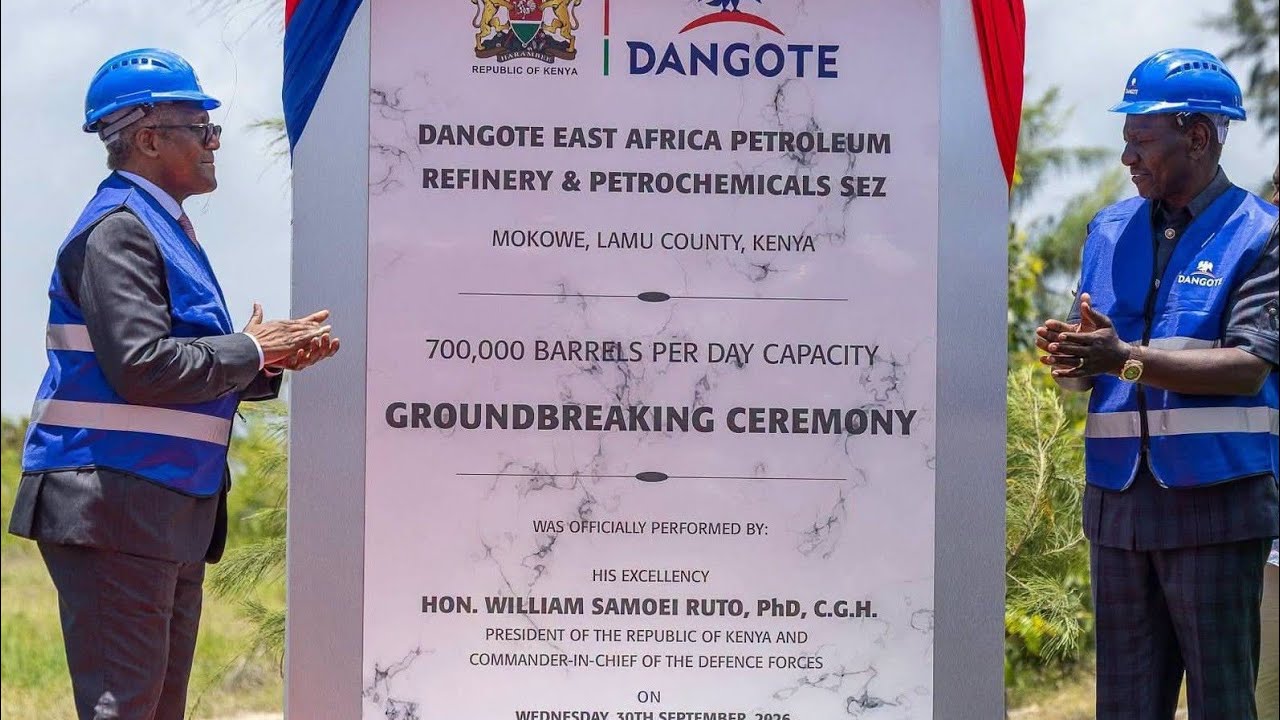
President William Ruto and Dangote Group president Aliko Dangote formally broke ground for the refinery in Lamu on September 30.
The project is expected to cost about $16 billion and take roughly 40 months to complete. It is designed to process 700,000 barrels of crude per day, making it larger than Dangote's 650,000-barrel-per-day refinery in Nigeria.
The project has been presented by the government and Dangote as a major step towards strengthening fuel security and reducing East Africa's dependence on imported refined petroleum products.
It is also expected to include associated infrastructure such as storage, pipelines, power generation and petrochemical facilities.
For Kenya, however, the immediate issue raised by COFEK is not whether the refinery can deliver those ambitions.
It is whether the public can see, in clear terms, what Kenya is contributing, what it will own, what it will receive and what obligations it may carry if the project runs into difficulties.
Those questions are now before the PPP Petition Committee as construction of the landmark Lamu project gets under way.
You may also like
Category: Business · Related Topic: William Ruto
Related Video: What Dangote’s proposed Lamu oil refinery could mean for East Africa
Related Explainer: Inside Kenya’s crude supply puzzle as Dangote prepares to break ground in Lamu
About the Author
Maureen Onyango is a journalist passionate about storytelling, life coaching and spiritual lessons. She studied at the Kenya Institute of Management and enjoys telling stories that inform, inspire and empower communities.
 Facebook
 Twitter / X
 WhatsApp
 LinkedIn
 Telegram
 Reddit