
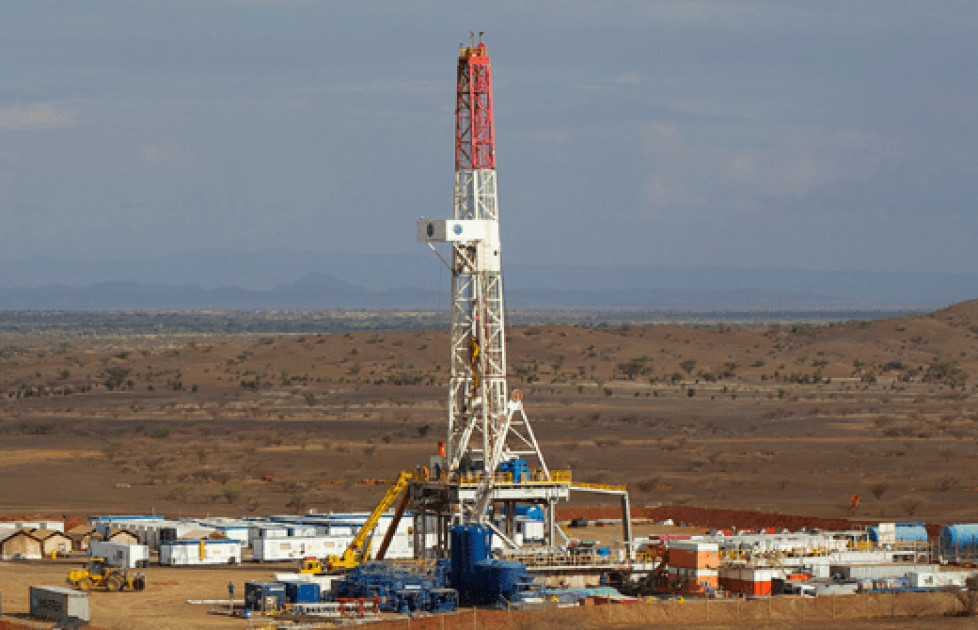
Kenya has 50 petroleum exploration blocks spread across four sedimentary basins.
But that number alone does not answer the biggest question now hanging over the country’s planned oil refinery in Lamu:
Where will the crude come from?
The question is becoming harder to ignore as Kenya moves towards its first commercial oil production in Turkana while Nigerian billionaire Aliko Dangote prepares to break ground on a proposed 700,000-barrel-per-day refinery in Lamu.

The numbers tell the story.
Kenya’s most advanced oil project, South Lokichar, is expected to start at about 20,000 barrels per day.
Its second phase is planned to raise production to 50,000 barrels per day.
Even at that level, Kenya’s planned output would cover only about 7 per cent of the Lamu refinery’s potential daily capacity.
The gap means the refinery cannot depend on Kenyan crude alone if it is eventually to operate at its full 700,000-barrel capacity.
Reuters has identified crude supply as one of the major challenges facing the project, with potential sources including Kenya, Uganda and South Sudan, alongside international seaborne supplies.
What the 50 blocks actually mean
The Energy and Petroleum Regulatory Authority's latest biannual statistics show that Kenya has 50 reconfigured petroleum exploration blocks.
They are spread across the country's four sedimentary basins:
- Lamu Basin — 29 blocks
- Tertiary Rift Basin — 12 blocks
- Anza Basin — six blocks
- Mandera Basin — three blocks
EPRA says the blocks were reorganised to make their sizes more suitable for exploration and to improve their attractiveness to investors. The government is preparing data packages and block information for future bidding and licensing rounds.
But an exploration block is not the same thing as a producing oilfield.
The presence of 50 blocks does not mean Kenya has 50 commercial oil deposits ready to supply a refinery.
Kenya has drilled 95 exploration wells across its four sedimentary basins, according to the East African Petroleum Centre of Excellence, with hydrocarbon discoveries and shows recorded in several areas.
The Tertiary Rift remains the country's most advanced petroleum province.
That is where the South Lokichar development is located.
Turkana oil is finally moving towards production
Kenya has spent more than a decade trying to move from oil discovery to commercial production.
That effort is now entering a more active phase.
A 1,500-horsepower GW70 drilling rig arrived at the Port of Mombasa last week and is being prepared for transport to Turkana.
Gulf Energy E&P BV SEZ says drilling is scheduled to begin on November 1, with the company maintaining its target of first oil in December 2026.
“All workstreams at Gulf Energy E&P BV SEZ are running to a tight project management schedule, and the project remains on course for First Oil production in December 2026,” Gulf Energy chief executive Paul Limoh said.
The first phase is expected to produce about 20,000 barrels per day.
The second phase is planned to raise output to 50,000 barrels per day.
Government project documents say crude from the first phase will initially be moved by road to Kenya Petroleum Refineries Ltd in Mombasa for storage before export. The second phase is expected to use rail for crude transportation.
That is significant because it also means South Lokichar's current production plan is not designed to directly supply the proposed Lamu refinery at full scale.
Then comes the Lamu problem
Dangote's proposed Lamu refinery is expected to have a processing capacity of 700,000 barrels per day.
The company estimates the project will cost between $15 billion and $16 billion and aims to complete it by 2030.
That would make it considerably larger than the production Kenya currently has in sight.
The refinery's planned location at Lamu Port gives it access to international shipping routes.
But crude imports also bring another challenge: the project needs the infrastructure to receive, store and move large volumes of crude.
Reuters reported earlier this month that Lamu currently lacks operational oil storage terminals, while some of the storage and marine-loading infrastructure envisaged under LAPSSET remains to be built.
This means the refinery's success will depend not just on finding crude, but on building the infrastructure needed to bring it to the plant reliably.
Regional crude could fill the gap — but there are complications
Kenya has previously pointed to possible crude supplies from neighbouring producers, including Uganda and South Sudan.
But neither source can simply be redirected to Lamu.
Uganda's crude is tied to the East African Crude Oil Pipeline running to Tanzania.
South Sudan's oil exports currently move through Sudan, where conflict and insecurity have disrupted supply routes.
A proposed pipeline connecting South Sudan and Kenya's Lokichar Basin to Lamu remains a much longer-term proposition.
That leaves imported crude as another potential source.
Reuters reported that the refinery could therefore remain dependent on the international seaborne crude market, at least until regional infrastructure and supply arrangements develop further.
Why the 50 blocks still matter
The crude supply gap does not make Kenya's wider exploration programme irrelevant.
Quite the opposite.
The 50 blocks represent the country's attempt to expand its petroleum resource base beyond South Lokichar.
The Lamu Basin alone accounts for 29 of the blocks.
Some are offshore, while others are onshore or in transition areas.
But exploration takes time.
A block must first attract an investor. Geological and seismic work follows. Wells must then be drilled and discoveries appraised before a commercial development can be considered.
There is therefore no guarantee that every open block will produce commercially viable oil or gas.
That is why the immediate Lamu refinery question cannot be answered simply by pointing to the number of blocks on Kenya's petroleum map.
The refinery is being built for a regional market
The proposed Lamu project is not designed only around Kenya's domestic fuel needs.
Its planned scale points to a much wider market.
Dangote and the Kenyan government have presented it as a regional energy project that could supply refined petroleum products to markets across East and Central Africa.
That makes the availability of crude from outside Kenya just as important as Kenya's own discoveries.
For Kenya, South Lokichar would provide an important domestic source.
But even if the Turkana project reaches its planned 50,000 barrels per day, the Lamu refinery would still need about 650,000 barrels per day from other sources to run at its stated 700,000-bpd capacity.
That is not a small supply gap.
It is the central commercial question facing the project.
Groundbreaking does not solve the supply equation
Dangote is scheduled to break ground on the Lamu refinery on Wednesday, September 30.
The ceremony comes as construction preparations advance, including the arrival of heavy machinery at Lamu Port.
But the start of construction is only one stage of a much longer project.
The refinery will still need financing, infrastructure, crude supply arrangements and regulatory and community issues to be worked through before it can begin processing oil.
A Kenyan court has also issued orders affecting activities on disputed land linked to the project, although Dangote has said the ruling will not stop the planned groundbreaking ceremony. The land case is scheduled for further hearing in October.
For Kenya, therefore, the bigger story is not simply that it has 50 petroleum blocks.
It is whether those blocks — alongside crude from neighbouring producers and the international market — can eventually provide enough reliable feedstock for one of Africa's most ambitious proposed refineries.
You may also like
Category: Explainers
Related Video: What Dangote’s proposed Lamu oil refinery could mean for East Africa
Related Explainer: Explainer: What happened to milk in Kenya?
About the Author
Maureen Onyango is a journalist passionate about storytelling, life coaching and spiritual lessons. She studied at the Kenya Institute of Management and enjoys telling stories that inform, inspire and empower communities.
 Facebook
 Twitter / X
 WhatsApp
 LinkedIn
 Telegram
 Reddit