
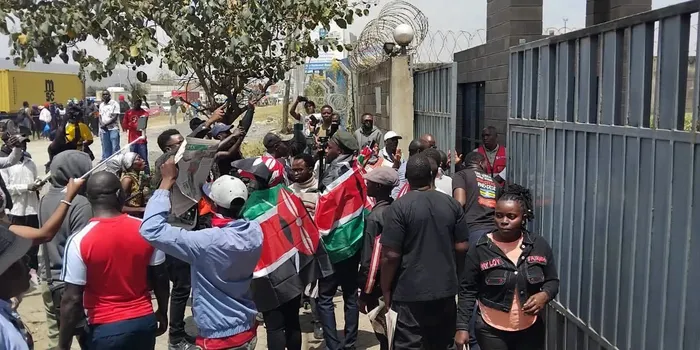
A protest over The Standard Group’s coverage of President William Ruto’s administration turned tense on Friday after demonstrators were confronted by activists outside the media company’s headquarters along Mombasa Road in Nairobi.
The protesters had gathered outside the Standard Group offices, carrying placards and twigs and accusing the media house of being consistently critical of the government.
The demonstration had been announced days earlier by a group identifying itself with Bunge la Mwananchi, which said it planned to mobilise more than 5,000 people to the media house.
The Standard Group had raised security concerns ahead of the protest and said it had notified South B Police Station and the Directorate of Criminal Investigations in Makadara.
By Friday morning, the protest had moved from a planned demonstration into a confrontation between the government supporters and a group of human rights activists who arrived carrying Kenyan flags.
Images from the scene showed the two groups facing off outside the Standard Group premises.
The activists said they were defending the role of the media in reporting matters of public interest.
The Standard Group described their presence as a show of solidarity with the media house and its journalists.
“Activists rally in solidarity with the Standard Group Plc., reaffirming their support for press freedom and bold journalism,” the company said.
The media house also said the protesters attempted to access its premises but were unable to enter.
The headquarters houses several Standard Group operations, including The Standard newspaper, KTN, Radio Maisha and Spice FM.
Dispute over government coverage
The confrontation is the latest episode in an increasingly public dispute between the Standard Group and supporters of President Ruto over the media house’s coverage of his administration.
On September 29, the Standard Group said the planned protest followed accusations circulating online that its platforms had repeatedly published reports critical of the President and his government.
The dispute has also involved the President himself.
On June 24, Ruto publicly criticised the media company in a post on X, accusing it of publishing what he called “extortionist propaganda” against his administration.
He challenged the media house to continue with its coverage, saying such reporting would not pressure his government into changing its position.
The Standard Group rejected the characterisation.
In an editorial response, the company said it stood by its journalism and argued that criticism of media organisations should be addressed through established channels rather than public attacks.
Media freedom concerns
The latest confrontation comes at a sensitive time for the Standard Group.
In September, its Associate Editor Alex Kiprotich was abducted by armed men along the Gilgil-Nakuru highway before being found safe near Masinga Dam.
The incident triggered condemnation from media and human rights organisations.
The Kenya National Commission on Human Rights said attacks, threats and intimidation against journalists undermine constitutional protections for freedom of expression and media independence under Articles 33 and 34 of the Constitution.
The Media Owners Association of Kenya also called for an independent investigation into Kiprotich’s reported abduction and stressed that journalists should be able to carry out their work without threats or interference.
The Friday protest does not, on its own, establish any connection between that incident and the demonstration at the Standard Group offices.
However, it adds another public confrontation to an already tense debate over the relationship between political power, the media and the right to criticise those in government.
A wider political backdrop
The dispute is unfolding as political activity intensifies ahead of the 2027 General Election.
The Standard Group has recently faced criticism from political figures over some of its election-related reporting.
On October 1, a group of MPs threatened to push for restrictions against media organisations they accused of publishing unverified claims about the 2027 elections. The lawmakers specifically criticised the Standard Group, while the media house maintained that it would continue its journalism.
Separately, the High Court in September issued interim orders restricting the Standard Group from republishing disputed allegations linking President Ruto’s daughter, Charlene Ruto, to a Kenya Police Service uniform tender. The case remains before the court, meaning the underlying allegations have not been finally determined.
For the Standard Group, Friday’s confrontation therefore comes amid several separate disputes over its reporting.
For its critics, the demonstrations are a protest against what they regard as unfair coverage of the government.
For media and human rights organisations, the central issue is whether criticism of journalism should be met through public debate and lawful complaints rather than pressure at newsrooms.
As Kenya heads towards another politically charged election period, the confrontation outside the Standard Group highlights the increasingly difficult space occupied by news organisations reporting on those in power.
You may also like
Category: News · Related Topic: William Ruto
Related Video: Murkomen Says Kenya Is Safe: “Stop Creating a Crisis” | Political Goons & Security Under Scrutiny
Related Explainer: Kenya’s inflation holds near 30-month high as transport and food costs squeeze households
About the Author
Maureen Onyango is a journalist passionate about storytelling, life coaching and spiritual lessons. She studied at the Kenya Institute of Management and enjoys telling stories that inform, inspire and empower communities.
 Facebook
 Twitter / X
 WhatsApp
 LinkedIn
 Telegram
 Reddit