
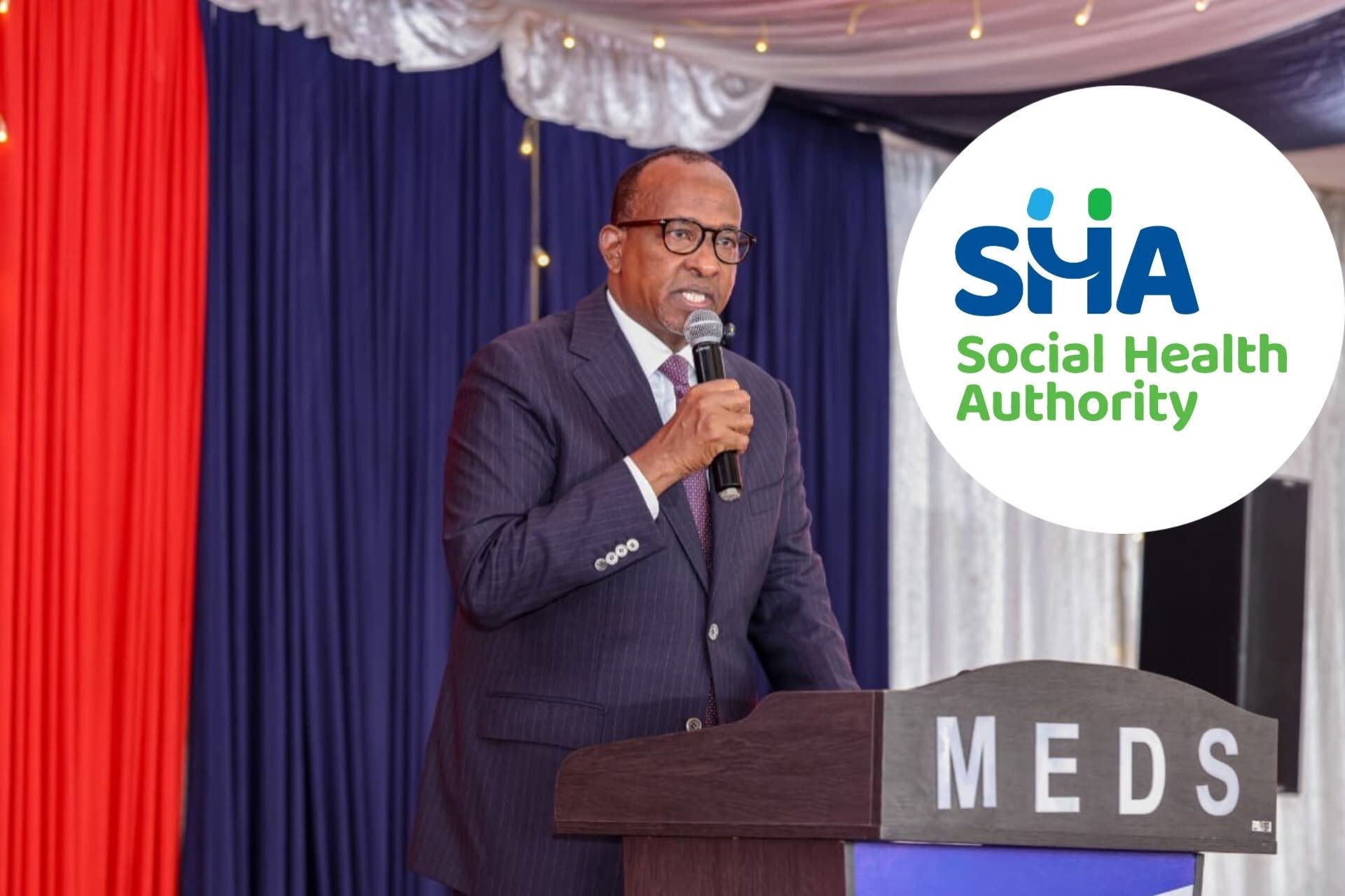
Kenya is undertaking a major overhaul of how hospitals interact with the Social Health Authority, moving healthcare facilities away from reliance on the SHA Provider Portal towards integrated Health Management Information Systems.
The transition attracted considerable attention this week after Health Cabinet Secretary Aden Duale warned that healthcare facilities contracted by SHA needed to migrate to HMIS as the government prepared to close the existing Provider Portal.
Duale initially said the Provider Portal would be shut from October 1 and warned that facilities that had not transitioned would not be able to use the system to serve SHA patients.
That position has since changed.
On October 1, the Ministry of Health granted remaining facilities an additional month to complete the migration, pushing the transition deadline to October 30, 2026.
More importantly for patients, Duale has assured Kenyans that healthcare services should not be interrupted because a hospital has not yet completed its HMIS migration.
So what exactly is HMIS, why is the government insisting on the transition, and what should SHA members know?
What is HMIS?
HMIS stands for Health Management Information System.
In practical terms, it is software used by healthcare facilities to digitally manage functions such as patient information, treatment records, billing and claims.
The government's wider objective goes beyond simply replacing one SHA website with another.
Kenya is attempting to create an interconnected digital-health ecosystem in which healthcare providers can exchange information securely and interact electronically with SHA and other components of the national health system.
The Ministry of Health formally began the transition from the SHA Provider Portal to the new HMIS framework in June.
At a June 29 consultative meeting involving healthcare providers, SHA and the Digital Health Agency, the government said the transition would be implemented progressively as part of its wider Taifa Care digital-health reforms.
Why is the government making the change?
One of the biggest reasons is claims management.
Under the integrated system, the government says hospitals should be able to verify patients electronically, authenticate providers, process claims digitally and securely exchange health information.
The Ministry says this should improve efficiency, speed up claims processing and make it easier to identify fraud and other irregularities.
There is also a longer-term objective: health-data portability.
The Digital Health Agency's statutory role includes developing integrated health-information infrastructure and enabling health information to move securely across the healthcare system.
In practical terms, Kenya wants to reduce fragmentation where a patient's information is trapped within one hospital's records and unavailable elsewhere when legitimately needed for treatment.
That could eventually make referrals and continuity of care easier, although the effectiveness of that system will depend on implementation, interoperability and protection of sensitive health data.
Are hospitals being forced to use one government software system?
Not exactly.
This is one of the most important distinctions in understanding the transition.
Healthcare providers can operate compliant HMIS platforms, but those systems need to satisfy national standards and integrate with the infrastructure established by SHA and the Digital Health Agency.
For public facilities, the government has already deployed the Taifa Care HMIS extensively. Level 4 public hospitals began processing new SHA claims through Taifa Care HMIS earlier this year.
The broader requirement is therefore about certification and interoperability, rather than simply requiring every private hospital to run precisely the same hospital-management software.
How far has the transition progressed?
According to figures released by the Ministry of Health on October 1, all 6,427 public Level 2, Level 3 and Level 4 health facilities have completed the transition.
Progress is considerably slower among larger facilities.
Only four public Level 5 facilities had completed migration by October 1, while another 23 were at various stages of transitioning.
The government is also supporting 518 contracted faith-based facilities to install and transition to HMIS. Of those, 38 had completed the process by October 1.
Those figures help explain why the government extended the deadline rather than enforcing the September 30 cut-off immediately.
Can a hospital that has not migrated still treat SHA patients?
For patients, this is the most important question.
The government's latest position is that patients should not be denied healthcare simply because a facility has not yet completed its HMIS transition.
The additional month is intended to allow remaining facilities to complete migration without disrupting healthcare services.
That is an important change from the warning issued before September 30.
Duale had initially said the Provider Portal would close and warned facilities that failure to transition would prevent them from serving patients through the SHA system.
The extension therefore effectively provides a transition window until October 30.
But there is another SHA deadline hospitals must meet
This is where the issue becomes confusing.
The HMIS migration and SHA provider contracting are two different processes happening at almost the same time.
SHA is simultaneously moving healthcare facilities onto its new 2026–2029 HAKIKA contracting framework.
That process determines whether a healthcare facility has a valid contractual relationship allowing it to provide services funded by SHA.
The original contracts expired on September 30, but SHA announced on October 1 that providers would receive another 14 days, moving the contracting deadline to October 14.
During that period, facilities that accept the extension can continue operating under their existing contracts.
SHA says 10,006 providers have expressed interest and are at various stages of the new contracting process.
This distinction matters.
A facility may be dealing simultaneously with its digital HMIS integration and its contractual status with SHA.
Patients should therefore not interpret the October 30 HMIS extension as meaning every hospital automatically remains an authorised SHA provider until that date.
What happens to your existing SHA claims?
The migration does not mean claims already submitted through the old Provider Portal simply disappear.
When Level 4 public hospitals were migrated earlier in the year, SHA specifically said claims submitted through the Provider Portal before migration would remain in the system and continue being processed.
New claims, however, are progressively being shifted to the integrated HMIS environment.
This is one reason the technical transition matters to hospitals: the systems are increasingly becoming the infrastructure through which treatment verification and reimbursement take place.
What could patients gain from HMIS?
If implemented properly, an interoperable digital system could address several longstanding problems in Kenyan healthcare.
Patient verification could become faster. Hospitals could submit claims electronically instead of relying on fragmented processes. Medical information could become more portable between authorised healthcare providers. SHA could potentially identify duplicate, fraudulent or suspicious claims more efficiently.
Hospitals could also have better visibility over claims processing and reimbursement.
But those are intended benefits, not guaranteed outcomes.
The system will only work effectively if facilities have reliable connectivity, trained personnel, compatible software and adequate technical support.
Cybersecurity and privacy will also be critical because the system involves highly sensitive medical information.
The Digital Health Agency says its mandate includes establishing national registries, interoperability standards and secure systems for health information exchange.
What should SHA members do now?
Patients do not need to install HMIS themselves. This transition primarily concerns healthcare providers and the government systems with which they interact.
However, before seeking planned treatment—particularly expensive procedures or ongoing specialised care—it remains prudent to confirm that the hospital is currently contracted to provide the relevant SHA service.
That is because HMIS compliance and SHA contracting are separate issues.
A hospital having working digital infrastructure does not by itself establish that every service it offers is covered by SHA.
Likewise, the government's assurance that patients will not be denied treatment during HMIS migration should not be interpreted as an assurance that every facility in Kenya has a valid SHA contract for every benefit.
The real test comes in October
The HMIS transition is one component of a much larger attempt to digitise Kenya's healthcare financing and patient-information infrastructure.
The government argues that the new system will improve accountability, reduce fraud, make health information portable and accelerate claims processing.
But October will provide a practical test of those ambitions.
Thousands of facilities must complete new SHA contracts, while hospitals that have not completed HMIS migration must simultaneously integrate their systems by the end of the month.
For patients, the most important development is the government's assurance that the technological transition should not interrupt access to healthcare.
For hospitals, however, the direction of policy is now clear: participation in SHA is becoming inseparable from compliance with Kenya's digital-health infrastructure.
You may also like
Category: Explainers · Related Topic: Social Health Authority (SHA)
Related Explainer: Why the BCG Vaccine Leaves That Small Scar on Your Arm
 Facebook
 Twitter / X
 WhatsApp
 LinkedIn
 Telegram
 Reddit