
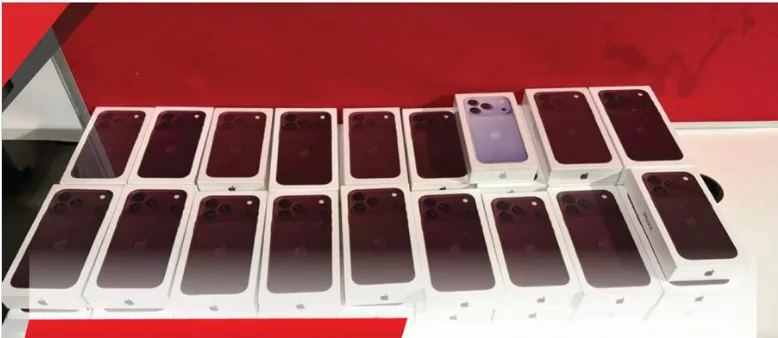
Travellers entering Kenya have been cautioned against carrying undeclared goods for other people after customs officers intercepted 40 high-end iPhones valued at approximately KSh8.2 million at Jomo Kenyatta International Airport.
The Kenya Revenue Authority said Customs officers recovered the iPhone 18 Pro and iPhone 18 Pro Max devices from a male passenger who arrived from Dubai on Thursday, October 1, 2026.
The phones had not been declared to Customs and were discovered during routine baggage screening at the international arrivals section of JKIA.
According to KRA, the devices were concealed among other items distributed across three small suitcases and a backpack.
The incident provides an important warning for travellers: accepting phones, electronics, parcels or other goods to carry across an international border for another person can expose the traveller to customs enforcement if the items have not been properly declared.
Frequent trips raised questions
KRA said officers subjected the passenger to further questioning after reviewing his recent travel history.
The authority initially reported that he had entered Kenya four times within nine days. More detailed reporting of KRA's account shows a pattern of repeated short trips between Kenya and Dubai during September.
According to the account given by Customs, he entered Kenya on September 15 and left on September 17, returned on September 19 and left the following day, entered again on September 21 and departed on September 22, before returning on September 23.
The frequency and short duration of the trips prompted additional scrutiny.
The passenger initially told officers that he was transiting through Kenya by road to a neighbouring country.
Further questioning, however, established that he was acting as a courier for a Dubai-based client and that the smartphones were destined for the Kenyan market, according to KRA's account of the incident.
The authority subsequently took possession of the phones, which were deposited at the Customs Warehouse pending verification and clearance.
The crucial lesson: know what you are carrying
Beyond the value of the seized phones, KRA has used the case to warn travellers about transporting goods for third parties.
That warning is particularly relevant to people who agree to carry phones, laptops, watches, jewellery or packages for friends, relatives, clients or strangers while travelling internationally.
Being told that an item belongs to somebody else does not remove a traveller's obligation to comply with Customs requirements.
KRA specifically warned passengers against carrying undeclared goods for third parties.
Travellers should therefore establish exactly what they are carrying and whether the goods must be declared before agreeing to transport them.
When should you declare goods?
Passengers arriving in Kenya who have goods subject to Customs requirements should declare them rather than proceed as though they have nothing to declare.
At JKIA, passengers carrying dutiable or restricted goods are expected to use the Red Channel and present the goods to Customs officers for assessment.
Travellers should also retain documentation establishing what they paid for valuable items, including invoices or receipts, because these may be required during Customs valuation and clearance.
The rules become particularly important where a traveller is carrying multiple new devices.
Forty boxed high-end smartphones, for example, are fundamentally different from a traveller arriving with an ordinary personal phone.
Goods being brought into Kenya for commercial purposes are subject to Customs procedures, including appropriate declarations and documentation.
Mobile phones have additional requirements
Mobile devices are also subject to specific declaration requirements.
KRA previously introduced requirements for passengers entering Kenya to declare details of mobile devices intended for use in the country, including their International Mobile Equipment Identity, or IMEI, numbers through the passenger declaration process.
Commercial importers are similarly required to provide accurate information about the quantities, models and IMEI numbers of imported devices through the Customs system.
This makes carrying large quantities of smartphones without appropriate documentation particularly risky.
Do not assume being a courier protects you
Perhaps the most important lesson from the JKIA incident is that travellers should not casually agree to transport merchandise across borders.
A seemingly simple request — "bring these phones for me" — can become a Customs matter when the traveller arrives at the airport.
Before carrying goods for somebody else, a traveller should know what is inside the package, who owns it, its approximate value, whether it is intended for resale and whether it needs to be declared.
If there is uncertainty, declaring the goods and seeking guidance from Customs is safer than attempting to pass through without disclosure.
Travellers should be especially cautious about carrying sealed packages whose contents they have not personally verified.
The principle extends beyond taxation. International travellers are responsible for what is in their luggage, making it important to know precisely what another person has asked them to transport.
What happened to the Sh8.2 million phones?
The 40 iPhone 18 Pro and Pro Max devices remain in Customs custody pending clearance and verification.
KRA valued the consignment at approximately KSh8.2 million.
The interception also forms part of intensified Customs enforcement against undeclared and under-declared imports.
For travellers, however, the practical lesson is straightforward.
Before boarding a flight with goods belonging to another person, ask what you are carrying, determine its value and establish whether Customs requires it to be declared.
A favour for a friend or client does not exempt a passenger from Kenya's Customs requirements.
Category: Business
Related Video: Dolly Parton’s Family Announces Her Passing in Emotional Tribute
Related Explainer: EXPLAINER: How can one mother give birth to five babies? The science behind Kenya’s rare quintuplets
 Facebook
 Twitter / X
 WhatsApp
 LinkedIn
 Telegram
 Reddit