
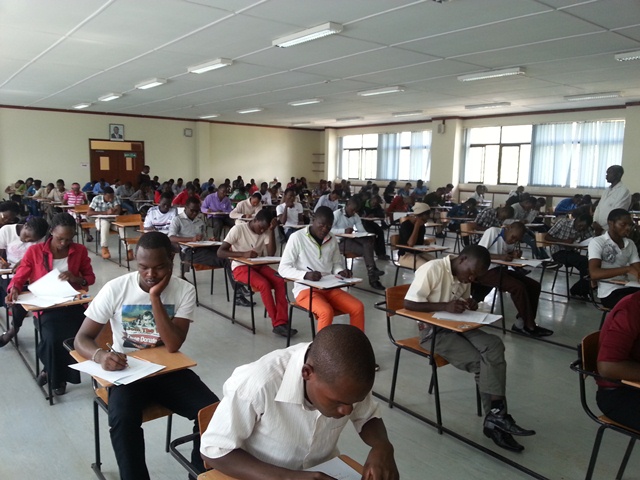
Examination cheating accounted for almost every student disciplinary case reported by Kenyan universities in 2025, putting academic integrity firmly at the centre of concerns facing the country's higher education sector.
Data from the Commission for University Education (CUE) shows that 2,803 of the 3,017 student disciplinary cases reported by 65 institutions involved examination irregularities.
That translates to 92.9 per cent of all reported cases.
The figure is striking because the overall number of disciplinary cases actually fell from 3,361 in 2024 to 3,017 in 2025, a decline of about 10.2 per cent.
In other words, fewer disciplinary cases were recorded overall, but examination offences took up an even larger share of them.
The figures are contained in CUE's University Statistics Report 2025, which draws data submitted by universities through the University Education Management Information System (UEMIS).
Cheating rises as a share of disciplinary cases
CUE recorded examination irregularities at 87.3 per cent of all disciplinary cases in the previous reporting period.
The proportion rose to 92.9 per cent in 2025.
The offences were not limited to students carrying notes into examination rooms.
CUE identified cases involving unauthorised written material, possession of mobile phones and other electronic devices, impersonation and students sitting examinations for units in which they were not registered.
The commission says the concentration of cases around examinations points to a need for universities to strengthen controls before and during examination periods.
Among the measures recommended are randomised seating arrangements and systematic checks for electronic devices before students enter examination rooms.
June recorded the highest number of cases
The data also shows a clear link between disciplinary cases and the academic calendar.
June recorded the highest monthly total, with 481 cases.
May followed with 382, while September recorded 364 and January 355.
All four months coincide with periods when universities commonly hold main or supplementary examinations.
CUE says this pattern suggests that preventive action around examination periods could have a significant effect on the overall disciplinary workload.
The finding also gives universities a practical window for intervention. Instead of relying mainly on disciplinary action after an offence has occurred, institutions can strengthen examination controls before students enter the room.
Other forms of misconduct were far lower
Gross misconduct and other violations were a distant second, with 154 cases, or 5.1 per cent of the total.
These included disorderly behaviour, failure to follow university rules and conduct considered damaging to an institution's reputation.
Another 40 cases involved theft, robbery, fraud and forgery.
CUE said these included suspected financial fraud, forged academic documents and theft of property within university premises.
Drug and substance abuse accounted for 12 cases, while six cases of gender-based violence were reported.
Only two cases were recorded under breaches of rules governing halls of residence and student elections.
The small numbers in some of these categories, however, should not automatically be interpreted as proof that such problems are rare.
CUE specifically cautioned that low reporting of issues such as gender-based violence may reflect difficulties in detection and reporting.
Fear of stigma, retaliation and a lack of confidence in institutional reporting systems can discourage victims from coming forward.
The commission has therefore called for functioning gender-based violence desks, accessible reporting channels and appropriate support for survivors.
A fall in cases does not tell the whole story
The 2025 figure is lower than the 3,361 cases recorded in 2024.
But disciplinary cases remain well above the levels recorded during the Covid-19 disruption.
CUE's data shows 1,476 cases in 2022, followed by a sharp increase to 3,158 in 2023 and 3,361 in 2024.
The increase coincided with the return of universities to more conventional in-person academic and examination arrangements.
The latest figures therefore show some reduction in the overall caseload, but examination malpractice remains overwhelmingly dominant.
What happens after a student is found guilty?
Fines were the most frequently recorded sanction in 2025.
CUE's data shows 1,953 cases, or 64.7 per cent, resulted in fines.
There were also 304 suspensions and 198 expulsions, while 562 cases were recorded under other sanctions.
That makes the disciplinary process an important part of the story.
The question is not only how universities detect cheating, but also how consistently and fairly disciplinary decisions are reached and implemented.
That issue has become more prominent following another finding in the same CUE report.
Thousands of disciplinary appeals remain unresolved
Between 2022 and 2025, universities recorded 11,016 disciplinary appeals.
Of these, 7,178 were successful and 1,120 failed.
A further 2,718 remained unresolved when the data was extracted.
CUE has warned that prolonged appeals can leave students in an uncertain academic position. Depending on the circumstances, unresolved cases can affect graduation, transfers or re-enrolment in particular units.
In 2025 alone, 916 appeals remained open at the time the data was extracted.
The commission has recommended that universities resolve disciplinary appeals within 90 days of filing and report compliance through UEMIS.
The high number of successful appeals has also prompted CUE to call for closer scrutiny of first-instance disciplinary decisions, including whether decisions are supported by evidence and whether sanctions are proportionate.
The bigger issue is academic integrity
For universities, the latest figures point to two linked challenges.
The first is preventing examination malpractice.
The second is ensuring that when disciplinary action is taken, students have a fair and timely process for challenging decisions.
CUE says stronger examination supervision, device checks and clear institutional disciplinary procedures can help address the problem.
But the figures also show that enforcement alone cannot be the entire response.
With more than 700,000 students enrolled in Kenyan universities in 2025, the integrity of examinations affects not just individual students but the credibility of the qualifications they earn.
The challenge for universities is therefore twofold: make cheating harder to commit while ensuring disciplinary systems remain fair, transparent and quick enough to protect both academic standards and students' rights.
That balance will be crucial if the sector is to reduce examination malpractice without creating a disciplinary system that leaves students waiting months or years for their cases to be resolved.
You may also like
Category: Education
Related Video: What Dangote’s proposed Lamu oil refinery could mean for East Africa
Related Explainer: Explainer: What happened to milk in Kenya?
About the Author
Maureen Onyango is a journalist passionate about storytelling, life coaching and spiritual lessons. She studied at the Kenya Institute of Management and enjoys telling stories that inform, inspire and empower communities.
 Facebook
 Twitter / X
 WhatsApp
 LinkedIn
 Telegram
 Reddit