
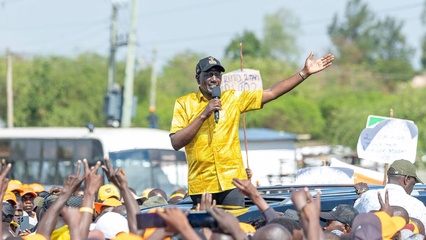
NAIROBI, Kenya — President William Ruto is changing the language of his political campaign ahead of the 2027 General Election, replacing the sharp economic divide of his 2022 “Hustler versus Dynasties” pitch with a new promise of equality and shared development.
The President is promoting the slogan “Usawa ni Sawa, Mbele Pamoja”, loosely translated as “Equality is fair, moving forward together”, as he seeks a second term in office.
The message puts a fresh question at the centre of his re-election campaign: are all Kenyans benefiting fairly from the country's resources, jobs and development projects?
Ruto introduced the phrase during a rally in Bondo, Siaya County, on October 7, shortly after presiding over the handover of the mausoleum of the late former Prime Minister Raila Odinga. He has since continued promoting the equality message during public engagements, including his North Rift tour.
“Kenyans have decided that it is in 2027 that they shall vote resoundingly for the equity and equality of all Kenyans,” Ruto said during the Bondo rally.
He also pledged to fight discrimination, hatred and tribalism, presenting national unity and equitable development as priorities for the next election.
The shift comes as the President works to broaden his political appeal following his alliance with Odinga's Orange Democratic Movement (ODM) in the broad-based government. It also comes amid growing opposition calls for Ruto to serve only one term.
But a new slogan will not, by itself, settle the questions voters have about the economy, public services and the distribution of government resources.
From the hustler to the promise of equality
Ruto's 2022 campaign was built around the idea that ordinary Kenyans had been locked out of economic opportunity by powerful political families.
The “Hustler Nation” message presented him as a champion of small traders, boda boda riders, market vendors and low-income households. Its wheelbarrow symbol became a recognisable image of his bottom-up economic agenda.
The message helped Ruto build support beyond his traditional political base and win a closely contested election against Odinga.
Four years later, the political circumstances have changed.
Ruto is no longer campaigning as an outsider challenging established power. He is the incumbent, defending his administration's record while seeking another five-year term.
The new equality message appears to broaden his earlier economic pitch. Instead of focusing mainly on the divide between ordinary citizens and political dynasties, it raises questions about which regions and communities have benefited from development and which still feel left behind.
The shift also gives the President a way to present his political partnerships as part of a national development agenda rather than simply an arrangement for sharing political power.
However, the language of equality comes with a higher burden of proof. Voters can judge the government not only by its promises but also by what they see in their communities and households.
Why regional equity is taking centre stage
The question of equitable development has long shaped Kenyan politics.
Since independence, successive governments have faced criticism over differences in access to infrastructure, education, employment, land and public investment across regions.
The debate has been particularly sensitive in areas whose residents believe they have received less than their fair share of national resources.
During the recent debate over Ruto's new message, Health Cabinet Secretary Aden Duale has defended the emphasis on equity and argued for a political alliance involving communities that consider themselves historically marginalised.
Such arguments reflect a wider contest over how the country's development record should be assessed.
Government supporters point to roads, housing projects, electricity connections and investments in areas previously associated with the opposition. Critics, meanwhile, question whether announced projects and spending have translated into meaningful improvements in household incomes, access to services and the cost of living.
These competing claims cannot be settled by a campaign slogan alone. They require evidence of where public money is going, who is benefiting and whether the promised projects are being completed.
For Ruto, the challenge will be to show that the language of equality is reflected in government decisions and measurable results.
The opposition has its own message
While Ruto promotes “Usawa ni Sawa”, sections of the opposition have rallied around “Wantam”, a slogan calling for the President to serve only one term.
The phrase has gained traction among critics who want a change of government and who cite concerns over taxation, living costs, accountability and the administration's performance.
Former Deputy President Rigathi Gachagua has been among the prominent political figures associated with the one-term message. Other opposition figures have used slogans such as “Cousins” to encourage political solidarity among communities and groups they hope to bring together against Ruto.
The competing messages show how political communication is already shaping the debate ahead of the 2027 election.
The Institute for Security Studies, in an analysis published on September 28, 2026, noted that public dissatisfaction has helped the “Wantam” message gain attention. It also warned that divisions within the opposition could weaken its ability to mount a united challenge.
That creates an opening for Ruto, whose supporters have promoted a contrasting message of continuity, development and national inclusion.
But the opposition faces its own test. A call to remove an incumbent may attract attention, yet voters will also want to know who should replace him, what that government would do differently and how it would pay for its promises.
Both sides will need more than catchy phrases to convince voters that they have credible plans for the country.
Kenya's history shows the power — and limits — of slogans
Political slogans have played a significant role in Kenya's elections, often giving complicated political campaigns a simple message that supporters can repeat and identify with.
In 2002, the National Rainbow Coalition (NARC) rallied behind “Yote Yawezekana bila Moi” — everything is possible without Moi — as it challenged KANU's long hold on power. Mwai Kibaki's victory ended KANU's uninterrupted rule and brought a new wave of expectations around political and economic change.
Earlier, founding President Jomo Kenyatta popularised “Harambee”, encouraging Kenyans to work together to build schools, health facilities and other community projects. His successor, Daniel arap Moi, adopted “Nyayo”, meaning footsteps, as a pledge to follow Kenyatta's principles of peace, love and unity.
Ruto himself benefited from a powerful political narrative in 2013, when his alliance with Uhuru Kenyatta framed their partnership around sovereignty amid their International Criminal Court cases. In 2017, the Jubilee campaign used “Tano Tena” to seek a second term, with infrastructure projects and development promises at the centre of its pitch.
These examples show how a short phrase can help a candidate organise supporters around a broader political identity. They also illustrate that the meaning of a slogan can change once a leader takes office and must account for the results of government policy.
For Ruto, “Usawa ni Sawa” will be judged against the same test.
Can ‘Usawa ni Sawa’ convince voters?
The President's new message arrives at a time when his administration must defend its record on taxation, employment, public services and household economic pressures.
For some voters, the promise of more equitable development may resonate, especially if they see new infrastructure, improved services or greater access to economic opportunities in their areas.
Others may ask whether the message addresses the immediate pressures facing families, including the cost of basic goods, access to healthcare and the ability to find secure work.
The answer will depend partly on how the government presents its achievements and partly on whether voters believe those achievements have improved their lives.
The political analyst quoted in The Star's October 16 report, James Wambua, argued that the success of the new message would depend on how effectively the President's team presents it and whether its promises are reflected in tangible outcomes.
That is the central challenge facing the campaign. Equality is an appealing promise, but Kenyans may differ over what it should mean in practice — whether through fairer regional investment, more jobs, better public services or improved access to economic opportunity.
The opposition, meanwhile, must demonstrate that its call for political change can be translated into a coherent alternative.
As the 2027 election approaches, Kenya's contest is likely to involve competing explanations of what the country needs and who can deliver it. Ruto is betting that a message of shared progress can strengthen his case for another term.
Whether “Usawa ni Sawa” becomes a defining campaign slogan or simply another rallying call will depend on a factor no political team can control through messaging alone: what voters believe the government has delivered.
You may also like
Category: Politics · Related Topic: William Ruto
Related Video: Dolly Parton’s Family Announces Her Passing in Emotional Tribute
About the Author
Maureen Onyango is a journalist passionate about storytelling, life coaching and spiritual lessons. She studied at the Kenya Institute of Management and enjoys telling stories that inform, inspire and empower communities.
 Facebook
 Twitter / X
 WhatsApp
 LinkedIn
 Telegram
 Reddit