
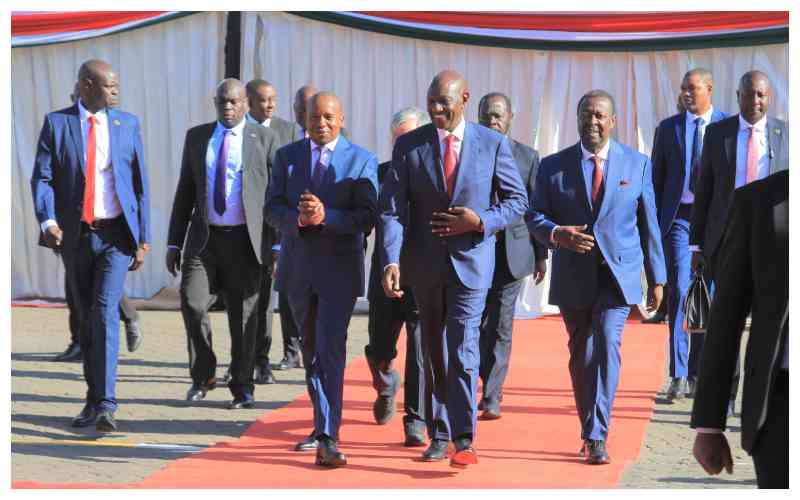
President William Ruto has defended the timing of Kenya’s push to develop a new long-term economic blueprint, arguing that the country cannot allow the 2027 General Election to dictate decisions that will shape its future for decades.
Speaking at the Kenyatta International Convention Centre (KICC) during the launch of the national dialogue on Vision 2060, Ruto said Kenya must learn to think beyond electoral cycles and focus on the interests of future generations.
His message was direct: elections come and go, but national development must continue.
“Kenya is bigger than any election,” Ruto said, warning against treating elections as a “matter of life and death.”
Ruto: Why Kenya must plan beyond 2027 election
- Ruto launches push for new national development vision to replace Vision 2030
- Ruto's big vision raises uncomfortable questions for Kenya's opposition
- Njuri Ncheke Elders Endorse DP Kindiki as Mt. Kenya Spokesman, Back Ruto's 2027 Re-election Bid
- Ruto and Kindiki Under Pressure After Ol Kalou Loss as Closed-Door State House Meeting Fuels Political Speculation
The President's comments come barely a year before the 2027 election, placing the new development vision squarely in the middle of an increasingly heated political environment.
Ruto: Don't wait for 2027
Ruto acknowledged that some people had advised him to postpone the Vision 2060 conversation until after the election.
He said he had faced pressure from people within his administration who feared that launching such a major national process so close to the election could have political consequences.
But the President rejected the argument.
He said Kenya should not suspend important national conversations simply because an election is approaching.
“The next election will come and go. Kenya must think beyond the next election,” Ruto said.
The President argued that previous administrations had sometimes focused too heavily on short-term political considerations instead of making decisions with future generations in mind.
His criticism was a clear defence of long-term planning over what he portrayed as election-driven policymaking.
Why Vision 2030 is no longer enough
Ruto said the world has changed dramatically since Kenya developed Vision 2030, the country's current long-term development blueprint.
Among the major changes he cited are the rapid growth of artificial intelligence, climate change and Africa's growing importance in the global economy.
When Vision 2030 was formulated, Ruto noted, artificial intelligence had not emerged as the transformative force it is today.
The impact of climate change has also become more apparent, while Africa's economic and demographic significance has grown.
The President said Kenya therefore needs a new national conversation about what kind of country it wants to become over the coming decades.
“We want to pick the minds of everybody — the farmers, entrepreneurs, students, technocrats, everybody,” he said.
The proposed Vision 2060 is intended to provide that longer-term destination.
What exactly is Vision 2060?
At its core, Vision 2060 is intended to extend Kenya's development planning beyond the end of Vision 2030.
The government wants the process to draw contributions from different sections of society rather than being designed exclusively by politicians and technocrats.
That includes farmers, businesses, young people, professionals, county governments and other stakeholders.
The idea is to establish a broad national development direction that successive administrations can implement regardless of who wins elections.
That ambition, however, faces a major political test.
Can Kenya maintain policies when governments change?
Deputy President Kithure Kindiki made that question central to his contribution to the discussion.
Kindiki warned against what he described as policy disruption, where incoming administrations abandon programmes started by their predecessors simply because they are associated with a previous government.
He argued that this is particularly damaging to developing countries, where long-term projects require consistency across several administrations.
“The biggest threat to African and developing countries is policy disruption,” Kindiki said.
His argument was that Kenya should improve policies that are working rather than automatically dismantling them when political leadership changes.
The remarks appeared aimed at opposition figures, including former Deputy President Rigathi Gachagua and his allies, who have promised to reverse or significantly change several Kenya Kwanza policies if they take power.
Among the programmes they have criticised are the Affordable Housing Levy, the current taxation framework, State House expenditure and the Hustler Fund.
Gachagua's challenge: What happens to Ruto's policies?
The Vision 2060 debate has therefore opened another front in the emerging 2027 political battle.
Gachagua has positioned himself as a major critic of the Ruto administration and has argued that some of the government's flagship policies have increased the financial burden on Kenyans.
He has called for changes to the housing levy and taxation system and has criticised government expenditure.
The former Deputy President has also argued that a new administration should not be bound by policies it considers harmful.
This creates a fundamental question for Vision 2060:
Can Kenya build a long-term development plan that survives political transitions?
That may be more important than the document itself.
Kenya has produced numerous policies and development plans over the years. The recurring challenge has often been implementation, financing and continuity rather than a lack of plans.
Nyong'o: Kenya risks repeating the same mistake
Kisumu Governor Anyang' Nyong'o, who is leading the strategic working group developing Vision 2060, acknowledged that questions about the timing of the process are legitimate.
But he argued that the country cannot simply wait for the election before deciding what comes next.
Nyong'o said Kenya is approaching the end of the Vision 2030 planning period and needs to establish a clear national destination beyond 2030.
Without such a destination, he warned, Kenya could simply move from one five-year development plan to another without a clear long-term direction.
His argument highlights one of the central weaknesses of development planning in Kenya: the tendency to focus on individual projects rather than maintaining a consistent national strategy.
Oburu: Fix corruption before chasing the Singapore dream
ODM leader Oburu Oginga offered another perspective on the country's development ambitions.
He said Kenya could achieve the kind of transformation associated with countries such as Singapore but argued that corruption and wastage of public resources must first be addressed.
His message was that development cannot be built on institutions that tolerate corruption.
For Vision 2060 to succeed, therefore, the question may not only be what Kenya wants to achieve, but also whether the country can build institutions capable of delivering it.
Counties expected to play a major role
The Vision 2060 conversation is also expected to involve Kenya's 47 counties.
Council of Governors Chairperson and Wajir Governor Ahmed Abdullahi said county governments would support the new vision and prioritise funding once it is formally adopted.
That could become critical because many of the issues at the centre of Kenya's development — healthcare, agriculture, water, urbanisation, infrastructure and local economic development — involve county governments.
A successful Vision 2060 would therefore need to go beyond State House and national ministries and become a framework that counties can realistically implement.
The big question: Who will implement Vision 2060?
The government now plans to consolidate proposals emerging from the national dialogue and eventually take them to Parliament in the form of legislation.
That process could determine whether Vision 2060 becomes a binding national development framework or another policy document vulnerable to political change.
For the plan to survive beyond 2027, it will likely need broad political and public ownership.
That means opposition parties, counties, business groups, civil society, young people and communities would need to see themselves in the vision.
Otherwise, the next administration could simply argue that it was a Kenya Kwanza project and seek to replace it.
A development plan meets an election year
The timing of Vision 2060 is unlikely to escape political scrutiny.
Ruto is entering the final stretch of his first term, with the 2027 presidential contest already taking shape.
His administration is seeking to defend its record while opposition leaders are promising significant policy changes.
Against that backdrop, critics are likely to question whether Vision 2060 is genuinely a national project or part of the President's political legacy.
The government, however, insists that Kenya cannot afford to put long-term planning on hold every five years.
That argument is difficult to dismiss in principle.
But the real test will be implementation.
Kenya has never lacked ambitious development blueprints. The harder task has been ensuring that projects are funded, institutions remain accountable, corruption is controlled and successive governments continue policies that serve the national interest.
The 2060 test
Vision 2060 is ultimately making a much bigger promise than a single government programme.
It is asking Kenyans to imagine where the country should be more than three decades from now.
But there is an immediate political obstacle standing between that ambition and reality: 2027.
If Kenya can agree on a long-term development direction and protect it from electoral politics, Vision 2060 could provide continuity across administrations.
If every incoming government rewrites the national agenda, the country could once again find itself launching a new plan while abandoning the old one.
For Ruto, the message is that Kenya must think beyond his presidency.
For the opposition, the challenge is whether they can distinguish between changing policies they believe have failed and preserving long-term national priorities.
And for Kenyans, the most important question may ultimately be much simpler:
Will Vision 2060 become a roadmap for the country — or just another political document that survives until the next election?
Subscribe to our newsletter
Get the latest updates and stories from LiveNow Africa, delivered to your inbox.
Choose your news updates
Select the stories you care about and how often you want them delivered.You may also like
Category: Politics · Related Topic: William Ruto
Related Video: What Dangote’s proposed Lamu oil refinery could mean for East Africa
Related Explainer: Inside Kenya’s crude supply puzzle as Dangote prepares to break ground in Lamu
 Facebook
 Twitter / X
 WhatsApp
 LinkedIn
 Telegram
 Reddit