
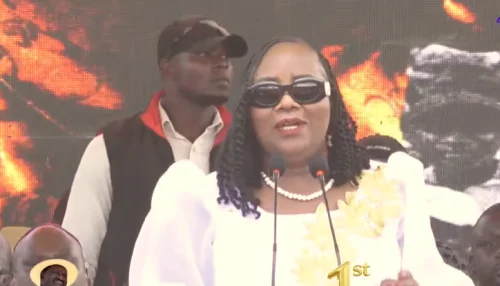
Ida Odinga has urged Kenyans to choose peace, tolerance and love as political competition intensifies ahead of the 2027 General Election, warning that her late husband’s name should not become a tool for personal or political gain.
Speaking on Thursday, 15 October, during the first anniversary commemoration of former Prime Minister Raila Odinga’s death at Migwena Cultural Grounds in Bondo, Siaya County, Ida asked Kenyans to honour his memory through three values she described as gifts to the nation.
“I want to ask you for three gifts in his memory. I don’t want to ask for more. I want to ask for three gifts,” she told mourners.
Her first request was for peace, which she said required more than the absence of open conflict.
“Peace is not the absence of noise. It is the presence of respect. No victory is worth a mother’s tears. Please, let’s try to hold peace in our nation,” Ida said.
Her appeal comes less than a year before Kenyans head to the ballot on 10 August 2027, according to the Independent Electoral and Boundaries Commission’s election plan. Political alliances and campaigns are already taking shape, making her message a timely call for restraint.
The challenge, she suggested, is not simply to prevent violence on election day. It is to stop political differences from destroying relationships and turning fellow citizens into enemies.
Why Ida wants Kenyans to learn from Raila
Ida said Raila had shown that it was possible to hold firm political convictions while remaining willing to engage those who disagreed with him.
“Baba held his conviction fiercely. Yet he sat across the table from those opposing him and disagreed with him,” she said.
She urged Kenyans to follow that example rather than allow political competition to become a source of personal hostility.
“If you think that somebody’s your enemy, that enemy should not stop you from loving him again, because Baba did that over and over again,” she said.
Her second gift was tolerance: the willingness to live alongside people whose political views differ from one’s own.
The message carries particular weight in a country where elections can strain family ties, friendships and community relationships. Support for different candidates is a democratic right, but it should not become a reason to threaten, intimidate or harm others.
Ida’s third request was for love and forgiveness.
“Love is what we say to your rivals: ‘You are not my choice, but you are still my countryman,’” she said.
The three values form a simple message for the months ahead: Kenyans can disagree over leadership without abandoning their shared responsibility for the country.
A warning to young people
Ida reserved a special appeal for young people, urging them not to allow political loyalty to turn into hostility.
“Do not let your passion turn into a weapon. Do not let your love for Baba turn into a weapon because a weapon is meant to harm,” she said.
She went on to warn against violence driven by political differences.
“Don’t harm one another just because they don’t believe in what you believe in. Don’t kill one another just because they don’t believe in what we believe in,” she added.
Her message was not a call for young people to withdraw from politics. Rather, she urged them to participate without losing sight of the lives and relationships that remain after elections.
“Now our people you are contesting against are not your enemies. You are contesting against them. When the election is over, let’s get together,” she said.
She also challenged older generations to give young people room to express themselves and raise concerns, while encouraging the youth to approach their elders with respect.
The appeal placed responsibility on both sides. Older Kenyans, she suggested, must be willing to listen, while younger people must be careful not to confuse disagreement with disrespect.
Ida cautions against using Raila’s name for political gain
Beyond her appeal for unity, Ida raised a concern about how her late husband’s legacy could be treated in the years ahead.
She warned that people might invoke Raila’s name for different reasons, not all of them rooted in genuine commitment to his ideals.
“In the months ahead, voices will rise in his name. Some will speak out of love. Some will speak out of convenience. Legacy is not inherited. It is not to be spent. It will live on,” she said.
The warning comes as political figures and supporters continue to debate how Raila’s influence, political base and ideals will be carried forward following his death.
Raila was a central figure in Kenyan opposition politics for decades and served as prime minister from 2008 to 2013. He died in India on 15 October 2025, aged 80.
Ida’s remarks suggest that invoking his name should not, by itself, be treated as proof that someone represents his values. The more important test, she argued, is whether their conduct reflects the principles he stood for.
Her message also offers a distinction between preserving a political legacy and using it as a campaign tool. The former requires continued commitment to stated ideals; the latter can amount to little more than appealing to public affection for a departed leader.
The personal cost of a year without Raila
For Ida, the anniversary was also a reminder of a loss that remains deeply personal.
She spoke about the difficulty of spending the past year without the man she had known and loved for more than five decades. The family also suffered another bereavement just 40 days after Raila’s death, adding to its grief.
Ida described the quiet moments at home when the reality of his absence became especially difficult to accept.
“Sometimes Baba used to come late in the evening. I leave the door open, hoping that he is going to come in, and the door remains open for a very long time. Then later I realised he is not coming back and I go and close the door,” she said.
The account offered a glimpse of the private grief behind a public figure whose life had been closely tied to national politics.
She thanked Kenyans at home and abroad for their prayers, support and solidarity during the difficult period.
Her remarks also showed why the anniversary was about more than political history. For the family, it marked a year of learning to live with an absence that cannot be undone.
A legacy that must outlive the anniversary
Thousands of mourners gathered at Migwena Cultural Grounds to remember Raila, with political leaders, family members and supporters joining the commemorations. The programme was intended to honour his life and reflect on his contribution to Kenya’s political journey.
But Ida’s message looked beyond the gathering itself.
As the country moves towards another election, her three requests offer a standard against which political leaders and ordinary citizens can assess their actions: whether they protect peace, tolerate opposing views and treat fellow Kenyans with love.
Her appeal cannot guarantee a peaceful election. That will also depend on political leadership, responsible campaigning, the conduct of institutions and the choices citizens make when disagreements arise.
Still, her message was clear. Raila’s memory should not be used to justify hostility or violence. If Kenyans want to honour him, Ida said, they must carry forward the values that allow people with different convictions to share one country.
The question now is whether those values will remain words spoken at a memorial or become part of how the country conducts its politics in the months ahead.
You may also like
Category: Politics · Related Topic: 2027 Elections
Related Video: What Dangote’s proposed Lamu oil refinery could mean for East Africa
Related Explainer: Kenya G-to-G Oil Deal Explained: How It Works, Who Supplies the Fuel and Why It Is Controversial
About the Author
Maureen Onyango is a journalist passionate about storytelling, life coaching and spiritual lessons. She studied at the Kenya Institute of Management and enjoys telling stories that inform, inspire and empower communities.
 Facebook
 Twitter / X
 WhatsApp
 LinkedIn
 Telegram
 Reddit