
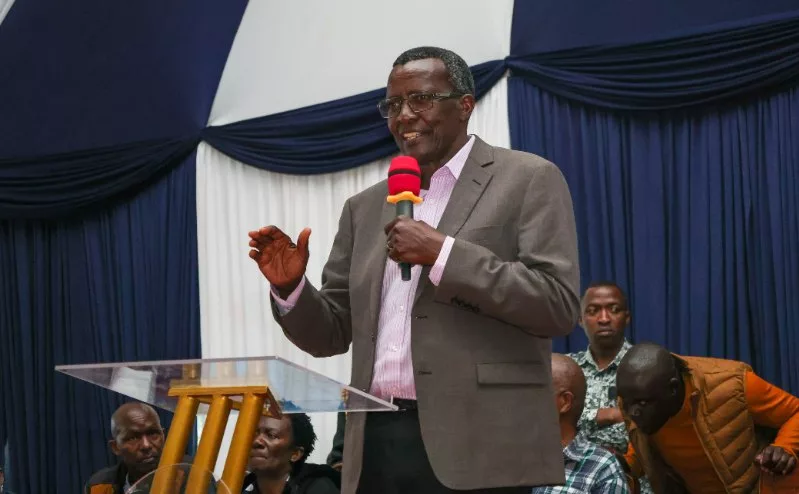
Former Chief Justice David Maraga says no Kenyan should be forced to choose between getting medical treatment and meeting basic household needs, pledging to improve access to affordable healthcare if elected president in 2027.
Maraga, the United Green Movement (UGM) co-party leader and presidential candidate, described the country’s health sector as being in “chaos” and accused the government of neglecting people who depend on public hospitals and dispensaries.
He made the remarks on Friday, October 16, during the funeral of George Morara Ongenyo Mogeni in Kerumbe Village, North Mugirango, Nyamira County.
“For families in rural Kisii and across the country, leadership must be judged by whether a sick person can access care and dignity without being pushed into poverty,” Maraga said.
He pledged to ensure public dispensaries have adequate supplies of medicine, making healthcare a central part of his pitch to voters ahead of the next General Election.
Healthcare promise meets a major policy test
Maraga’s message speaks to a concern shared by many households: whether they can obtain treatment when they need it without facing costs they cannot afford.
But the promise also raises practical questions about how a future administration would make it work. Ensuring medicines are available requires reliable procurement, funding, distribution and oversight, as well as enough health workers and functioning facilities.
Maraga did not set out a detailed implementation plan or funding proposal for the pledge during the funeral remarks reported.
His criticism comes as Kenya continues to implement changes to its public health financing system through the Social Health Authority (SHA). The Ministry of Health has said it is working with counties and health-sector stakeholders to complete facility contracts and maintain services for eligible beneficiaries.
The transition has been a point of political dispute. Maraga has previously criticised the implementation of SHA and questioned whether Kenyans can access treatment as readily as they should.
His latest remarks therefore place healthcare access and the availability of essential medicines among the issues likely to feature in the 2027 campaign.
University strike adds to education criticism
Maraga also turned his attention to education, criticising the government as public university staff continued their nationwide strike over pay and employment terms.
He argued that students should not bear the cost of a prolonged dispute between university workers and the government.
The industrial action, which began on October 2, has disrupted learning at public universities. Unions have raised concerns over the 2025–2029 collective bargaining agreement, including remuneration and how staff salaries should be funded. Negotiations have yet to produce a settlement acceptable to the unions, according to recent reports.
Maraga described the wider education sector as being in disarray and accused the administration of failing to give learners and teachers the attention they deserve.
The strike has left students facing uncertainty over their academic calendars, while the government and university managements face pressure to resolve the dispute.
Questions over the cost of Kenya’s UN trip
The former Chief Justice also questioned the reported size and cost of Kenya’s delegation to the United Nations General Assembly in New York.
Media reports have put the delegation at close to 100 people, including seven Cabinet Secretaries, and cited estimates of about KSh500 million for the trip.
The figure should be treated as an estimate, not a confirmed final expenditure. The reports reviewed did not provide an official government breakdown establishing the total cost.
Maraga used the issue to argue that public spending should reflect the needs of ordinary Kenyans, particularly at a time when families are concerned about the cost and accessibility of essential services.
The question of value for money is a legitimate one, but a firm assessment of the trip’s cost requires a verified breakdown of travel, accommodation, allowances and other expenses, alongside the purpose and outcomes of the delegation’s work.
Maraga frames 2027 as a choice on accountability
The UGM leader urged voters to make the 2027 election a judgement on corruption, public services and the management of state resources.
“Our people of Kisii, Nyamira and Kenya at large, the upcoming 2027 election is between the current government and Kenyans,” he said.
He promised to uphold integrity and the rule of law, saying he would not tolerate corruption in his administration. He also urged residents to reject political bribery and ethnic mobilisation.
Maraga, who served as Chief Justice from 2016 to 2021, has made constitutionalism, accountability and public-sector reform central to his presidential campaign.
His latest remarks continue that message, but the challenge for his campaign will be to turn broad promises into clear policies, measurable targets and credible funding plans.
For voters, the key question is not only whether a candidate recognises the problems in healthcare and education, but whether their proposed solutions can deliver reliable services and withstand scrutiny.
With the 2027 election approaching, Maraga is seeking to make access to medicine, affordable treatment and accountable public spending part of that national debate.
You may also like
Category: Politics · Related Topic: 2027 Elections
Related Video: Murkomen Says Kenya Is Safe: “Stop Creating a Crisis” | Political Goons & Security Under Scrutiny
Related Explainer: Ebola contact tracing: Why the 21-day window matters in Kenya’s response
About the Author
Maureen Onyango is a journalist passionate about storytelling, life coaching and spiritual lessons. She studied at the Kenya Institute of Management and enjoys telling stories that inform, inspire and empower communities.
 Facebook
 Twitter / X
 WhatsApp
 LinkedIn
 Telegram
 Reddit