
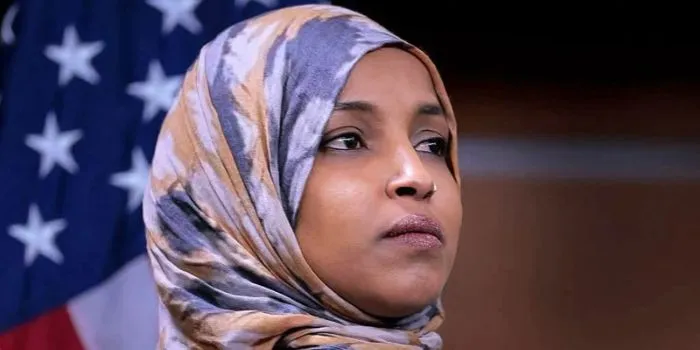
US investigators are examining decades-old immigration records belonging to the Minnesota congresswoman, raising questions about citizenship, due process and the timing of a politically sensitive investigation.
A former Somali refugee who spent four years in a camp in Kenya before building a political career in the United States is now at the centre of a federal investigation that could have serious consequences for her citizenship.
US Representative Ilhan Omar’s Washington home was searched by federal agents on 12 October as investigators examined whether information provided by her or her family during their immigration process was false. The inquiry could eventually lead to criminal charges or an attempt to revoke her US citizenship, according to Reuters and The Associated Press. <Cite refs={["turn983855news40","turn674897news43"]}/>
No finding of wrongdoing has been announced, and Omar has denied the allegations. The investigation has also triggered concerns over whether federal law enforcement is being used to target a prominent political critic of President Donald Trump.
For Kenya, the case carries a personal connection. Omar’s family spent years in a refugee camp in the country after fleeing conflict in Somalia before being resettled in the United States.
From a Kenyan refugee camp to the US Congress
Omar was born in Mogadishu, Somalia, in 1982. Her family fled the civil war and spent four years at the Utange refugee camp in Kenya before travelling to the United States in 1995.
She became a US citizen in 2000, at the age of 17, and later entered politics in Minnesota. In 2018, she was elected to the US House of Representatives, taking office in January 2019. She represents Minnesota’s Fifth Congressional District. <Cite refs={["turn983855search0","turn983855search7","turn983855search55"]}/>
Her journey from displacement to Congress has made her a prominent voice in debates about immigration, refugees and American identity. She has also become a frequent target of criticism from Trump and some of his political allies.
The current investigation focuses on records from her childhood and the process through which she and her family obtained legal status in America.
What investigators are examining
Reuters reported on 15 October that investigators were looking into whether Omar or members of her family provided false information when entering the United States as refugees or during the process of obtaining citizenship.
The inquiry reportedly includes scrutiny of documents prepared by Omar’s late father. Investigators are examining whether details in the family’s immigration records were misstated, including information relevant to her eligibility for citizenship as a minor. <Cite refs={["turn983855search3","turn674897search1"]}/>
The search of Omar’s home was conducted under a court-authorised warrant. The Associated Press subsequently reported that agents seized her phone and that investigators issued more than a dozen grand jury subpoenas, including to relatives. <Cite refs={["turn983855news48","turn674897news43"]}/>
The Justice Department has not publicly set out a complete account of the allegations or disclosed evidence establishing that Omar committed an offence.
The existence of an investigation, a search warrant or a subpoena does not establish guilt. Investigators must still assess the evidence, and any criminal charge would have to be tested through the legal process.
Omar calls the search political intimidation
Omar has rejected the allegations and argued that the investigation is politically motivated.
Following the search, she said she would not be intimidated into silence. Her office has also denied wrongdoing and criticised the operation as an abuse of federal power. <Cite refs={["turn983855news48","turn983855search4"]}/>
The timing has intensified the political controversy. The search took place weeks before the US midterm elections scheduled for 3 November 2026, in which Omar is seeking re-election.
Trump has repeatedly criticised Omar, who is among the most outspoken Democratic opponents of his immigration policies. The president has also made public remarks about her Somali background.
Democratic lawmakers and civil rights advocates have questioned whether the investigation risks undermining confidence in the independence of federal law enforcement. The administration, however, has not publicly accepted Omar’s claim that the search was politically motivated. <Cite refs={["turn983855news46","turn983855news48"]}/>
The available public information does not establish that the investigation was launched to influence the election. Equally, its proximity to the vote has become a central issue in the debate over how the case is being handled.
A previous review reportedly found no wrongdoing
The current inquiry is not the first time Omar’s immigration history has attracted federal scrutiny.
The Washington Post reported on 15 October that officials in the first Trump administration examined her immigration records in 2019 after a political appointee requested a review. According to the newspaper, investigators did not find evidence of citizenship-related wrongdoing at the time. <Cite refs={["turn674897search0","turn983855news41"]}/>
That earlier review does not automatically settle the questions raised by the current investigation. Authorities may reopen an inquiry if they believe new information warrants it. However, the reported outcome of the previous review is relevant background when assessing the renewed scrutiny.
The government has not publicly explained in full what new evidence, if any, prompted the latest investigation.
Could Omar lose her citizenship?
The possibility of denaturalisation — the legal process through which a person’s naturalised citizenship may be revoked — has become one of the most serious aspects of the case.
Under US law, citizenship can be revoked if the government proves in court that it was obtained illegally or through the deliberate concealment or misrepresentation of material facts. The process is not an automatic consequence of a criminal investigation, and the president cannot simply cancel a person’s citizenship by declaration. <Cite refs={["turn674897search2","turn674897search47"]}/>
If the government were to pursue denaturalisation, it would have to bring the matter through the prescribed legal process. Any attempt to remove Omar from the United States would raise further legal questions.
For now, there is no court ruling that her citizenship was unlawfully obtained and no established basis to say that she will be deported. Those outcomes remain possibilities under discussion, not decisions that have been made.
Why the case matters beyond one congresswoman
Omar’s case comes amid a broader effort by the Trump administration to intensify immigration enforcement and review citizenship obtained through naturalisation.
The stakes extend beyond her political career. The investigation raises questions about how the government handles decades-old records, what evidence is sufficient to revisit a person’s citizenship and how authorities can pursue legitimate investigations without creating the appearance of political retaliation.
For refugees and naturalised citizens, the distinction matters. A government may investigate suspected fraud, but allegations must be supported by evidence and assessed under the law. A person’s refugee history, political views or criticism of an administration are not, on their own, proof of immigration wrongdoing.
Omar’s story also illustrates the long journey many displaced families make after fleeing conflict. Her family found refuge in Kenya before being resettled in the United States, where she went on to become a member of Congress.
Whether the investigation leads to charges or any attempt to revoke her citizenship will depend on evidence that has not yet been fully disclosed publicly.
Until then, the central facts remain that Omar’s home has been searched, federal investigators are examining her family’s historic immigration records, and she denies wrongdoing. The investigation has intensified political tensions, but it has not established that she committed fraud or that she will lose her citizenship.
You may also like
Category: International
Related Video: Dolly Parton’s Family Announces Her Passing in Emotional Tribute
About the Author
Maureen Onyango is a journalist passionate about storytelling, life coaching and spiritual lessons. She studied at the Kenya Institute of Management and enjoys telling stories that inform, inspire and empower communities.
 Facebook
 Twitter / X
 WhatsApp
 LinkedIn
 Telegram
 Reddit