
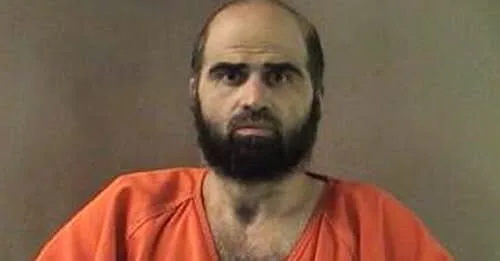
WASHINGTON, US, October 16, 2026 — US President Donald Trump has abandoned plans to broadcast the execution of former Army psychiatrist Nidal Hasan, backing away from a proposal that triggered criticism across the political divide and raised questions about whether military justice should be turned into a public spectacle.
Hasan’s execution by firing squad remains scheduled for December 3 at Fort Hood, Texas. The change concerns how the execution will be witnessed, not the death sentence itself, according to the US Army’s published schedule and Trump’s announcement. <Cite refs={["turn260498search1","turn260498search0"]}/>
Trump announced the reversal on Thursday, October 15, in a post on his Truth Social platform. He had earlier defended the proposed broadcast as a possible deterrent to terrorism.
“I think streaming the execution for all to see might have been a strong deterrent for the World to witness how America deals with Terrorists and SCUM like Hasan,” Trump wrote.
But he acknowledged that many people did not want to watch a person die. He then confirmed: “He will die, as scheduled, by firing squad, but this event will not be streamed.” <Cite refs={["turn260498search0","turn260498search7"]}/>
The decision followed mounting opposition from both Republicans and Democrats, as well as religious leaders and human rights advocates. Vice-President JD Vance had also expressed reservations, saying he would not watch the broadcast. <Cite refs={["turn260498news45","turn260498search11"]}/>
Pentagon plan sparks debate over public executions
The proposal was first announced by Defence Secretary Pete Hegseth, who argued that showing the execution would make clear the consequences of carrying out an attack of this kind.
The plan drew criticism because it went beyond the usual practice of allowing a limited number of witnesses to attend an execution. Broadcasting the killing would have made it accessible to a much wider audience and raised concerns about the dignity of the victims, the condemned man and the military justice system.
The United Nations was among those reported to have condemned the proposal. Critics also warned that a broadcast could risk turning a punishment into a spectacle rather than serving the stated aim of justice or deterrence. <Cite refs={["turn260498news44","turn260498search7"]}/>
Trump’s reversal also marked a shift from his earlier public support for the idea. The Pentagon said Hegseth had spoken with the president before the announcement and supported the final decision.
Sean Parnell, a Pentagon spokesman, said the defence secretary backed Trump’s position and that the two were aligned. <Cite refs={["turn260498news45","turn260498search2"]}/>
Trump has said the immediate families of the victims may attend the execution in person if they wish. The option is distinct from a public broadcast and leaves the families to decide whether they want to witness the event. <Cite refs={["turn260498search8","turn260498search0"]}/>
The 2009 Fort Hood attack
Hasan was convicted by a military jury in 2013 for the November 5, 2009, shooting at Fort Hood, then one of the deadliest attacks on US military personnel on a domestic military installation.
He killed 13 people and wounded 32 others when he opened fire inside a crowded medical facility where soldiers were undergoing checks before deployment. The victims included service members preparing to travel overseas.
During his court-martial, Hasan acknowledged carrying out the shooting and said he believed he was acting to protect Muslims and the Taliban in Afghanistan from the US military. The jury found him guilty of 13 counts of premeditated murder and 32 counts of attempted premeditated murder and sentenced him to death. <Cite refs={["turn260498search1","turn260498news45"]}/>
The Army said the death sentence had completed the required appeals process. The US Supreme Court declined to review Hasan’s conviction in March 2025. President Trump approved the death sentence on October 2, 2026, and the Army subsequently set December 3 as the execution date. <Cite refs={["turn260498search1"]}/>
If carried out, the execution would be the first by the US military since 1961. It would also mark a rare use of a firing squad in the modern US military justice system. <Cite refs={["turn260498search1","turn260498news45"]}/>
A wider argument about the death penalty
The dispute over the livestream has revived a broader debate about how governments carry out capital punishment and whether public exposure can ever be justified as a deterrent.
Amnesty International recorded at least 17 public executions worldwide in 2025: 11 in Iran and six in Afghanistan. The figures provide context for the criticism of the Pentagon’s proposal, although they do not establish whether public executions deter crime. <Cite refs={["turn260498search3"]}/>
For Hasan’s victims and their relatives, the case remains rooted in the loss and injuries caused by the 2009 attack. Trump has said the families can attend in person if they choose, while the government’s decision to cancel the livestream means the execution will not be broadcast to the general public.
The reversal settles the immediate question of whether the public will be able to watch the execution online. It does not end the debate over capital punishment, the use of firing squads or the role of public exposure in the administration of justice.
You may also like
Category: International
Related Video: Dolly Parton’s Family Announces Her Passing in Emotional Tribute
About the Author
Maureen Onyango is a journalist passionate about storytelling, life coaching and spiritual lessons. She studied at the Kenya Institute of Management and enjoys telling stories that inform, inspire and empower communities.
 Facebook
 Twitter / X
 WhatsApp
 LinkedIn
 Telegram
 Reddit