
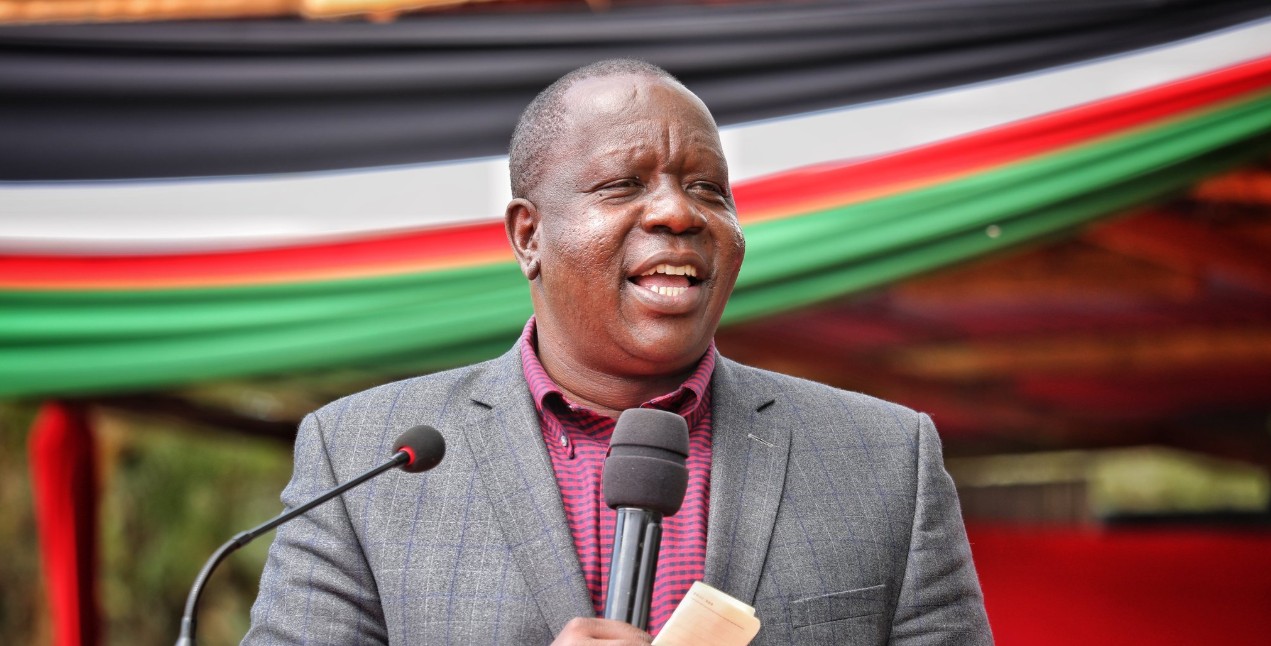
Former Interior Cabinet Secretary Fred Matiang’i has escalated his criticism of President William Ruto, alleging that the violence surrounding opposition activities in Homa Bay could not have happened without the knowledge of the country’s top security leadership.
Matiang’i, who is positioning himself for the 2027 presidential race, said his experience as a former Interior CS informed his assessment of the security situation. He stopped short of presenting evidence that directly links the President to the violence, but argued that the scale and coordination of the incidents warranted serious questions.
“It is now abundantly clear that the President and his government have chosen violence as a weapon for political survival and engagement,” Matiang’i said.
His remarks followed chaotic scenes during the Linda Mwananchi political rallies in Homa Bay on Sunday, where vehicles were attacked, property was damaged and journalists were among those assaulted. The National Cohesion and Integration Commission condemned the violence, while Amnesty International Kenya called for independent investigations into the reported attacks.
Matiang’i questions what security agencies knew
Speaking about the incidents, Matiang’i drew on his former role in government to question whether the security agencies could have been unaware of what was happening.
“From my experience, I want to tell Kenyans very sincerely. I do not think, and I cannot see how the scale of violence in Homa Bay and the activity that happened there could have happened without the knowledge of the National Security Council,” he said.
He added that the President receives security briefings and questioned how such incidents could unfold without reaching the highest levels of government.
Those are allegations, however, and Matiang’i did not provide evidence establishing that Ruto personally authorised or directed the violence.
The latest claims come after a weekend of political clashes that extended beyond Homa Bay. Matiang’i cited incidents involving his team in Mulot, confrontations involving opposition politicians in Nakuru and disturbances in Salgaa.
In Homa Bay, the violence became particularly serious. Reports indicated that a vehicle was torched, people were injured and arrests were made. Journalists covering the rally were also attacked and equipment was reportedly stolen.
NCIC and rights groups raise alarm
The violence has drawn concern beyond the political parties involved.
The National Cohesion and Integration Commission said the Homa Bay incidents were a worrying sign of growing political intolerance and warned that such behaviour threatens constitutional freedoms and national cohesion.
Amnesty International Kenya also called for prompt, independent and transparent investigations. It said the reported attacks affected political participation, media freedom, freedom of movement and public safety.
The developments are significant because Kenya is less than a year away from the 2027 General Election. Political rallies are already becoming a key arena for competing camps to test their strength.
Matiang’i warns of a dangerous political climate
Matiang’i said Kenya risked sliding into a more dangerous political environment if violence became normal during campaigns.
He described the country as being on a “final descent towards anarchy” and said political differences could not justify attacks on opponents or ordinary citizens.
“Political difference is not a good enough excuse to inflict the kind of loss and pain we have witnessed this weekend,” he said.
He also accused the government of what he called “digital terrorism”, alleging that opposition politicians were being targeted online.
Matiang’i further claimed that some opposition leaders had encountered vehicles fitted with signal-jamming equipment during rallies. He suggested that such equipment would require significant resources and questioned who could deploy it.
“I believe this is the work of the state because who else has the capacity to do that?” he asked.
Again, the claim has not been independently established.
The political stakes are rising
Matiang’i's intervention comes as opposition parties and political figures intensify preparations for the 2027 contest.
He has been endorsed by Jubilee as its presidential candidate, while other opposition figures are also seeking to build a coalition capable of challenging Ruto.
The President, meanwhile, has maintained that his administration is focused on development and has repeatedly called for political stability and an end to violence.
In a recent address, Ruto urged Kenyans to reject violence and said political differences should not be allowed to disrupt lives and economic activity.
The latest confrontation therefore goes beyond the competing accusations between politicians. It raises a broader question for the 2027 campaign: can Kenya's political parties compete aggressively without returning to the violence that has marred previous election cycles?
For now, Matiang’i says the opposition will consult on how to respond to what he describes as an increasingly hostile environment.
The government and security agencies will face growing pressure to establish what happened in Homa Bay, who was responsible and whether anyone in authority failed to act.
You may also like
Category: Politics · Related Topic: William Ruto
Related Video: What Dangote’s proposed Lamu oil refinery could mean for East Africa
About the Author
Maureen Onyango is a journalist passionate about storytelling, life coaching and spiritual lessons. She studied at the Kenya Institute of Management and enjoys telling stories that inform, inspire and empower communities.
 Facebook
 Twitter / X
 WhatsApp
 LinkedIn
 Telegram
 Reddit