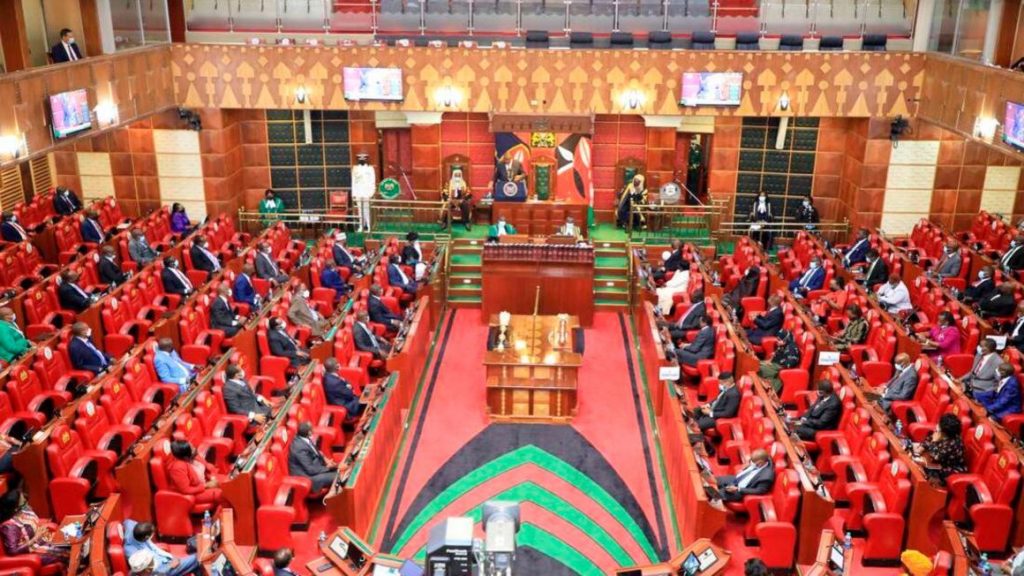
Kenyan families could get stronger protection from hospitals demanding deposits before emergency treatment or withholding loved ones’ bodies over unpaid bills, following reported approval of a proposed amendment by the National Assembly.
The proposed changes would make it an offence for public health facilities to demand advance payment before providing emergency medical care. They would also prohibit public hospitals from keeping the bodies of deceased patients as a way of recovering outstanding bills.
The Health (Amendment) Bill, 2024, sponsored by Kirinyaga Woman Representative Jane Njeri Maina, reportedly passed its third reading in the National Assembly on Wednesday, 11 November 2026.
If it completes the remaining legislative stages and becomes law, a person in charge of a public health facility who demands payment before providing emergency treatment could face a fine of up to KSh3 million.
A public health facility officer who authorises or allows the detention of a deceased person's body over unpaid bills could face a fine of up to KSh2 million.
The proposal addresses two problems that have repeatedly placed vulnerable families in difficult situations: being asked to find money before a critically ill relative receives urgent care, and being unable to collect a loved one's body for burial because of an outstanding hospital bill.
Emergency care before payment
The Bill seeks to strengthen the right to emergency medical treatment already recognised under Article 43(2) of the Constitution.
That provision states that no person should be denied emergency medical treatment. Section 7 of the Health Act also requires medical institutions capable of providing emergency care to do so.
The proposed amendments go further by explicitly addressing demands for advance payment.
They also seek to widen the definition of emergency care to include appropriate treatment at the scene of an incident, during transportation to a health facility and through the initial stages of hospital care.
The proposed penalties are significant, but the scope of the Bill is important. Its wording targets public health facilities and public-sector healthcare providers. It should therefore not be presented as a blanket ban covering every private hospital.
The distinction emerged during parliamentary consideration. In February 2026, Maina told MPs that the original proposal had sought to cover both public and private facilities, but discussions with the Health Committee resulted in the amendments being limited to public facilities.
She argued that this did not go far enough and urged lawmakers to consider stronger protection for all Kenyans.
Hospitals would need other ways to recover unpaid bills
The proposed ban on detaining bodies is also aimed at protecting the dignity of deceased patients and easing the burden on grieving families.
Families have sometimes faced delays in arranging burials because they could not settle hospital or mortuary bills. The proposed law would make it an offence for a person in charge of a public health facility to retain a body specifically to force payment.
However, the proposal does not mean medical bills would be cancelled or that hospitals would lose the right to recover money owed to them.
Instead, facilities would have to pursue lawful ways of recovering outstanding fees without using emergency treatment or the release of a body as pressure.
The issue has also attracted attention from the courts. Kenyan courts have previously questioned the legality of hospitals detaining patients over unpaid bills, while Parliament has acknowledged that the practice involving deceased persons continues despite legal concerns.
Kitutu Masaba MP Clive Ombane Gisairo welcomed the reported passage of the Bill, describing it as an important step towards protecting patients and families.
“The exploitation of vulnerable patients in both public and private hospitals will soon be a thing of the past under the proposed reforms in the health sector,” Gisairo said.
He added that the proposed changes would help ensure that patients receive emergency care and that families are not prevented from collecting deceased relatives because of unpaid medical bills.
His reference to both public and private hospitals should, however, be read alongside the actual wording of the Bill, which focuses on public facilities.
What happens next?
The National Assembly's reported approval does not automatically make the proposed changes law.
The Bill must complete the remaining constitutional legislative process, including consideration by the Senate where required, before it can be presented to President William Ruto for assent.
Until it is enacted, the proposed new offences and penalties cannot be treated as provisions already in force.
For patients and families, the debate goes beyond the proposed fines. It raises a fundamental question about how hospitals can recover the money they are owed without making access to urgent treatment or the dignity of the deceased dependent on a family's ability to pay immediately.
You may also like
Category: Health
Related Video: Dolly Parton’s Family Announces Her Passing in Emotional Tribute
Related Explainer: Ebola contact tracing: Why the 21-day window matters in Kenya’s response
About the Author
Maureen Onyango is a journalist passionate about storytelling, life coaching and spiritual lessons. She studied at the Kenya Institute of Management and enjoys telling stories that inform, inspire and empower communities.
 Facebook
 Twitter / X
 WhatsApp
 LinkedIn
 Telegram
 Reddit