
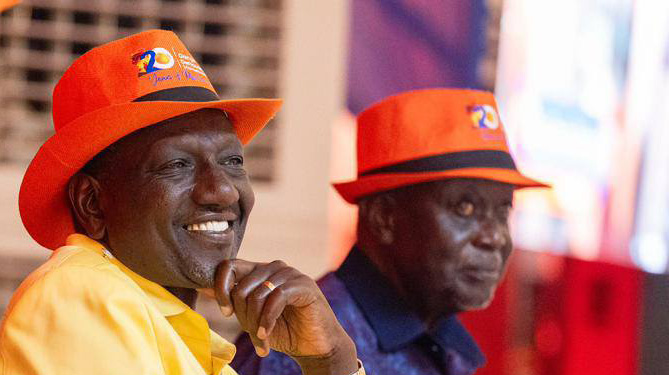
The Broad-Based Government is still struggling to win over a majority of Kenyans, with more respondents opposing the political arrangement than supporting it, a new TIFA Research poll has found.
The survey, released on Thursday, November 12, shows that 43 per cent of Kenyans oppose the partnership between President William Ruto’s United Democratic Alliance (UDA) and the Orange Democratic Movement (ODM).
Only 32 per cent said they support it.
But the figures also reveal a more complicated picture. Opposition has eased, yet support has barely moved. A further 25 per cent of respondents either had no opinion about the arrangement or said they were unaware of it.
The findings suggest that while resistance to the political deal may be losing some intensity, the partnership has not convinced a wider section of the public.
The latest figures mark a nine-percentage-point drop in opposition from the 52 per cent recorded in TIFA’s previous survey. Support has risen by just two points, from 30 to 32 per cent.
Northern Kenya and Central Rift lead support
The national figures hide sharp regional differences.
Northern Kenya recorded the strongest backing for the Broad-Based Government, with 68 per cent of respondents supporting the arrangement. Central Rift followed at 57 per cent.
Nyanza, which has traditionally been an important ODM political base, recorded 38 per cent support.
Western Kenya registered 37 per cent, while South Rift and the Coast recorded 26 and 25 per cent respectively.
Support was weakest in Mt Kenya, where only 12 per cent backed the arrangement. Nairobi followed at 13 per cent, while Lower Eastern recorded 21 per cent.
The results show that the partnership enjoys considerably stronger support in some regions than others. They also suggest that the political benefits of the UDA-ODM arrangement have not translated into uniform public acceptance across the country.
The low support in Mt Kenya and Nairobi is particularly notable as the government heads towards the 2027 General Election.
Opposition is falling, but support remains limited
TIFA’s latest findings show a gradual reduction in the proportion of Kenyans opposed to the Broad-Based Government.
Opposition has fallen from 56 per cent to 52 per cent and now stands at 43 per cent, according to the survey trend presented by the research firm.
However, support has remained below one-third in most of the surveys tracked by TIFA. November 2025 was the notable exception, when backing for the arrangement reached 44 per cent.
The latest increase to 32 per cent therefore represents a modest recovery rather than a major shift in public opinion.
The proportion of respondents who either had no opinion or were unaware of the arrangement has also returned to 25 per cent, the same level recorded in May 2025.
TIFA said the reasons behind the increase in this group were not clear.
That figure matters because it shows that a sizeable section of the population has not settled on a position. It also means the political arrangement has a potential audience it has yet to persuade, rather than simply a fixed bloc of supporters and opponents.
A political test for the UDA-ODM partnership
The Broad-Based Government emerged from an agreement between Ruto and the late former Prime Minister Raila Odinga in March 2025.
The deal followed the 2024 Gen Z-led protests and was built around a ten-point reform agenda. It brought ODM figures into government and created a working political relationship between the ruling UDA and the opposition party.
The arrangement was presented as a way to promote national unity, political stability and the implementation of agreed reforms.
However, it has also faced criticism from Kenyans who believe the cooperation has weakened the opposition’s ability to hold the government accountable.
The latest poll does not establish why individual respondents support or oppose the arrangement. It does, however, show that the partnership remains more contested than accepted.
The challenge for both parties is likely to grow as the 2027 election approaches. ODM will have to navigate its relationship with the government while responding to members and supporters who want the party to maintain a distinct opposition identity.
For UDA, the figures suggest that cooperation with ODM has not yet translated into widespread public approval of the arrangement.
What the survey tells us
TIFA conducted the latest survey between October 26 and November 5, 2026, through face-to-face household interviews with 2,036 adults aged 18 and above across the country.
The sample covered nine regions: Central Rift, Coast, Lower Eastern, Mt Kenya, Nairobi, Northern Kenya, Nyanza, South Rift and Western.
Interviews were conducted mainly in Kiswahili, with some in English. TIFA reported a margin of error of plus or minus 2.16 percentage points, although the margin is higher for smaller sub-groups.
The results provide a snapshot of public opinion during the survey period. They do not predict how Kenyans will vote in 2027.
For now, the message is clear: opposition to the Broad-Based Government is declining, but the arrangement has yet to secure widespread public backing. With a quarter of respondents still undecided or unaware, the political contest over its future is far from settled.
You may also like
Category: Politics · Related Topic: William Ruto
Related Video: What Dangote’s proposed Lamu oil refinery could mean for East Africa
Related Explainer: Kenya G-to-G Oil Deal Explained: How It Works, Who Supplies the Fuel and Why It Is Controversial
About the Author
Maureen Onyango is a journalist passionate about storytelling, life coaching and spiritual lessons. She studied at the Kenya Institute of Management and enjoys telling stories that inform, inspire and empower communities.
 Facebook
 Twitter / X
 WhatsApp
 LinkedIn
 Telegram
 Reddit