
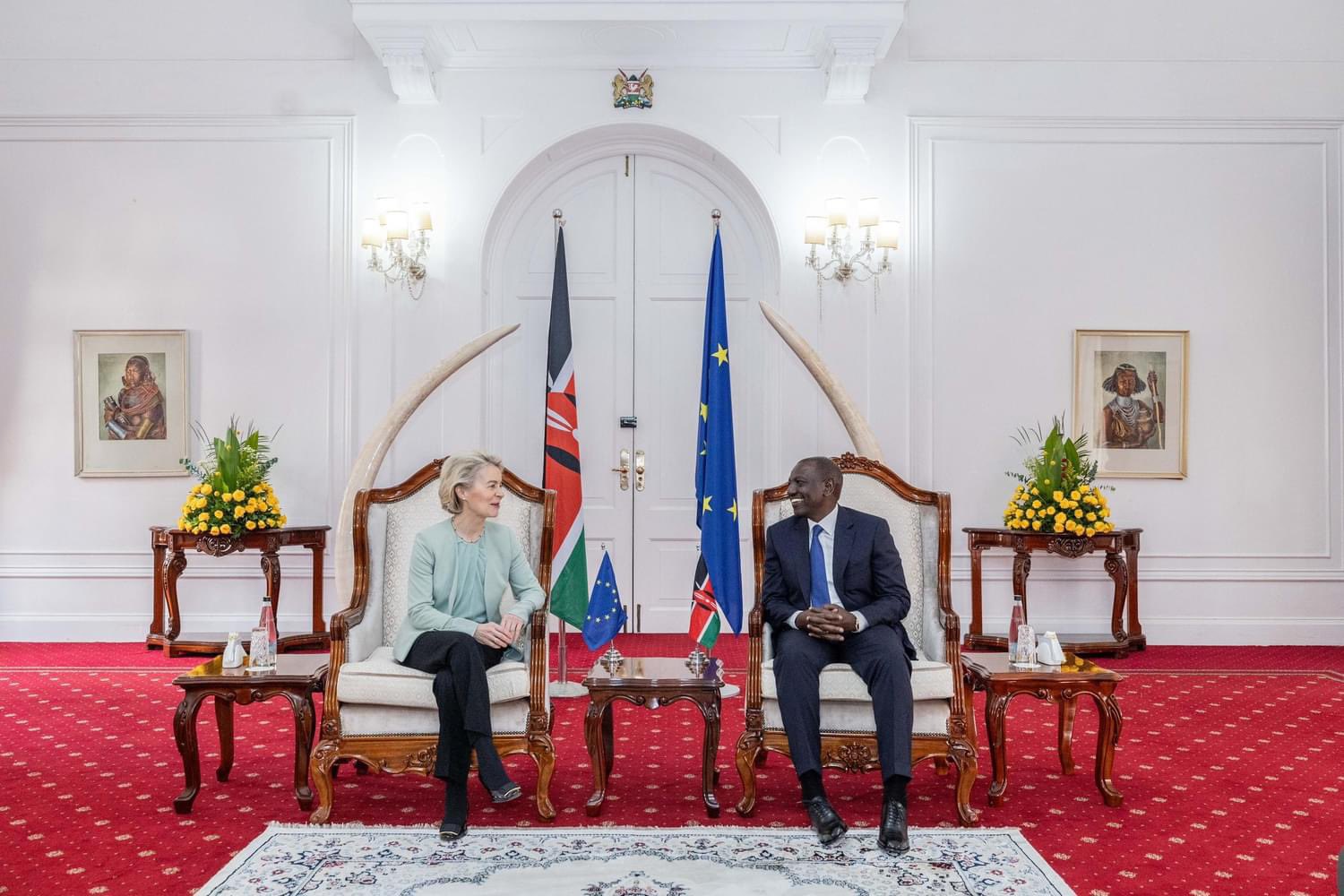
President William Ruto wants Kenya’s 50-year relationship with the European Union to deliver more than diplomatic goodwill, with his government seeking stronger trade, investment and security ties with the bloc.
Speaking on Thursday, November 12, after meeting heads of EU delegations to African countries at State House in Nairobi, Ruto said Kenya and the EU had agreed to work towards a comprehensive strategic partnership.
The proposed arrangement would place greater emphasis on economic opportunities, regional security, democratic governance and sustainable development.
The announcement comes as Nairobi hosts senior European diplomats for discussions on the future of relations between Africa and Europe.
Ruto said the relationship should be guided by respect for international law, multilateral cooperation and shared democratic principles.
But the economic stakes are particularly significant for Kenya.
Trade deal puts exporters in the spotlight
The EU accounts for about 21 per cent of Kenya’s global exports, making it one of the country’s most important overseas markets, according to figures cited by the President.
Ruto said the government wanted to turn the existing Economic Partnership Agreement (EPA) into greater opportunities for Kenyan businesses.
“We are committed to translating the Economic Partnership Agreement into greater trade and investment opportunities, while addressing barriers facing our exporters, particularly smallholder producers,” he said.
The agreement, which took effect on July 1, 2024, gives Kenyan goods duty-free and quota-free access to the EU market.
It also includes provisions covering workers’ rights, gender equality, environmental protection and climate action.
For Kenyan producers, however, access to the European market is only part of the challenge. Meeting market requirements, maintaining quality standards and managing the costs of exporting can determine whether small businesses and farmers benefit from the agreement.
That is why Ruto's emphasis on removing barriers facing smallholder producers is important. The test will be whether the proposed cooperation translates into better market access, stronger local businesses and more income for producers.
Kenya’s Foreign Affairs Principal Secretary Korir Sing’oei said earlier this week that trade between Kenya and the EU had grown by about 20 per cent since the EPA came into force. He also pointed to horticulture, particularly flowers, as an important source of jobs and livelihoods.
EU defence support and regional security
Security cooperation was another key issue during the State House meeting.
Ruto welcomed the EU’s support for African Union-led peace and security operations, including efforts in Somalia.
He also highlighted a €20 million contribution through the European Peace Facility to strengthen the Kenya Defence Forces.
The support is significant, but it is not a fresh funding package announced for the first time this week. The Council of the European Union approved the €20 million assistance measure in June 2024.
The package is intended to improve the operational capacity of the KDF, including its ability to protect border areas and respond to security threats linked to al-Shabaab.
It covers equipment, supplies and training. The approved support includes tactical drones, equipment to counter improvised explosive devices, military vehicles and medical facilities. The Kenya Navy is also set to receive protective and night-vision equipment.
The renewed focus on security reflects Kenya’s position as a key regional player in the Horn of Africa, where instability, terrorism and maritime security remain major concerns.
A relationship moving beyond traditional aid
The 50-year milestone offers an opportunity for both sides to redefine what they expect from the partnership.
The EU established its diplomatic presence in Nairobi in 1976. Over the years, cooperation has expanded from development assistance into trade, investment, climate action, education, technology and security.
EU Ambassador to Kenya Andreas Peschke said in an October interview that the two sides wanted to move away from a traditional donor-recipient relationship towards one based on mutual interests and investment.
He said trade between Kenya and the EU was worth about €3 billion annually, with both sides aiming to double that figure within five years.
The EU has also identified investment, youth engagement and stronger people-to-people links as priorities for the next phase of cooperation.
For Kenya, the challenge will be ensuring that the relationship produces measurable benefits at home, including jobs, investment, stronger exports and opportunities for local businesses.
Ruto’s announcement signals an ambition to deepen the partnership. Whether it becomes a comprehensive strategic arrangement with clear commitments and timelines will be an important measure of what the next 50 years deliver.
You may also like
Category: Business · Related Topic: William Ruto
Related Video: What Dangote’s proposed Lamu oil refinery could mean for East Africa
About the Author
Maureen Onyango is a journalist passionate about storytelling, life coaching and spiritual lessons. She studied at the Kenya Institute of Management and enjoys telling stories that inform, inspire and empower communities.
 Facebook
 Twitter / X
 WhatsApp
 LinkedIn
 Telegram
 Reddit