
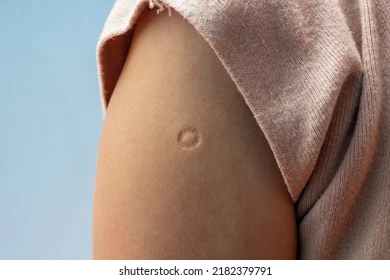
For millions of Kenyans, it is one of the clearest reminders of childhood.
A small, round scar sits on the upper arm. Some people have carried it for decades without giving it much thought.
But why does the BCG vaccine leave a permanent mark when most childhood injections leave little or no visible trace?
The answer lies in where and how the vaccine is given.

BCG, short for Bacille Calmette-Guérin, is the vaccine used to protect young children against the most severe forms of tuberculosis (TB).
In Kenya, it is part of the routine childhood immunisation programme and is given at birth. Ministry of Health guidance specifies an intradermal injection into the left forearm.
Unlike vaccines injected into muscle, BCG is placed directly into the skin.
That is what sets off the distinctive reaction.
What happens after the injection?
The BCG reaction does not usually appear as a scar immediately.
A small raised area can develop at the injection site. Over the following weeks, it may become a small sore or ulcer.
The area then heals gradually.
WHO says the local reaction can take several months to settle, eventually leaving a small, superficial scar.
So the mark that remains on the arm is not the result of a mistake by the person who administered the vaccine.
It is generally part of the expected response to BCG.
The size and appearance of the scar can vary. Factors include the BCG strain used and differences in injection technique.
Does everyone who receives BCG get a scar?
No.
This is one of the most important points about the familiar mark.
WHO says approximately 10 per cent of people who receive BCG do not develop a visible scar.
That means the absence of a scar does not automatically mean that someone missed the vaccine or that the vaccine did not work.
Studies cited by WHO have also found immune responses among some children who did not develop a scar after vaccination.
A scar can therefore provide a useful clue when vaccination records are unavailable, but it should not be treated as a medical test of immunity.
Does a bigger scar mean better protection?
Not necessarily.
The BCG scar is not a measure of the level of protection against tuberculosis.
WHO specifically notes that scar formation is not a marker of protection.
That means comparing scars — whether by size, darkness or shape — cannot tell you who is better protected against TB.
The same applies to someone with no visible scar.
The presence or absence of the mark cannot, on its own, establish whether the vaccine has provided protection.
So what does BCG actually protect against?
This is another common misunderstanding.
BCG does not provide complete protection against every form of tuberculosis.
Its strongest benefit is in protecting babies and young children against severe forms of TB, including TB meningitis and widespread, or miliary, tuberculosis.
Protection against pulmonary TB later in life is more variable.
WHO continues to recommend BCG vaccination for infants in countries where TB is highly endemic because of its protection against severe childhood disease.
That distinction matters.
Someone can have a BCG scar and still develop TB.
The scar does not mean a person can never contract the disease.
Why is the vaccine given so early?
Young children are particularly vulnerable to severe TB if they become infected.
TB can affect the lungs, but it can also spread to other parts of the body, including the brain and spine.
TB meningitis is especially dangerous in young children.
The BCG vaccine therefore provides an important layer of protection early in life, when the consequences of infection can be particularly serious.
That is why WHO recommends a single BCG dose for infants living in areas with a high TB burden.
What if the scar looks unusual?
Most BCG reactions are mild and settle without treatment.
However, WHO notes that complications such as an abscess, excessive ulceration or significant swelling of nearby lymph nodes can occur, although serious complications are uncommon.
A persistent, unusually large or worsening lesion should therefore be assessed by a health professional rather than assumed to be a normal BCG scar.
Parents should also avoid squeezing, scratching or otherwise interfering with the healing vaccination site.
The small scar has a bigger story
For many Kenyans, the BCG mark is simply something they have had since infancy.
It is often used informally as proof that someone received their childhood TB vaccine.
But medically, the scar tells only part of the story.
It is the visible result of a local reaction to a vaccine that is designed to protect children from some of the most dangerous forms of tuberculosis.
It does not tell us how strongly a person is protected.
And a missing scar does not automatically mean that the vaccination was unsuccessful.
In other words, that little circle on the arm is a reminder of a childhood vaccine — not a lifelong TB immunity certificate.
You may also like
Category: Explainers
Related Video: Dolly Parton’s Family Announces Her Passing in Emotional Tribute
Related Explainer: Fact Check: Did elephants save people during Nepal’s floods?
About the Author
Maureen Onyango is a journalist passionate about storytelling, life coaching and spiritual lessons. She studied at the Kenya Institute of Management and enjoys telling stories that inform, inspire and empower communities.
 Facebook
 Twitter / X
 WhatsApp
 LinkedIn
 Telegram
 Reddit