
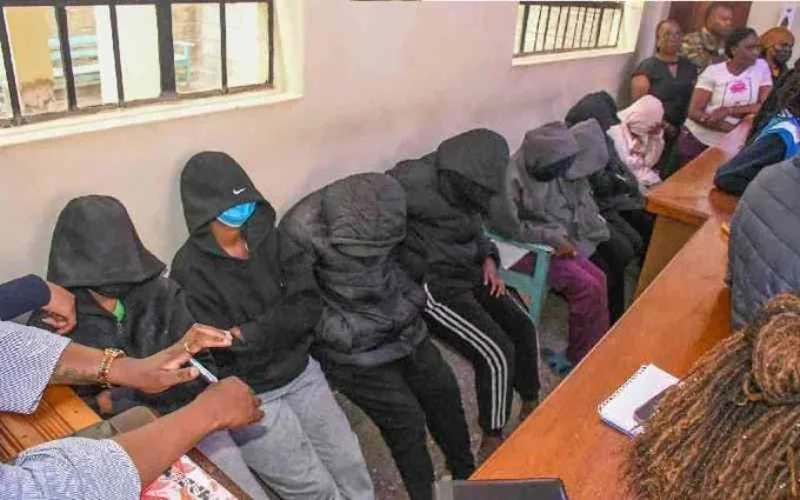
Seven of the eight minors charged over the deaths of 16 students in the Utumishi Girls Academy dormitory fire are now involved in plea-bargaining discussions with prosecutors, as the High Court pushes for the case to move forward.
But the negotiations remain unsettled. The prosecution has rejected some proposals, including a request to have three of the minors become prosecution witnesses, and says other applications are still awaiting consideration by the Director of Public Prosecutions.
The latest developments emerged during a court session before Justice Diana Kavedza at the Kibera High Court on Thursday, November 12.
The judge gave the parties until December 15, 2026, to make progress and present any written agreements reached.
“We give you one month to see how far we have gone,” Justice Kavedza told the parties.
The deadline sets up another important stage in a case that has drawn national attention since the May 2026 fire, which killed 16 students and left 79 others injured.
Three minors proposed as prosecution witnesses
One of the main disagreements concerns a proposal to have three of the accused children, identified in court as Subjects 5, 6 and 8, converted into prosecution witnesses.
The State told the court that it was not satisfied with the terms proposed for their participation as witnesses and would not accept the requests in their current form.
Other minors have expressed interest in pleading guilty, but their applications are at different stages.
The prosecution said some proposals had been rejected, while others remained under review. At least one request was awaiting a response from the ODPP, with another requiring approval from the Director of Public Prosecutions.
The State also maintained its opposition to plea negotiations involving Subject 1, saying it wanted the minor to remain in the proceedings as an accused person.
The discussions therefore do not amount to a blanket agreement between the prosecution and the seven minors. Each proposal is being considered separately, and the parties have yet to confirm which, if any, will result in formal agreements.
Plea talks do not mean the case is over
The latest development follows earlier reports that two of the minors had sought plea-bargaining arrangements in October.
At the time, the ODPP confirmed receiving a formal request concerning one child, while another defence lawyer said a similar request had been submitted on behalf of a client.
The fact that seven minors are now reportedly involved in discussions marks a significant expansion of the negotiations.
However, seeking a plea agreement is not the same as admitting guilt. A plea bargain must be negotiated in accordance with the law, reduced to a formal agreement and presented to the court for consideration.
The court must establish that the process is lawful and that the accused understands the consequences. The involvement of children also makes their welfare, legal representation and informed participation particularly important.
If no acceptable agreements are reached, the murder proceedings remain open to continue through the ordinary trial process.
Judge raises concern over access to parents and lawyers
Beyond the negotiations, Justice Kavedza raised questions about whether the minors were receiving adequate access to their parents and legal representatives while being held at Kamae Borstal Institution.
The judge asked about arrangements for family visits, particularly whether parents were able to see the children regularly.
The prosecution said it had not received reports suggesting that the minors were being denied access to their families.
The judge declined to impose fixed visiting dates, citing security considerations and the need to protect the children's identities and welfare. Instead, she directed that visits be arranged flexibly while ensuring the minors could maintain contact with their families.
The issue is important because the children need opportunities to consult their lawyers and parents as they consider decisions that could have lasting consequences for their futures.
In October, the court had already directed that parents be allowed two enhanced visits per month, in coordination with the institution holding the minors.
The case behind the negotiations
The eight minors face murder charges arising from the fire that broke out at Utumishi Girls Academy in Gilgil, Nakuru County, on the night of May 27 and into May 28, 2026.
Sixteen students died in the blaze, while 79 others were injured.
The eight children pleaded not guilty when they appeared before the High Court in July. They were later denied bail, with the court citing concerns about their safety, welfare and the integrity of the proceedings.
The government had earlier said preliminary investigations pointed to arson, but the criminal charges against the minors remain allegations that must be proved in court unless lawfully resolved through an approved plea agreement.
The tragedy also raised wider questions about school safety. Education Cabinet Secretary Julius Ogamba said investigations had identified failures by the school to meet safety requirements under the School Safety Manual and Basic Education Regulations.
Those concerns remain important beyond the criminal case, which is focused on the responsibility of the accused children.
December 15 becomes the next key date
The court now expects the prosecution and defence teams to return on December 15 with an update on the negotiations and any written agreements reached.
The outcome could determine whether some of the accused children resolve their cases through plea agreements or whether the proceedings move towards a full trial.
For the families of the 16 students who died, the negotiations are another step in a long wait for answers and accountability.
For the accused children, the process carries equally serious consequences. Any agreement must be reached lawfully, with their rights and welfare protected.
Until the court approves any agreement or delivers a verdict, all eight remain accused persons and the charges have not been proved
You may also like
Category: News
Related Video: The tears of a mother - nothing was wrong with my daughter, how did she DlE in school?
Related Explainer: Ebola contact tracing: Why the 21-day window matters in Kenya’s response
About the Author
Maureen Onyango is a journalist passionate about storytelling, life coaching and spiritual lessons. She studied at the Kenya Institute of Management and enjoys telling stories that inform, inspire and empower communities.
 Facebook
 Twitter / X
 WhatsApp
 LinkedIn
 Telegram
 Reddit