
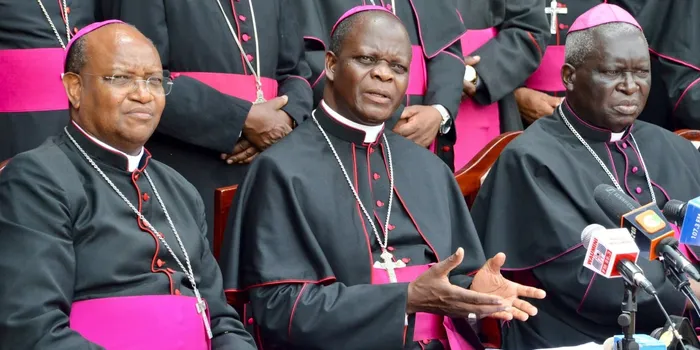
Kenya’s Catholic bishops have ordered priests to stop politicians from using church services to campaign, while challenging Parliament to protect public access to presidential election results ahead of the 2027 General Election.
The Catholic Church in Kenya has drawn a firm line against political campaigning in its places of worship, warning politicians that churches will not be available as platforms for soliciting votes.
The Kenya Conference of Catholic Bishops (KCCB) issued the directive on Thursday, November 12, instructing Catholic priests across the country to ensure that no political addresses are delivered in their churches.
The bishops said politicians have other ways of reaching voters, including public meetings, media interviews and roadside rallies.
“We are therefore reiterating and directing that there shall be no political addresses given in any of our Catholic churches in any part of the country,” the bishops stated.
They also instructed priests to enforce the position with the seriousness it deserves.
The directive comes as political activity gathers pace ahead of the 2027 General Election, with politicians increasingly seeking public platforms to communicate their ambitions and win support.
Church wants worshippers protected from political pressure
The bishops said churches must remain places where Kenyans can worship together regardless of their political affiliations.
Their concern is that political speeches during church gatherings can create divisions among congregations and turn religious occasions into opportunities for political mobilisation.
In remarks reported during the bishops’ press briefing in Embu, Archbishop of Nyeri Anthony Muheria said people from opposing political camps should be able to attend the same place of worship without being treated as political rivals.
He maintained that churches should offer spiritual nourishment and a sense of peace, rather than expose worshippers to partisan messaging.
The position does not prevent politicians from attending church services as worshippers. It targets political addresses and campaign activity within Catholic churches.
The bishops also urged political aspirants and their supporters to avoid inflammatory language as campaigns intensify. They called on candidates to demonstrate civility and respect for those with different political views.
Bishops turn attention to election transparency
Beyond the church directive, the bishops raised concerns about proposed changes to electoral laws, particularly provisions touching on the public livestreaming of presidential election results.
They warned that reforms which restrict access to election information could undermine public confidence in the 2027 polls.
The bishops urged Senate Speaker Amason Kingi and National Assembly Speaker Moses Wetang’ula to guard against legislation that could weaken transparency.
They argued that Kenyans should be able to follow the electoral process and access information about how votes are counted and reported.
The debate over livestreaming has already generated political and public disagreement.
In October, concerns emerged after the National Assembly considered amendments to the Elections Act that were seen as potentially removing the requirement for the Independent Electoral and Boundaries Commission (IEBC) to livestream results.
However, the legal position has since been clarified.
A High Court ruling delivered on September 22, 2026, upheld the relevant provisions of Section 39 of the Elections Act, including the requirement for the IEBC to establish a mechanism for livestreaming results announced at polling stations.
The provision states that livestreamed results are for public information and are not themselves the basis on which the Commission declares the final presidential result.
The National Assembly and Government Spokesperson Charles Owino have also maintained that the parliamentary amendments did not abolish the existing livestreaming requirement.
The bishops’ warning is therefore best understood as a call to protect and strengthen transparency, rather than evidence that a ban has already become law.
IEBC faces pressure to earn public confidence
The bishops also called on the IEBC to prepare thoroughly for the next election, including clear procedures for voter registration, election logistics, training of officials, protection and verification of results, and the management of political party agents.
They urged the Commission to communicate regularly with the public and resist political interference.
The clergy said the credibility of an election depends not only on the final announcement but also on whether voters trust the process that produces the result.
They further called on the Judiciary to handle election-related disputes fairly and without favour.
Voters urged to make informed choices
The bishops also challenged Kenyans to examine the performance of their current leaders before deciding who deserves another term or a new mandate.
They warned voters against allowing the noise of political campaigns, ethnic loyalties or personal interests to cloud their judgement.
“The noise that pollutes the air during political campaigns must not block our individual discernment of who is best suited to represent and lead us,” the bishops stated.
They also appealed to young people to obtain national identity cards and register as voters ahead of the election.
The clergy cautioned against political actors who might offer money to recruit young people into violence or electoral malpractice, urging them to use their influence to promote peace and justice instead.
With the 2027 elections approaching, the bishops’ message places responsibility on politicians, electoral institutions, Parliament and voters alike.
Their central appeal is that churches should remain places of worship, while the electoral process should remain open enough for Kenyans to trust the results.
You may also like
Category: News · Related Topic: 2027 Elections
Related Video: Murkomen Says Kenya Is Safe: “Stop Creating a Crisis” | Political Goons & Security Under Scrutiny
About the Author
Maureen Onyango is a journalist passionate about storytelling, life coaching and spiritual lessons. She studied at the Kenya Institute of Management and enjoys telling stories that inform, inspire and empower communities.
 Facebook
 Twitter / X
 WhatsApp
 LinkedIn
 Telegram
 Reddit