
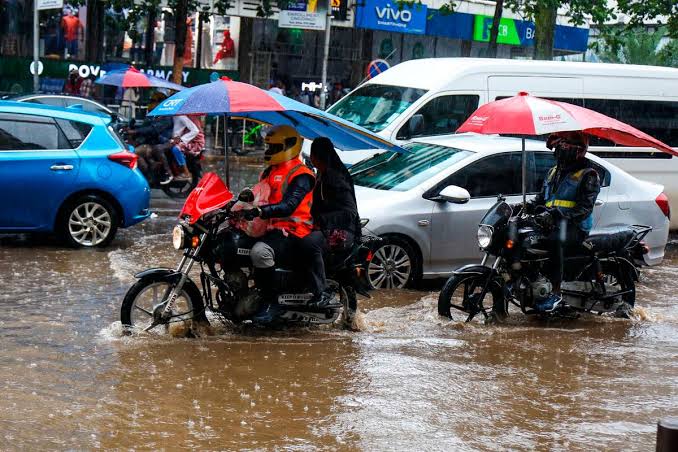
Kenya’s expected El Niño rains have yet to reach some areas in full, but the weather service says November is still the key month and much of the country could receive the forecast rainfall before the month ends.
Residents of Nairobi and other parts of Kenya waiting for the heavy rains predicted for the October–December season may have to be patient.
The Kenya Meteorological Service Authority says the delayed rainfall does not necessarily mean the forecast has failed. Instead, the amount and timing of rain depend on several climate systems working together, not El Niño alone.
Speaking during an interview on Spice FM on Wednesday, 11 November, Eastern Region Meteorological Services Deputy Director Richard Muita explained that El Niño is a climate pattern that influences weather around the world. It does not, by itself, produce rain everywhere.
“We need to understand what El Niño is. It is one of the factors causing changes in weather around the globe. We have not received rainfall as forecast because El Niño is just a factor that drives rainfall patterns across the world, and it is not rainfall itself; that should be clearly distinguished,” Muita said.
His remarks come amid growing questions from Kenyans, particularly in Nairobi, about why some areas have experienced limited rainfall despite warnings of an unusually wet season.
However, Muita offered a more immediate indication of what could happen next. He said November is the peak month of the October–December short rains and that much of the country could receive the expected rainfall before the month ends.
“By the end of November, we should have seen possibly much of the country achieved what we predicted. However, some areas have almost achieved that,” he said.
Why El Niño has not brought the same rains everywhere
Muita pointed to the Indian Ocean Dipole (IOD) as one of the other major factors shaping rainfall in East Africa.
While El Niño develops in the Pacific Ocean, the IOD is driven by differences in sea temperatures across the Indian Ocean. Its positive and negative phases can influence how moisture and weather systems move towards the region.
When El Niño coincides with favourable Indian Ocean conditions, Kenya is more likely to experience enhanced rainfall. But the interaction between the two systems can produce different outcomes depending on their strength and timing.
Muita cited 2015 as an example of a year when strong El Niño conditions did not translate into the level of rainfall many might have expected in Kenya.
He said the country was facing a comparable situation, although seasonal forecasts and actual rainfall patterns can still change as the season progresses.
The broader regional forecast had also pointed to wetter-than-normal conditions. In August, the IGAD Climate Prediction and Applications Centre (ICPAC) said El Niño and an expected positive Indian Ocean Dipole increased the likelihood of enhanced rainfall across much of the Greater Horn of Africa. It also warned that the onset of rain would vary across the region.
What Kenya Met had forecast for November
Kenya Met's October–December seasonal outlook, released on 31 August, projected above-average rainfall in 43 counties, including Nairobi, Kisumu, Mombasa, Kiambu, Nakuru, Machakos and Meru.
The department also expected above-average rainfall across much of West Pokot, Samburu and Marsabit, while parts of Turkana and the three northern counties were forecast to receive near-average to above-average rainfall.
Its November monthly forecast, issued on 30 October, maintained the expectation of above-average rainfall across most of the country. It also warned of possible flash floods, riverine flooding, landslides and damage to infrastructure.
The forecast does not mean every county will receive the same amount of rain. Nor does it guarantee that rainfall will be evenly spread throughout the season.
That distinction matters for farmers making planting decisions, households relying on rain-fed water supplies and communities in areas vulnerable to flooding.
Flooding already reported in some areas
While parts of Nairobi have been waiting for more consistent rainfall, other parts of the country have already experienced damaging downpours.
Flooding has affected communities in Tana River and Lamu counties. The Star reported on 30 October that hundreds of households had been displaced in Tana Delta after dams overflowed, with the Kenya Red Cross reporting thousands of households affected.
The contrast shows why the national forecast needs to be read alongside local weather updates. Some communities are dealing with excess water, while others are still waiting for enough rain.
FEWS NET's October 2026 food security outlook also warned that heavy rainfall and flooding could disrupt markets and humanitarian operations in parts of eastern Kenya, even as improved rains support recovery in other areas.
Muita urged Kenyans not to assume that the absence of heavy rain in one location means the entire country will miss the season.
The public has been encouraged to keep monitoring Kenya Met's daily, five-day and seven-day forecasts, as well as county-specific advisories.
For now, the message from the weather service is that the short rains season is still unfolding. November remains a critical period, and the next few weeks will provide a clearer picture of how closely actual rainfall matches the forecast.
You may also like
Category: News
Related Video: How a tweet cost Idris Mukhtar a job with CNN | Globe Traktion Ep# 11
Related Explainer: Kiharu Technical College September Intake 2026: Courses, Skills and New Opportunities
About the Author
Maureen Onyango is a journalist passionate about storytelling, life coaching and spiritual lessons. She studied at the Kenya Institute of Management and enjoys telling stories that inform, inspire and empower communities.
 Facebook
 Twitter / X
 WhatsApp
 LinkedIn
 Telegram
 Reddit