
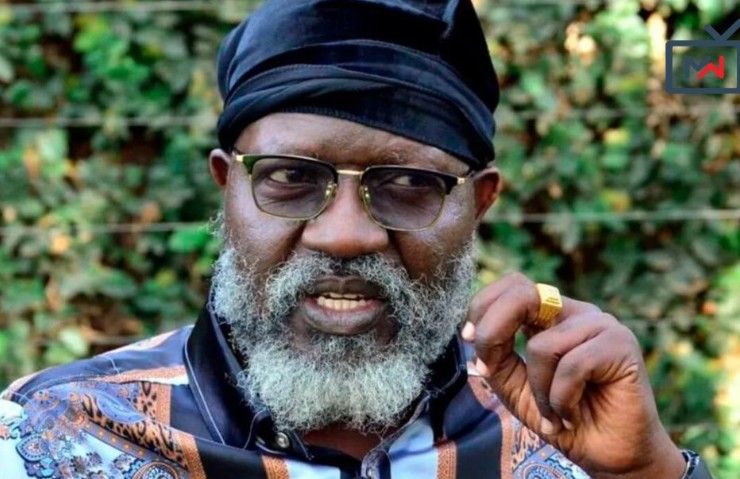
Roots Party leader George Wajackoyah is once again putting cannabis legalisation at the centre of his political message, arguing that Kenya could unlock new economic opportunities by allowing farmers to grow and process the crop.
In an interview with a local radio station on Tuesday, 10 November, Wajackoyah said he intends to contest the 2027 presidential election. He said he was holding back a fresh formal announcement while rival political camps continue their preparations.
“I will vie for the presidency next year, but I have not announced yet. I want first people to fight each other… then I come out,” he said.
However, this is not the first time Wajackoyah has declared his intention to run. In May, he said he would seek the presidency under the Roots Party ticket. He repeated the commitment in August, saying he was campaigning at grassroots level.
The latest interview has instead brought renewed attention to the economic proposal that made him one of the most talked-about candidates in the 2022 election: legalising bhang cultivation and developing an industry around hemp products.
Wajackoyah said Kenyans dismissed the idea during his previous campaign without appreciating the range of products that can be made from the plant. He pointed to possible uses in clothing, construction, manufacturing and medicine, and argued that Kenya should consider the crop as an agricultural investment.
He also suggested that large-scale production could take place in parts of western Kenya and the Gusii region. Among his proposals was setting aside 200,000 acres of the Galana-Kulalu irrigation project for cultivation.
But turning that proposal into policy would require more than identifying suitable farmland. Kenya would need a clear legal framework, scientific assessment of the crop’s suitability, investment in processing facilities and evidence that farmers could access reliable markets.
What the law says about cannabis farming
Under Kenya’s Narcotic Drugs and Psychotropic Substances (Control) Act, the cannabis plant is listed among prohibited plants. The law defines a cannabis plant broadly as a plant of the cannabis genus and makes unauthorised cultivation an offence. Section 6 provides for a fine, imprisonment of up to 20 years, or both, for cultivating a prohibited plant.
That makes the distinction between industrial hemp and cannabis for recreational use a central issue in Wajackoyah’s proposal. Hemp is grown for materials such as fibre and seeds, while other cannabis varieties may be cultivated for their psychoactive compounds. Any plan to commercialise hemp in Kenya would therefore need to explain how cultivation would be regulated, licensed and monitored.
There is a legitimate industrial case to examine. Hemp fibre can be used in textiles and other manufactured products, while hemp-based materials have applications in construction. But the existence of these uses does not, on its own, establish that the crop would be profitable at the scale Wajackoyah is proposing.
Claims about medicine and global industries need evidence
Some of the claims made during the interview require particular caution.
Wajackoyah alleged that Pfizer’s COVID-19 medicine was made from hemp and linked the crop to cancer treatment in India. Pfizer’s published ingredient information for its Comirnaty COVID-19 vaccine lists messenger RNA, lipids, cholesterol, tromethamine and sucrose. It does not list hemp as an ingredient.
Cannabis-derived compounds are being studied for certain medical uses, but that is not proof that hemp treats cancer or that cancer medicines across southern Africa are generally manufactured from the crop. Such claims require specific clinical and pharmaceutical evidence.
His other assertions — including that hemp underpins most of Israel’s economy, is used to manufacture Israeli military equipment and is responsible for major infrastructure developments in India — were not supported by evidence presented in the interview. The claim that the World Health Organisation identified Nyamira and Bunyore as having the country’s best soils for cannabis cultivation also needs a verifiable WHO study or report.
Wajackoyah further repeated his interest in commercialising snake meat and snake venom, ideas that formed part of his unconventional economic platform in 2022. He said the criticism he received during that campaign had not changed his position, describing the experience as a learning process.
A small vote share, but a familiar campaign message
In the 2022 presidential election, Wajackoyah received 61,969 votes, equivalent to about 0.4 per cent of the vote. He finished fourth, behind William Ruto, Raila Odinga and David Mwaure.
He attributed his performance partly to a lack of support from the Kikuyu community, saying he had failed to win over voters from the region.
His return to the hemp debate gives the Roots Party a recognisable campaign message as political activity builds ahead of 2027. But the challenge will be to move beyond headline-grabbing claims and present a practical plan that addresses the law, public health, agricultural research, investment and the market for the proposed products.
For voters, the question is not simply whether hemp has commercial uses. It is whether Wajackoyah can show how Kenya could develop a lawful, safe and economically viable industry — and provide credible evidence for the benefits he says it would bring.
You may also like
Category: Politics · Related Topic: 2027 Elections
Related Video: What Dangote’s proposed Lamu oil refinery could mean for East Africa
About the Author
Maureen Onyango is a journalist passionate about storytelling, life coaching and spiritual lessons. She studied at the Kenya Institute of Management and enjoys telling stories that inform, inspire and empower communities.
 Facebook
 Twitter / X
 WhatsApp
 LinkedIn
 Telegram
 Reddit