Kenya's Government-to-Government oil deal is back in the spotlight following fresh questions about middlemen, fuel prices and exactly who benefits from the arrangement.
The debate intensified after Ugandan President Yoweri Museveni spoke about intermediaries involved in Uganda's previous petroleum supply chain through Kenya. Former Interior Cabinet Secretary Fred Matiang'i subsequently demanded publication of Kenya's G-to-G agreements and disclosure of the companies involved.
But what exactly is Kenya's G-to-G oil deal? Who supplies the fuel? Why are private companies involved in something called a government-to-government arrangement? Did it make fuel cheaper? And is Museveni talking about the same deal Kenya signed in 2023?
Here is what we know.

What is Kenya's G-to-G oil deal?
The Government-to-Government petroleum arrangement is a system introduced by Kenya in March 2023 to import petrol, diesel and jet fuel from major Gulf suppliers using extended credit terms.
On March 10, 2023, Kenya entered Master Framework Agreements with three suppliers:
Saudi Aramco Trading Fujairah FZE, Abu Dhabi National Oil Company Global Trading Ltd, commonly known as ADNOC, and Emirates National Oil Company Singapore, or ENOC.
The National Treasury said the arrangement was primarily designed to address a shortage of US dollars and exchange-rate volatility.
Before the deal, petroleum imports created substantial immediate demand for dollars because oil companies needed foreign currency to pay international suppliers.
The G-to-G arrangement changed the timing of those payments.
Instead of requiring payment shortly after fuel arrived, suppliers provided petroleum on extended credit, initially allowing payment over roughly 180 days.
That is why the arrangement was as much a foreign-exchange intervention as an oil procurement policy.
Why did Kenya introduce it?
The answer starts with the shilling.
In late 2022 and early 2023, Kenya was facing acute pressure on its foreign exchange market. Businesses complained about difficulties obtaining dollars, while the shilling was depreciating against the US currency.
Oil was particularly important because petroleum represents one of Kenya's biggest import expenses.
According to the government's explanation, the country's petroleum import bill was running at about $500 million and accounted for roughly 35 per cent of the import bill at the time.
Paying oil suppliers immediately therefore created large and concentrated demand for dollars.
The government argued that postponing those payments would spread foreign-exchange demand over a longer period, ease pressure on commercial banks and help stabilise the shilling.
The National Treasury said in 2023 that the arrangement was intended to allow foreign reserves to accumulate as immediate demand for foreign currency from the petroleum sector reduced.
How does the G-to-G deal actually work?
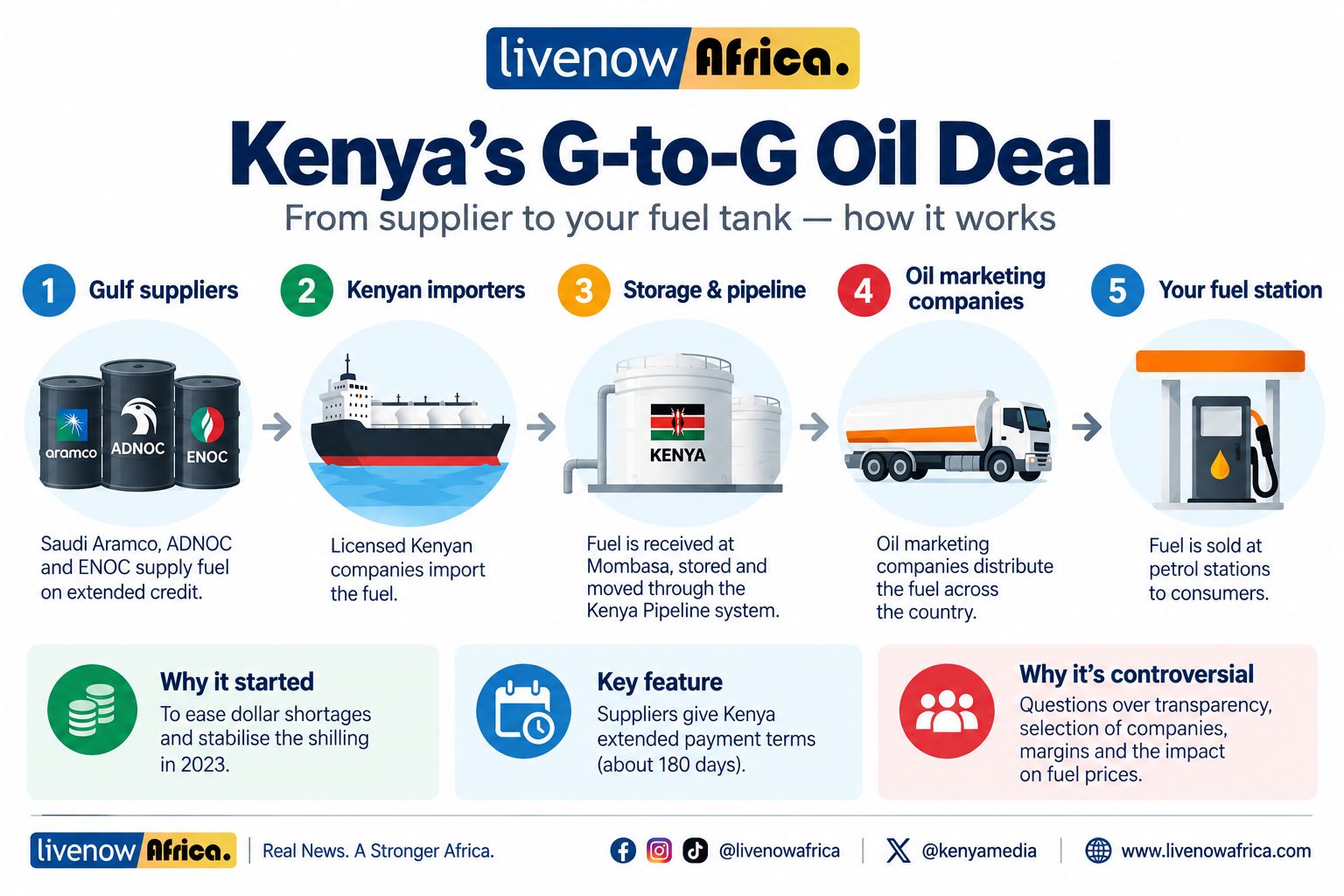
The easiest way to understand it is to follow a litre of fuel.
A simplified version looks like this:
Gulf supplier → Kenyan bulk importer → Kenya Pipeline/storage system → oil marketing companies → petrol stations → motorist
At the international end are Aramco, ADNOC and ENOC.
The petroleum is shipped to Kenya, principally through Mombasa.
Licensed Kenyan oil companies then participate in importing and handling the products locally. Fuel enters storage and pipeline infrastructure before being distributed to oil marketing companies and ultimately petrol stations.
Commercial banks are also involved because the deferred payments to international suppliers have to be financed.
This explains one of the most misunderstood parts of the arrangement.
“Government-to-government” does not mean that Kenyan civil servants buy tankers of petrol and sell the fuel directly to motorists.
Private companies remain part of the commercial supply chain.
Which Kenyan companies are involved?
The role of private oil companies has become one of the most politically sensitive questions surrounding the deal.
The government says the international suppliers required licensed local oil marketing companies to act as counterparties and handle local logistics.
The companies initially involved included:
Gulf Energy Limited, Galana Energies Limited and Oryx Energies Kenya Limited.
Energy Cabinet Secretary Opiyo Wandayi says three additional companies were subsequently brought into the framework following vetting:
One Petroleum Limited, Asharami Synergy Limited and BE Energy Limited.
Those companies should not automatically be described as illegal “middlemen” merely because they sit between international suppliers and the Kenyan market.
The important public-interest questions are different: how were they selected, what services do they provide, what margins or fees do they receive and whether those arrangements provide value to consumers.
Those are among the issues critics now want disclosed.
Is it really a government-to-government deal if private companies are involved?
This is where much of the confusion begins.
The government describes it as a G-to-G framework because Kenya negotiated the supply arrangement with state-linked Gulf suppliers under an intergovernmental framework.
But actual petroleum trading, financing, importation, storage and distribution still involves commercial companies and banks.
Government Spokesperson Isaac Mwaura said in 2023 that the arrangement included memoranda of understanding, Master Framework Agreements, letters of support and operational agreements involving banks, nominated oil marketing companies and the Ministry of Energy.
The existence of private companies therefore does not by itself prove that the arrangement is not G-to-G.
It does, however, create legitimate questions about transparency and the commercial terms under which those private entities participate.
Did the G-to-G deal make petrol cheaper?
Not necessarily.
This is one of the biggest misconceptions about the arrangement.
The original objective was primarily to address dollar liquidity, exchange-rate volatility and security of petroleum supply. It was not simply a promise to buy the world's cheapest fuel.
The price motorists pay at a Kenyan petrol station depends on much more than the international purchase price.
It includes the landed cost of petroleum, exchange rates, transport and storage costs, oil-company margins, taxes and levies, among other components incorporated into Kenya's regulated pricing system.
EPRA then publishes maximum retail prices during its regular fuel-price reviews.
That means international crude prices can fall without producing an identical reduction at a Kenyan pump.
Conversely, a weaker shilling can make imported fuel more expensive even if international oil prices are relatively stable.
The right test of the G-to-G arrangement is therefore broader than whether petrol immediately became cheaper.
It includes whether Kenya secured reliable supplies, reduced foreign-exchange pressure and obtained competitive commercial terms compared with alternative procurement systems.
What system did Kenya use before G-to-G?
Before the change, Kenya primarily procured petroleum through the Open Tender System, commonly known as OTS.
Under that system, oil marketing companies competed for the right to import petroleum products required by the industry.
The successful importer would bring in the cargo and other oil companies would purchase their allocated volumes.
The IMF said the previous system generally required oil-import payments within about five days of delivery.
That created concentrated demand for dollars whenever large petroleum payments became due.
The G-to-G framework replaced that arrangement with longer credit terms.
The fundamental difference was therefore not that Kenya suddenly began importing fuel for the first time through large suppliers.
It was the procurement and financing structure.
What did the IMF say about the deal?
The International Monetary Fund provided one of the more important independent assessments of the arrangement.
In its 2024 review of Kenya's programme, the IMF acknowledged that the system had been introduced as an interim measure to ease foreign-exchange pressure.
But it also recorded significant concerns.
The IMF said the Kenyan authorities intended to exit the arrangement because of distortions it had created in the foreign-exchange market and increased rollover risks associated with private-sector financing facilities supporting the scheme.
That is an important qualification to government claims about the programme.
The arrangement may have helped address an immediate dollar-liquidity problem while simultaneously creating other financial risks.
Both can be true.
What did the Auditor-General find?
The G-to-G arrangement has also attracted scrutiny from the Office of the Auditor-General.
The Auditor-General's reporting on the State Department for Petroleum notes that Kenya shifted from the Open Tender System to the G-to-G framework in March 2023, primarily in response to pressure on the shilling associated with oil marketers' foreign-exchange requirements.
The audit records a network of agreements supporting the arrangement, including memoranda of understanding, Master Framework Agreements and tripartite agreements involving the National Treasury, nominated bulk importers and financial institutions.
This is important because the G-to-G system is not one simple contract between Kenya and another government.
It is a framework supported by several contractual and financing relationships.
That complexity is one reason calls to publish the agreements have persisted.
Where does Uganda fit into this?
This requires particular care because two different petroleum stories are increasingly being mixed together.
Uganda has historically imported much of its refined petroleum through Kenya.
Fuel would arrive at Mombasa and move through Kenya's infrastructure before reaching Uganda.
President Museveni has recently complained that Uganda previously bought petroleum through intermediaries in Kenya and said the arrangement resulted in unnecessarily high premiums.
He said former Kenyan politician Cyrus Jirongo alerted him to the problem around 2019.
But Kenya's current G-to-G framework began in 2023.
Museveni's reference to events in 2019 therefore predates the Ruto administration's G-to-G arrangement by approximately four years.
The two should not be presented as the same deal without evidence linking them.
What Museveni's comments have done is revive the broader question of intermediaries and margins in the regional petroleum supply chain.
Why did Uganda change its system?
Uganda eventually decided that its national oil company, Uganda National Oil Company, should take a more direct role in importing petroleum.
UNOC subsequently secured the necessary Kenyan licence to import petroleum products destined for Uganda.
That reduced Uganda's dependence on the previous procurement structure while it continued using important Kenyan infrastructure, including the Port of Mombasa and Kenya Pipeline network.
The change also affected Kenya's G-to-G volumes.
The IMF reported that after UNOC entered the market, Kenya expected the number of monthly G-to-G petrol and diesel cargoes to fall.
Uganda's experience is therefore relevant to the current debate, but it does not establish wrongdoing in Kenya's 2023 arrangement.
Why is the deal controversial again?
The latest controversy has three separate strands.
First are Museveni's claims about intermediaries involved in Uganda's previous petroleum procurement through Kenya.
Second is Matiang'i's demand that Kenya publish its G-to-G agreements and reveal how private companies participate.
Third is the government's defence that the arrangement was introduced during a genuine foreign-exchange crisis and helped secure fuel supplies and stabilise the currency market.
Energy Cabinet Secretary Opiyo Wandayi says the system was necessary because Kenya faced severe dollar shortages that threatened petroleum supplies and wider economic activity.
Matiang'i argues that the contracts should nevertheless be subjected to public scrutiny.
Those positions are not necessarily mutually exclusive.
A programme can have been introduced to address a legitimate economic problem while still being subject to questions about procurement, margins, transparency and value for money.
Did G-to-G strengthen the Kenya shilling?
The government argues that it contributed.
Deferring hundreds of millions of dollars in petroleum payments reduced immediate demand for foreign currency, which was one of the programme's objectives.
But attributing the shilling's subsequent recovery solely to the oil arrangement would be misleading.
Exchange rates respond to many factors, including interest rates, foreign investment, remittances, exports, government borrowing, debt repayments, central-bank policy and market expectations.
The G-to-G programme therefore formed part of a much wider set of economic forces affecting the currency.
The IMF's later concerns about foreign-exchange distortions created by the scheme also demonstrate why the relationship is more complicated than saying G-to-G “saved the shilling”.
Does the government use taxpayers' money to buy the fuel?
This also requires nuance.
The arrangement is not simply the Treasury purchasing every litre of petroleum with money collected from taxpayers and reselling it at filling stations.
Private oil companies and commercial banks play central roles in financing and settling petroleum transactions.
But government involvement creates potential public financial exposure.
The National Treasury provided support within the framework, and the IMF specifically highlighted potential contingent liabilities and rollover risks associated with the financing structure.
That is why scrutiny of the contracts and financial guarantees matters even where payments originate in the private petroleum market.
Who determines the price at the petrol station?
The Energy and Petroleum Regulatory Authority, EPRA, regulates maximum retail petroleum prices in Kenya.
Pump prices incorporate several components.
These include the underlying cost of imported petroleum, exchange-rate effects, distribution and storage costs, taxes, levies and regulated margins.
This means the G-to-G procurement price is only one part of what determines how much a Kenyan motorist eventually pays.
Understanding that distinction is important whenever politicians claim either that the deal made fuel cheap or that it alone made fuel expensive.
So, was Kenya's G-to-G oil deal a success or failure?
Available evidence does not support reducing the programme to such a simple conclusion.
The government says it helped Kenya navigate a serious dollar shortage, maintain petroleum supplies and reduce immediate pressure on foreign reserves.
The IMF acknowledged why the arrangement was introduced but subsequently recorded the government's intention to exit it, citing foreign-exchange distortions and financing rollover risks.
Critics are now asking a different question: whether the commercial arrangements were sufficiently transparent and whether private intermediaries received appropriate margins.
Those questions require access to the contracts, pricing arrangements and financial records.
What information is still missing?
This is where the renewed debate becomes important.
For Kenyans to fully evaluate the arrangement, several questions need clear documentary answers.
How were all participating local oil companies selected?
What exact margins, premiums and fees apply at different stages of the supply chain?
What financial guarantees or commitments were provided by the government?
How do G-to-G import costs compare with what Kenya would have paid under a competitive Open Tender System during the same periods?
How much did the arrangement actually reduce immediate dollar demand?
What financial risks remained when supplier invoices became due after the credit period?
And how much of the benefit, if any, ultimately reached motorists?
Publishing the relevant agreements would allow those questions to be examined using documents rather than political claims.
Bottom line
Kenya's G-to-G oil deal was introduced in March 2023 primarily as a response to a foreign-exchange crisis.
It allowed petroleum products to be supplied by Aramco, ADNOC and ENOC using extended payment terms, reducing the need for Kenyan oil companies to immediately source hundreds of millions of US dollars.
Private Kenyan oil companies and commercial banks remained part of the supply chain.
The government says the arrangement helped protect fuel supplies and ease foreign-exchange pressure.
The IMF later raised concerns about distortions and financing risks associated with the arrangement, while critics are demanding greater transparency over contracts, intermediaries, margins and beneficiaries.
Museveni's recent remarks have reopened that debate.
But one distinction is essential: the petroleum middlemen arrangement Museveni says Cyrus Jirongo alerted him to in 2019 predates Kenya's current G-to-G deal, which began in 2023.
The outstanding question is therefore not simply whether “middlemen” exist.
It is whether every participant in Kenya's petroleum supply chain performs a necessary service at a competitive cost — and whether the public has enough information to verify that.
You may also like
Category: Explainers
Related Video: Human Ladder Reaches Dangerous Heights as Climbers Keep Going
Related Explainer: Explainer: What happened to milk in Kenya?
 Facebook
 Twitter / X
 WhatsApp
 LinkedIn
 Telegram
 Reddit