
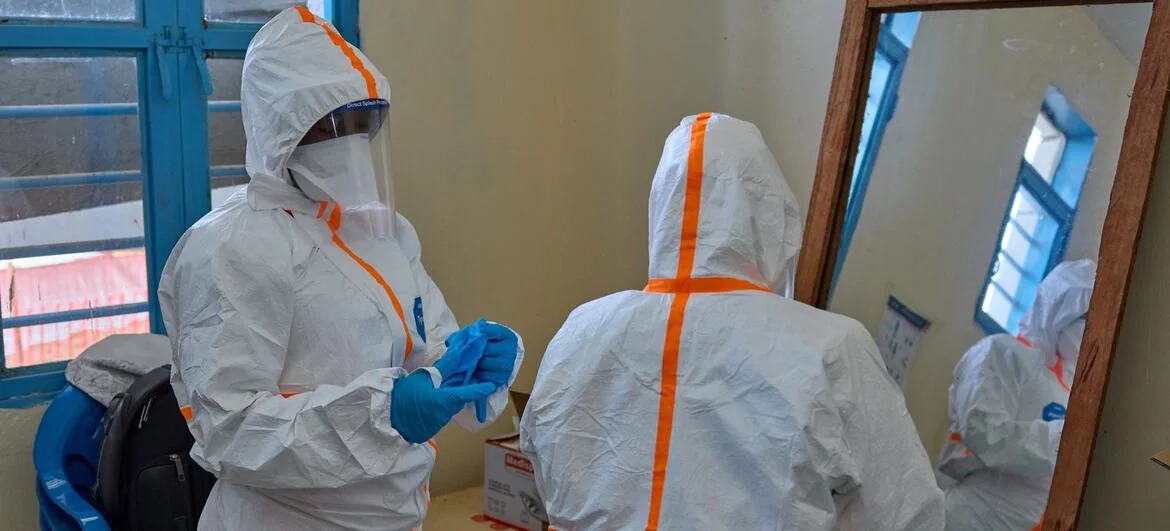
The United States has announced an additional $242 million (about Sh31 billion) for the Ebola response in Africa, with part of the support aimed at strengthening preparedness in Kenya as the outbreak continues to spread in the Democratic Republic of Congo.
The new funding, announced by the US Department of State, will support immediate response operations in the DRC and Uganda. It will also cover regional preparedness and humanitarian assistance linked to the outbreak.
For Kenya, the significance is less about treating Ebola cases and more about making sure the country is ready if the virus crosses its borders.
The US Embassy in Nairobi said American support includes securing medical supplies for Kenya and helping strengthen the country's capacity to detect and respond to the virus.
The funding comes as the outbreak caused by the Bundibugyo virus continues to put pressure on health systems in eastern DRC.
The World Health Organisation said in its latest detailed outbreak update that, as of July 15, the DRC had recorded 2,124 confirmed cases and 828 deaths. Uganda had reported 20 confirmed cases, including two deaths, although no new cases had been reported there since June 21.
More recent reporting from the DRC's health authorities, cited by Reuters and The Associated Press, put the number of confirmed cases at 3,874, including 1,751 deaths, by early August. WHO has warned that the true scale of the outbreak could be considerably larger because of gaps in detection and contact tracing.
That makes preparedness outside the immediate outbreak zone increasingly important.
Why Kenya matters
Kenya has not been identified as having Ebola transmission in the current outbreak. But its position as a regional transport and trade hub means health authorities have a strong interest in detecting any imported case quickly.
The US funding is therefore expected to support measures such as disease surveillance, laboratory capacity, screening at borders and points of entry, isolation and treatment capacity, medical supplies and community communication.
The State Department said the additional money would support both immediate response operations and preparedness in the region.
The move follows a broader US commitment made at the G7 summit in France in June, when Washington indicated that it could provide up to $500 million in additional support for the Ebola response.
The latest pledge brings direct US assistance for the current response to more than $512 million, according to Reuters.
Uganda offers a different picture
While the DRC remains the centre of the outbreak, Uganda's situation has improved significantly.
WHO said Uganda entered the 42-day countdown towards declaring its outbreak over in July after the last confirmed patient tested negative twice and was discharged. By July 16, the country had recorded 20 confirmed cases and two deaths.
The development illustrates why early detection matters.
Most of Uganda's confirmed cases were linked to infections imported from the DRC, with additional transmission occurring among contacts and healthcare workers. WHO has continued to classify the risk to Uganda as high because of its proximity and movement of people across the DRC-Uganda border.
Kenya is further removed from the main outbreak zone, but the regional nature of the response means its health system remains part of the wider preparedness effort.
US tightens travel measures
The United States has also imposed strict travel measures for Americans because of the outbreak.
The US State Department currently lists both Uganda and the DRC at Level 4 — Do Not Travel. The advisory for Uganda cites the Ebola outbreak alongside other security concerns.
For the DRC, the US introduced an additional restriction under which US citizens and nationals who have been in the country within the previous 21 days cannot board commercial flights to the United States.
The measures reflect Washington's concern about imported infections rather than evidence that the outbreak has become a global pandemic.
WHO has assessed the global risk as low, while the risk remains much higher in the DRC and countries sharing borders with affected areas.
Kenya's preparedness comes into focus
For Kenya, the immediate question is whether the country can detect and isolate a case before it becomes a wider public-health problem.
That requires more than equipment.
Health workers need training. Laboratories need to be able to test suspected cases quickly. Border officials need clear protocols. Hospitals need isolation capacity. And communities need reliable information so that fear and misinformation do not complicate an emergency.
The US funding is intended to support several of those areas.
The current outbreak has also exposed the consequences of delayed detection and weak surveillance. WHO has described the situation in the DRC as particularly challenging because of sustained transmission, population movement and difficulties accessing some affected areas.
The strain involved also presents a particular challenge. Unlike the Zaire strain responsible for several major Ebola outbreaks, Bundibugyo virus does not currently have an approved vaccine or specific treatment, according to WHO.
That makes prevention, early detection, isolation and supportive care especially important.
For Kenya, the latest US commitment is therefore less a sign that Ebola has reached the country than a reminder of how quickly a health emergency in one part of East Africa can become a regional concern.
The money is meant to help countries prepare before they have a crisis to manage.
You may also like
Category: News
Related Video: What Dangote’s proposed Lamu oil refinery could mean for East Africa
Related Explainer: Ebola contact tracing: Why the 21-day window matters in Kenya’s response
About the Author
Maureen Onyango is a journalist passionate about storytelling, life coaching and spiritual lessons. She studied at the Kenya Institute of Management and enjoys telling stories that inform, inspire and empower communities.
 Facebook
 Twitter / X
 WhatsApp
 LinkedIn
 Telegram
 Reddit