
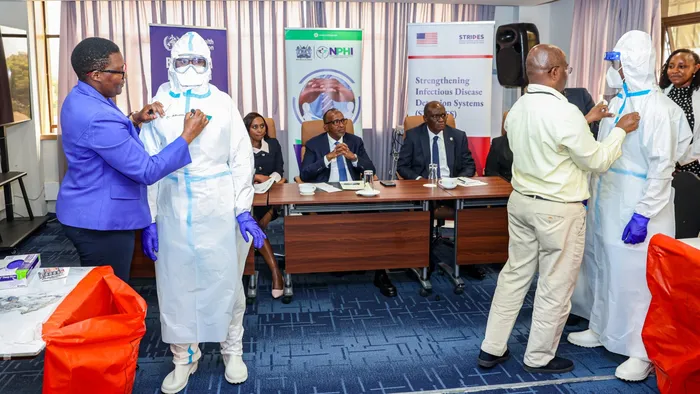
Kenyan health authorities have isolated a 20-year-old man in Wajir after he developed a severe illness following travel from the Democratic Republic of Congo (DRC).
The patient is being treated at Albadar Nursing Home in Habaswein, Wajir South Sub-County, after presenting with fever, headache and cough.
He was also found to have severe anaemia, with his haemoglobin level reported at 4g/dL.
Health officials are investigating the illness as a suspected viral haemorrhagic fever or another serious acute febrile illness.
Importantly, there is no confirmation that the man has Ebola.
Samples have been collected and are being sent for laboratory testing at the National Public Health Virology Laboratory. The results will determine whether Ebola or another infection is responsible for his condition.
His journey has raised concern
The patient's travel history is at the centre of the investigation.
According to a disease surveillance report cited by local authorities, the man works as a commercial truck assistant and had travelled through the DRC, Uganda and several parts of Kenya.
He reportedly developed fever and headache while in the DRC on September 2.
He then travelled overland through Uganda before entering Kenya at Malaba. From there, he travelled through Nairobi and Isiolo before reaching his home area in Habaswein on September 20.
While in Uganda, he reportedly stayed for about five days and sought medical attention.
After reaching Habaswein, he was initially treated at Hilac Medical Clinic for pneumonia and septicaemia.
His condition did not improve, prompting his transfer to Albadar Nursing Home, where he was isolated and placed under further medical care.
The travel history is particularly significant because Kenya is already dealing with the aftermath of its first confirmed imported case of Bundibugyo virus disease, a form of Ebola.
Kenya has one confirmed Ebola case
Kenya confirmed its first imported Bundibugyo virus disease case on October 6.
The patient was a Kenyan man who had been living in the DRC and became ill there before travelling through Uganda and later flying to Nairobi.
He was isolated after reaching hospital in Nairobi, but died on October 5.
Laboratory testing at both the National Virology Reference Laboratory and the Kenya Medical Research Institute confirmed Bundibugyo virus.
The World Health Organisation says Kenya remains focused on preventing further transmission and has been working with the government on surveillance, contact tracing and screening at high-risk entry points.
That confirmed case makes the Wajir investigation particularly sensitive.
But health authorities have not said that the Wajir patient has Ebola, and the two cases should not be treated as linked unless laboratory or epidemiological investigations establish such a connection.
Contact tracing already under way
The Wajir case has been escalated to local disease surveillance teams, with authorities monitoring the patient's movements and possible contacts.
That comes as Kenya's wider Ebola response expands.
The Ministry of Health said on October 7 that 57 contacts linked to the confirmed imported case had been identified. Ten had been traced and placed under quarantine at the National Police Service Hospital in Nairobi, while efforts continued to locate and monitor the rest.
The ministry has also activated health officers across the country to identify and respond to suspected cases.
Public Health and Professional Standards Principal Secretary Mary Muthoni said the number of contacts could increase as investigations continue.
The government has also introduced enhanced screening for travellers arriving from 10 countries considered relevant to the current regional Ebola response: the DRC, Uganda, Rwanda, Burundi, South Sudan, Ethiopia, Angola, Zambia, Tanzania and the Central African Republic.
At Jomo Kenyatta International Airport, Gate 16 has been designated for enhanced screening of arrivals from those countries.
WHO says no border closures
The developments have raised questions about whether Kenya should impose wider restrictions on movement.
The WHO, however, is not recommending travel or trade restrictions involving Kenya, the DRC or Uganda based on the information currently available.
The agency has instead stressed surveillance, early detection, contact tracing and cooperation across borders.
WHO's guidance is important because closing borders can push travellers and traders towards unofficial crossing points that are harder to monitor.
For Kenya, the focus remains on finding suspected cases quickly and ensuring anyone who may have been exposed is monitored.
Kenya's surveillance system under pressure
The Wajir case also highlights the challenge of monitoring people who move across several countries by road.
Unlike air travel, where passenger records can provide a relatively clear trail, commercial road transport can involve multiple stops, changing vehicles and informal movement between communities.
That makes timely information-sharing between countries and counties critical when a traveller becomes seriously ill.
Kenya says it has been preparing for the regional Ebola threat since May.
By October 6, more than 652,000 travellers had been screened, 267 suspected samples had been tested and about 5,000 health workers had received Ebola prevention and case-management training, according to the WHO.
The country has also identified isolation capacity in 27 high-risk counties and strengthened laboratory and rapid-response systems.
The immediate question in Wajir is now straightforward: what is making the young man so ill?
Until laboratory results are available, it would be premature to label the case Ebola.
For now, he remains an isolated patient under investigation, while health teams work to establish the diagnosis and determine whether anyone else may have been exposed.
You may also like
Category: News
Related Video: Human Ladder Reaches Dangerous Heights as Climbers Keep Going
Related Explainer: Ebola contact tracing: Why the 21-day window matters in Kenya’s response
About the Author
Maureen Onyango is a journalist passionate about storytelling, life coaching and spiritual lessons. She studied at the Kenya Institute of Management and enjoys telling stories that inform, inspire and empower communities.
 Facebook
 Twitter / X
 WhatsApp
 LinkedIn
 Telegram
 Reddit