
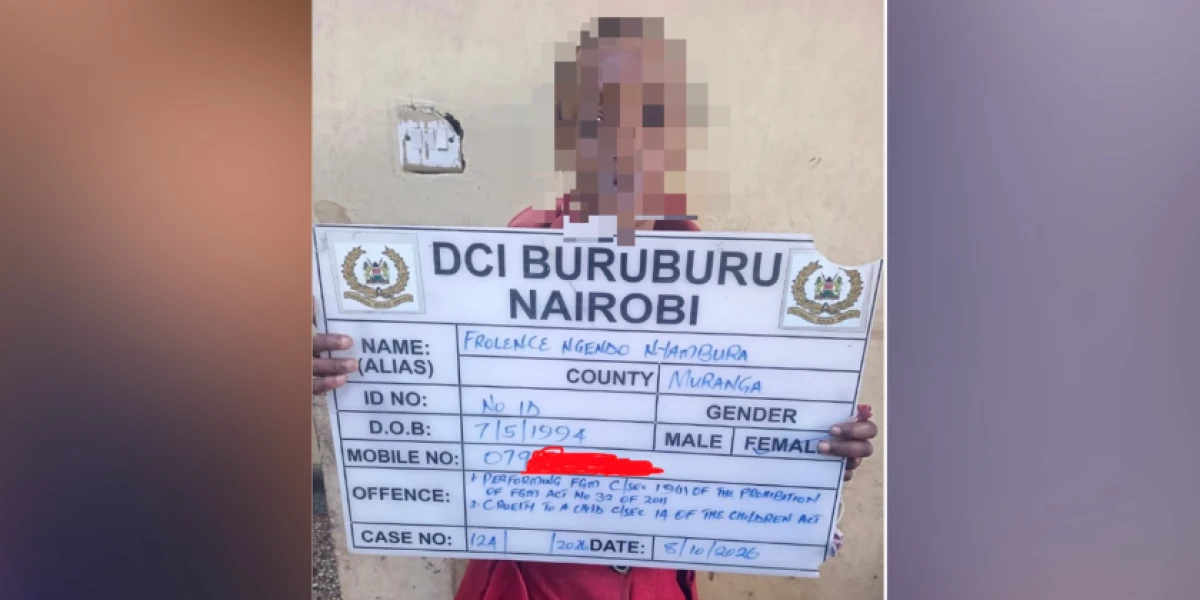
An eight-year-old girl is recovering in a safe home after neighbours in Dandora raised the alarm and stopped the alleged mutilation of the child, leading to her mother's arrest.
The 32-year-old woman, identified by police as Frolence Ngendo Nyambura, was arrested after residents in Dandora Phase 2 reportedly confronted her as she allegedly subjected the girl to female genital mutilation using a surgical blade.
Police officers from Dandora Police Station, accompanied by the Sub-County Children Officer, responded after the alarm was raised.
The Directorate of Criminal Investigations (DCI) said officers confirmed the incident and found that the girl had already undergone the mutilation.
She was rescued and taken to Dandora Phase 3 Health Centre, where she received medical treatment.
She was later discharged and placed in a safe home as authorities worked to protect her and support her recovery.
Nyambura remains in custody at Dandora Police Station and is expected to face charges including performing FGM and cruelty to a child.
She has not been convicted, and the allegations against her will be tested through the courts.
Neighbours' intervention brings case to light
The case has highlighted the role neighbours and communities can play in stopping FGM before it causes further harm.
According to police accounts, residents noticed what was happening and intervened before alerting authorities.
The incident also brought police and child-protection officers together at the scene, allowing the girl to be removed from the situation and taken for medical care.
The National Police Service has urged members of the public to report suspected cases of FGM and other forms of child abuse.
The DCI's Fichua Kwa DCI hotline is 0800 722 203, while reports can also be made through WhatsApp on 0709 570 000. Reports may be made anonymously.
What Kenyan law says about FGM
FGM has been illegal in Kenya since the enactment of the Prohibition of Female Genital Mutilation Act, 2011.
The law prohibits performing FGM and also criminalises several related acts, including aiding or facilitating the practice, allowing premises to be used for it and failing to report a planned or ongoing offence in circumstances covered by the law.
Under Section 19, a person who performs FGM commits an offence. The Anti-FGM Board says a conviction under the Act can attract a prison sentence of at least three years, a fine of at least Sh200,000, or both.
The law also makes clear that consent does not provide a defence where FGM has been performed.
Kenya has made progress, but children remain at risk
The Dandora case comes despite a long-term decline in the prevalence of FGM in Kenya.
The latest Kenya Demographic and Health Survey, conducted by the Kenya National Bureau of Statistics, found that 15% of women aged 15 to 49 had undergone FGM in 2022.
That was a significant decline from 38% recorded in 1998.
The survey also found that 2% of girls aged 0 to 14 had undergone FGM. The proportion was higher among girls whose mothers had no formal education and below 1% among girls whose mothers had more than secondary education.
The figures show that while the practice has declined nationally, it has not disappeared.
More than nine in ten women and men surveyed who had heard of FGM said the practice should not continue, pointing to a broad shift in attitudes against it.
Focus shifts to protecting survivors
Kenya's approach to FGM is also facing an important policy discussion.
In April 2026, the Senate's Standing Committee on Justice, Legal Affairs and Human Rights called for changes to ensure survivors are protected rather than subjected to prosecution or further trauma because of their status as victims.
The debate centres on how the law can punish those who perform, facilitate or arrange FGM while ensuring girls and women who have undergone the practice receive medical, psychological and legal support.
The Office of the Director of Public Prosecutions has also previously engaged stakeholders on proposed amendments to the FGM law, saying the framework should provide stronger protection for victims and avoid re-traumatising them.
That distinction is important in cases involving children.
A child who has undergone FGM should be treated first as someone requiring protection and care, while investigators establish who was responsible and the courts determine criminal liability.
The road ahead
For the girl in Dandora, the immediate priority is recovery and safety.
The police investigation will determine the circumstances surrounding the incident and whether additional people were involved.
For the wider fight against FGM, the case is another reminder that legislation alone cannot end the practice.
Kenya's national figures show substantial progress over the past two decades. But the fact that an eight-year-old girl allegedly underwent FGM in a Nairobi neighbourhood shows why enforcement, community awareness, child protection and access to support services remain necessary.
In this case, it was neighbours who first raised the alarm.
Their intervention allowed the child to receive medical care and be moved to safety before the case reached the criminal justice system.
You may also like
Category: News
Related Video: Dolly Parton’s Family Announces Her Passing in Emotional Tribute
Related Explainer: Why the BCG Vaccine Leaves That Small Scar on Your Arm
About the Author
Maureen Onyango is a journalist passionate about storytelling, life coaching and spiritual lessons. She studied at the Kenya Institute of Management and enjoys telling stories that inform, inspire and empower communities.
 Facebook
 Twitter / X
 WhatsApp
 LinkedIn
 Telegram
 Reddit