
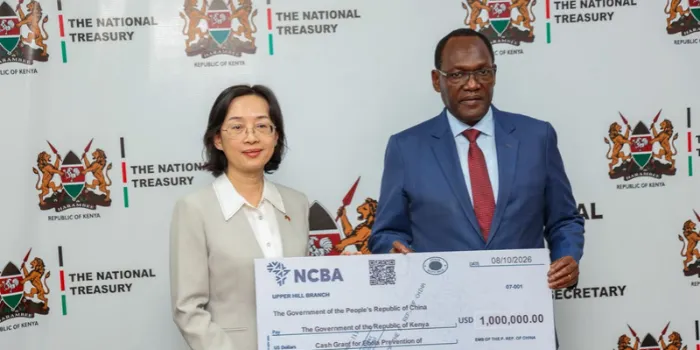
Kenya has received a US$2 million (about KSh260 million) grant from China to support drought mitigation and strengthen preparedness for possible Ebola transmission.
The funding was formally handed over on Thursday, October 8, at the National Treasury by Chinese Ambassador to Kenya Guo Haiyan during a meeting with Treasury Principal Secretary Chris Kiptoo.
Kiptoo said the grant would be divided equally between the two emergencies.
About US$1 million (KSh130 million) will go towards drought mitigation, while another US$1 million will support Ebola preparedness and response.
“Welcomed H.E. Amb. Guo Haiyan, Ambassador of the People’s Republic of China to Kenya, at the National Treasury for the official handing over of a USD 2 million grant from the Government of China to the Government of Kenya,” Kiptoo said.
The timing is significant.
Kenya confirmed its first imported case of Bundibugyo Ebola virus disease on October 6, after a Kenyan man who had been living in the Democratic Republic of Congo (DRC) travelled to Nairobi through Uganda.
The patient died on October 5 while receiving treatment in Nairobi.
Kenya is not facing an Ebola outbreak
The latest case has raised concern because of the ongoing Ebola outbreak in the DRC.
However, the Ministry of Health has stressed that the confirmed case does not mean Kenya has an active outbreak.
Health Cabinet Secretary Aden Duale said on October 7 that Kenya remains on high alert but is not experiencing an Ebola outbreak.
The government has moved quickly to trace people who may have been exposed.
The Health Ministry initially identified 28 contacts linked to the patient. By October 7, the number of contacts under investigation had risen to 57, with 10 people already accounted for and placed in quarantine.
Authorities are also tracing passengers and crew who travelled on the same flight as the patient from Kampala to Nairobi.
The patient arrived in Nairobi on October 3 after travelling by road from the DRC to Kampala. He was taken to Nairobi Hospital, where he was isolated after developing symptoms. Tests conducted independently by the National Virology Reference Laboratory and the Kenya Medical Research Institute confirmed Bundibugyo virus disease.
Kenya had already been preparing
The Chinese funding is arriving after months of preparation.
According to the Ministry of Health, Kenya had screened more than 652,000 travellers and tested 267 samples by October 6.
Nearly 5,000 healthcare workers had also received training in Ebola prevention and case management.
The country has identified five facilities for isolation and treatment of suspected or confirmed cases.
They include Kenyatta National Hospital, Moi Teaching and Referral Hospital, National Police Service Hospital, Port Reitz Hospital and Nairobi Hospital.
Nairobi Hospital has the largest designated capacity, with 133 beds in its Ebola isolation unit, including high-dependency and intensive-care beds.
The World Health Organization is supporting Kenya with surveillance, contact tracing, laboratory work and other containment measures.
WHO said Kenya's response is focused on screening at high-risk entry points, investigating the case and strengthening communication with communities.
The other half of the grant targets drought
While Ebola has dominated the headlines, half of China's new grant is earmarked for drought mitigation.
That support comes as Kenya continues to monitor dry conditions in parts of the country through the National Drought Management Authority.
The Kenya Meteorological Department's current October outlook is also important. The country has entered the October-December short-rains season, with forecasts varying significantly by region.
This means drought and excessive rainfall can exist as competing risks in different parts of the country.
Some areas can face water shortages and deteriorating pasture, while others may experience heavy rainfall, flooding and related disruption.
The latest grant therefore gives the government additional resources to respond to two very different emergencies at the same time.
A small grant against a much larger response
The KSh260 million contribution is significant as emergency support, but it is modest compared with the wider sums being discussed for Kenya's Ebola preparedness.
The government has said it is setting aside billions of shillings for the response and is seeking additional external financing.
Kenya has also been engaging development partners as the country strengthens its public health emergency systems.
That wider funding picture matters because Ebola preparedness involves more than treating patients.
It requires surveillance at borders, laboratory testing, protective equipment, trained health workers, isolation facilities, contact tracing and public communication.
WHO says Kenya had already been building this capacity before the imported case was confirmed.
Why the border matters
The patient's journey from the DRC through Uganda and into Kenya has also highlighted the challenge of controlling diseases that do not respect national borders.
The patient travelled by road from the DRC to Kampala before taking a commercial flight to Nairobi.
Kenya's health authorities are now working with regional and international partners to establish who may have been exposed along that route.
Uganda, which had reported 20 Ebola cases earlier in 2026, was declared free of the disease in August. The current outbreak in the DRC, however, remains active.
The WHO says Kenya is the fourth country to confirm Bundibugyo virus disease in the current outbreak.
For Kenya, the immediate priority is therefore containment.
The government says the confirmed case remains an imported case, and officials are working to ensure it does not develop into wider community transmission.
China's KSh260 million grant comes at a critical moment. But the real test will be how quickly the money is converted into stronger surveillance, faster response capacity and practical support for communities facing drought.
You may also like
Category: News
Related Video: Human Ladder Reaches Dangerous Heights as Climbers Keep Going
Related Explainer: Ebola contact tracing: Why the 21-day window matters in Kenya’s response
About the Author
Maureen Onyango is a journalist passionate about storytelling, life coaching and spiritual lessons. She studied at the Kenya Institute of Management and enjoys telling stories that inform, inspire and empower communities.
 Facebook
 Twitter / X
 WhatsApp
 LinkedIn
 Telegram
 Reddit