
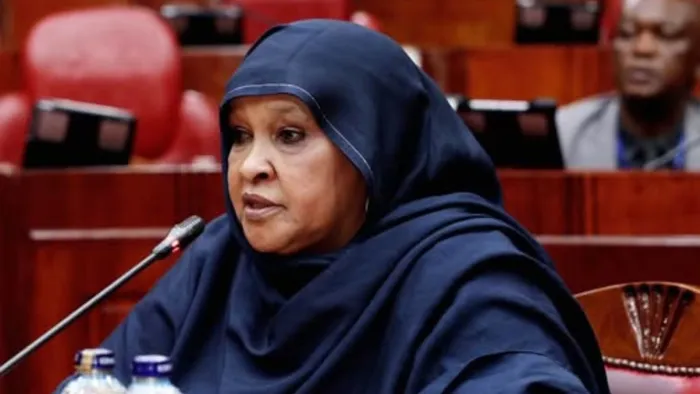
Former Wajir County Woman Representative Fatuma Ibrahim Ali is returning to the centre of Parliament after the National Assembly approved her appointment to the Parliamentary Service Commission (PSC).
Ali will serve as the female non-Member Commissioner, taking over the seat previously held by Rachel Ameso after the expiry of her term.
The National Assembly approved her appointment on Wednesday, October 7, completing the parliamentary approval process after the Senate had endorsed her nomination.
Her appointment places a former MP and regional legislator inside the body responsible for the administration and welfare of Kenya’s Parliament, but in a role constitutionally reserved for someone who is not a sitting Member of Parliament.
From Wajir politics to Parliament's administrative centre
Ali brings a career that has moved between elective politics, human rights and regional parliamentary work.
She served as Wajir County Woman Representative during the 11th Parliament and later served in the East African Legislative Assembly (EALA).
She has also served as a commissioner at the Kenya National Commission on Human Rights, giving her experience outside elective politics.
That background was central to her case before Parliament.
PSC Commissioner Patrick Makau told the National Assembly that Ali was interviewed on September 10 and assessed on her academic and professional qualifications, parliamentary experience, understanding of the Commission, leadership and management abilities, and the integrity requirements under Chapter Six of the Constitution.
“The Commission interviewed her on 10th September 2026 and assessed her qualifications, covering academic qualifications, relevant experience, understanding of Parliament and the Commission, leadership and management, and the Chapter Six requirements on leadership and integrity,” Makau said.
Ali emerged top of a field of 12 shortlisted candidates after 75 people applied for the position. She scored 80.48 per cent in the selection process.
What Ali will be doing
The PSC is not a legislative committee. Its role is largely about ensuring Parliament has the structures, staff and resources needed to function.
Under the Constitution, the Commission provides services and facilities to Parliament, establishes offices within the parliamentary service, appoints and supervises certain office holders, prepares parliamentary expenditure estimates and oversees the welfare of MPs and parliamentary staff.
It also has a role in promoting the ideals of parliamentary democracy.
Ali's appointment therefore gives her responsibility beyond political debate.
During her Senate vetting, she said her experience in recruitment, promotion and staff welfare would be useful in the Commission. She also spoke about equal opportunities, transparency and better treatment of parliamentary staff.
The position is particularly notable because Article 127(2)(d) of the Constitution requires Parliament to appoint one man and one woman to the Commission from among people experienced in public affairs who are not MPs.
The two non-MP seats are intended to bring experience from outside the sitting membership of Parliament while retaining an understanding of public institutions.
Senate scrutiny came before the final vote
Ali's approval followed a multi-stage process.
The PSC advertised the vacancy on August 14 and received 75 applications. Twelve women were eventually shortlisted and interviewed.
The PSC selected Ali as its preferred candidate before her nomination was subjected to further parliamentary scrutiny.
The Senate Standing Committee on Justice, Legal Affairs and Human Rights held her approval hearing on September 28. The committee examined her qualifications, professional experience and integrity before recommending her nomination to the Senate.
The Senate subsequently approved the nomination, paving the way for the National Assembly vote.
With the National Assembly's approval now complete, Ali can proceed to the next formal stage before taking up the commissioner's office.
A return to public service
Ali's appointment marks another chapter in a public career that began long before her return to Parliament.
Records from the Kenya National Commission on Human Rights show that she previously served as a commissioner at the institution, including during its formative years.
Her earlier parliamentary experience also means she returns to an institution she knows from the inside.
But the PSC role is different from being an elected representative.
As a commissioner, her work will centre on the machinery that allows Parliament to operate, from staff and administrative systems to resources and institutional services.
For Ali, the move represents a return to Parliament in a role where her political experience is only one part of the job.
For the PSC, her appointment fills the female non-Member seat left vacant by Ameso and completes the latest change to the Commission's membership.
You may also like
Category: News · Related Topic: Kenya Politics
Related Video: Murkomen Says Kenya Is Safe: “Stop Creating a Crisis” | Political Goons & Security Under Scrutiny
About the Author
Maureen Onyango is a journalist passionate about storytelling, life coaching and spiritual lessons. She studied at the Kenya Institute of Management and enjoys telling stories that inform, inspire and empower communities.
 Facebook
 Twitter / X
 WhatsApp
 LinkedIn
 Telegram
 Reddit