
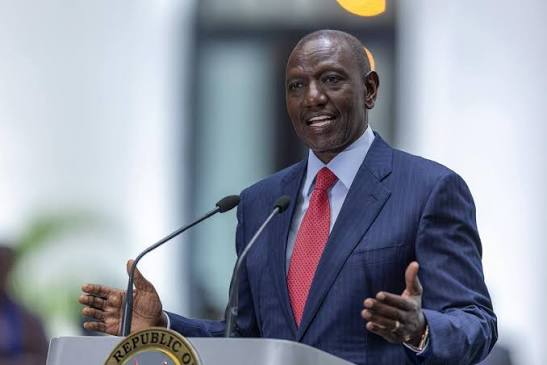
President William Ruto says Kenya is too complex to be governed by a leader without the ability to understand its challenges, as political competition ahead of 2027 intensifies.
President William Ruto has sharpened his message to Kenya's political class, saying the country needs an intelligent leader capable of understanding its complexity.
Speaking at State House, Nairobi, on Thursday, October 8, Ruto said Kenya was a modern and sophisticated country that could not be entrusted to what he described as a “fool”.
“We are a very serious country, and I see many people running around. Kenya is a modern, very complex and sophisticated country. No fool can run this country,” Ruto said.
“It requires someone with intelligence. That's how you take the country forward,” he added.
The remarks come as political activity builds ahead of the 2027 General Election, with the President increasingly challenging his opponents to present concrete programmes rather than relying on criticism of his administration.
But Thursday's speech was not only about politics.
Ruto made the remarks while addressing thousands of skilled workers receiving formal recognition for skills acquired through experience, apprenticeships and workplace training.
That gave his comments a second theme: his argument that Kenya needs both capable leadership and a workforce whose practical abilities are properly recognised.
Ruto defends Kenya's international engagements
The President's comments followed criticism over his frequent participation in international meetings, including the United Nations General Assembly and African Union engagements.
Ruto defended the trips, arguing that appearing on international platforms helps raise Kenya's standing and gives the country a stronger voice abroad.
“That is how you profile a nation. That is how you raise the profile of a country,” he said.
He added that Kenya now enjoys greater international recognition because it is seen as a serious country.
Ruto's remarks came weeks after he attended the 81st United Nations General Assembly in New York, where he represented Kenya at the global forum.
The President questioned why his participation should attract criticism when leaders from around the world regularly address the same international institutions.
His defence points to a wider argument his administration has made repeatedly: that Kenya's foreign engagements are part of pursuing the country's economic and diplomatic interests, rather than a distraction from domestic affairs.
A familiar challenge to his rivals
Ruto's latest comments also fit a pattern in his political messaging.
During a September 3 rally in Kajiado, he challenged opposition leaders to explain their alternative plans rather than concentrating on attacks against his government.
“Kuja utueleze ajenda yako ni gani, sera yako ni gani, mpango wako ni gani, maono yako ni gani. Usituletee kelele, sisi ni watu tuko na akili,”
he said.
The remarks were a call for political opponents to put forward their agendas, policies, plans and visions.
The President has similarly accused opposition figures of lacking clear plans and has sought to frame the next election as a contest between his government's record and what rivals would offer instead.
The opposition, however, continues to criticise the administration over the cost of living, taxation, public services and other policy decisions.
That means the coming political contest is likely to involve competing claims not only about leadership ability, but also about which side can provide workable solutions to Kenya's problems.
Why the remarks came at a skills graduation
The setting of Thursday's speech was significant.
Ruto presided over a graduation ceremony for beneficiaries of the Recognition of Prior Learning (RPL) programme run through the National Industrial Training Authority.
About 3,750 beneficiaries received certification at State House. The programme recognises skills gained outside the conventional classroom, including through work experience, apprenticeships and informal training.
The graduates included workers in areas such as construction, electrical work, automotive technology, textiles and cosmetology.
NITA says RPL is designed to identify, assess and certify skills regardless of where or how they were acquired. The authority says formal certification can improve workers' employment prospects, career progression and access to further training.
For workers who have spent years doing skilled jobs without formal qualifications, the certificate can therefore provide something they previously lacked: official recognition of what they already know how to do.
'Do not sell your skills cheaply'
Ruto used the occasion to urge the graduates to place a higher value on their skills.
He joked about a plumber being offered only Sh50 for a job and told the graduates not to accept such terms simply because someone had asked them to do the work.
“Msipige your skill na bei ya chini… Hata wewe tumia akili bwana, mwambie hii kazi hapana,”
he said, drawing laughter from the audience.
The broader message was more serious.
Ruto told skilled workers to negotiate from a position of confidence and avoid undervaluing their labour.
The argument is particularly relevant for artisans and workers in the informal economy, where many acquire substantial practical experience without passing through conventional academic routes.
NITA has previously said RPL can help skilled workers gain formal qualifications and improve their prospects for employment and career advancement.
Government wants technical skills to carry more weight
The RPL graduation also fits into the government's broader push to increase the status of technical and vocational training.
Ruto said on Thursday that technical training was attracting more young people, with enrolment expected to reach 1.3 million by the end of 2026.
He said some young people who qualify for university are increasingly choosing technical colleges because they see practical skills as a route to employment and business.
The government has also linked the RPL programme to the NYOTA initiative, which includes skills training, on-the-job experience and certification.
Earlier government plans targeted 20,000 young people for RPL under NYOTA.
The Thursday graduation therefore represented more than a ceremonial event.
It was also a showcase of the government's attempt to shift how Kenya measures employability — from academic certificates alone to a combination of formal education, technical training and proven practical ability.
The political test will be harder
Ruto's statement that Kenya needs an intelligent leader is likely to resonate differently depending on where voters stand politically.
Supporters can read it as a defence of competence and experience in governing a complex country.
Critics may see it as another example of the President attacking political opponents without naming them.
Either way, the question that will matter more as 2027 approaches is what follows the rhetoric.
Kenya's next presidential contest will ultimately be fought over issues that affect daily life: jobs, prices, taxes, healthcare, education, debt, public services and economic opportunity.
Calling for “intelligence” is one thing.
The harder task for every presidential contender will be showing voters what that intelligence means in practice.
For Ruto, Thursday's message was that leadership requires the ability to understand Kenya's complexity and move the country forward.
His opponents will have an opportunity to make their own case.
And increasingly, Kenyans will be listening not only to who says they can lead, but to what they intend to do with the opportunity.
You may also like
Category: Politics · Related Topic: William Ruto
Related Video: What Dangote’s proposed Lamu oil refinery could mean for East Africa
About the Author
Maureen Onyango is a journalist passionate about storytelling, life coaching and spiritual lessons. She studied at the Kenya Institute of Management and enjoys telling stories that inform, inspire and empower communities.
 Facebook
 Twitter / X
 WhatsApp
 LinkedIn
 Telegram
 Reddit