
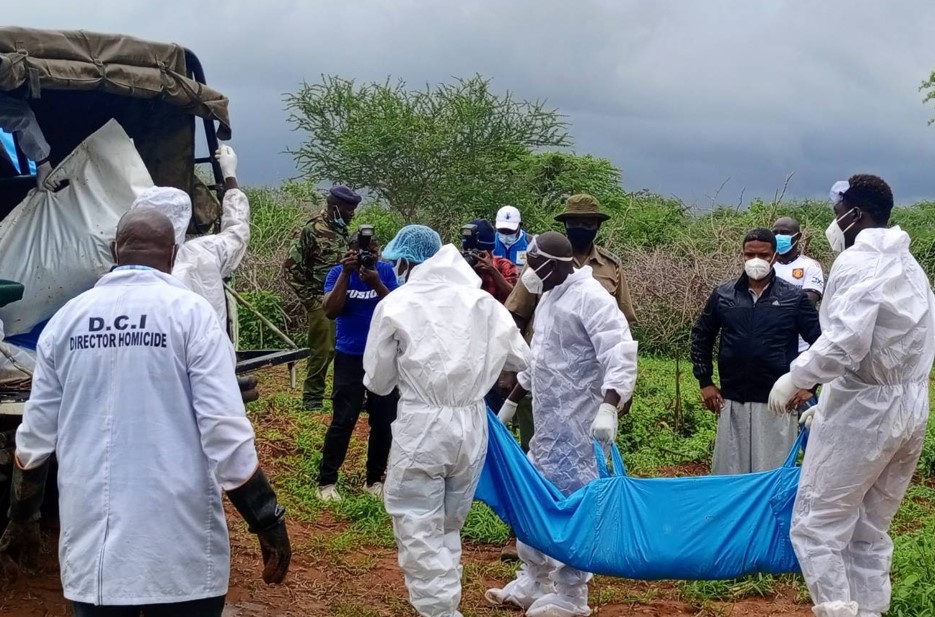
More than three years after the Shakahola tragedy exposed hundreds of deaths in Kilifi County, 443 bodies and human remains are still being held at Malindi Sub-County Hospital.
Now, families who may still be searching for missing relatives have 21 days to come forward.
Kilifi County says it will seek court approval to inter the unclaimed remains once the period set out in its Gazette notice expires. The county wants the process completed by December.
The announcement was made on Monday, September 21, during a visit to Malindi Sub-County Hospital by the Senate committees on Health and Public Investments and Special Funds.

Kilifi County Executive Committee Member for Health Peter Mwarogo told senators that the Directorate of Criminal Investigations had completed its work on the remains and cleared the way for the county to begin the interment process.
“DCI have concluded investigations on the bodies. We have embalmed the 443 bodies which are at our base. They have given us the go-ahead for the interment of the bodies,” Mwarogo said.
The county says only 14 of the 443 remains have so far been identified by relatives through DNA matching.
That leaves hundreds of remains without a confirmed family claim.
County promises identification will remain possible
Kilifi officials say burial will not mean abandoning the identification process.
Mwarogo said the remains would be interred in a way that preserves records and allows future identification if relatives come forward later.
“They have to be disposed of in a way that they can be identified even several years if somebody comes here,” he said.
The county has already identified land near Shakahola where the remains are expected to be interred.
The 443 figure includes complete bodies as well as body parts recovered during the extensive exhumation exercise.
Mwarogo said the condition of some remains made identification particularly difficult.
“Some are full bodies and others are body parts because by the time the exhumation was being done, some had been eaten by wild animals,” he said.
The DCI will retain the DNA and identification records, which are also relevant to the criminal cases arising from the Shakahola deaths.
Senators question whether 21 days is enough
The decision immediately raised another concern.
Senators visiting the hospital questioned whether a Gazette notice would reach families who may still be searching for relatives who disappeared around Shakahola.
Elgeyo Marakwet Senator William Kisang urged the county to use television, radio, newspapers and social media to publicise the deadline.
“Who reads the Gazette notice?” Kisang asked, arguing that families still searching for relatives needed to be reached through channels they are more likely to see.
The concern is significant because the people affected are not necessarily based in Kilifi.
The Shakahola deaths drew victims and followers from different parts of Kenya. Some families may have spent years without knowing whether relatives who disappeared were among those recovered from the forest.
The county has said it intends to publicise the notice more widely.
There is also another complication.
Mwarogo said some families had already been able to establish that their relatives were among the remains but had not collected them because of the stigma surrounding the tragedy.
That means the identification challenge is not only about finding DNA matches. It also involves helping families deal with the painful consequences of what happened.
Why the remains have stayed in Malindi
The 443 remains have been preserved in a separate container at Malindi Sub-County Hospital.
Their prolonged storage has placed additional pressure on the county's facilities.
Mwarogo said the hospital's ordinary mortuary has a capacity of 25 bodies and currently has 22.
A new mortuary is being built at the facility and was reported to be about 90 per cent complete.
The county says resolving the Shakahola remains will also free up the temporary storage facility for other needs.
But officials face a delicate balance.
They must provide a dignified final resting place for remains that have been held for years while ensuring that the burial process does not close the door on families who may eventually identify their loved ones.
The Shakahola death toll and what the courts have established
The scale of the tragedy first became clear in April 2023, when authorities began uncovering mass graves in Shakahola Forest.
By October 2023, a court record noted that 429 bodies had been exhumed, alongside the rescue of 67 adults and 25 children from the forest.
The Senate had also conducted an inquiry into the deaths and the activities of Paul Mackenzie and his Good News International Church.
The investigations subsequently led to several criminal cases.
In the main murder case, the High Court in Mombasa ruled in April 2026 that Mackenzie and 30 co-accused had a case to answer on 191 murder charges.
Justice Diana Kavedza reached the decision after the prosecution presented evidence from 121 witnesses, including survivors, investigators and experts. The prosecution also produced post-mortem reports and other forensic material.
Importantly, a finding that an accused person has a case to answer is not a conviction. The accused are entitled to present their defence, and the court must ultimately determine whether the prosecution has proved the charges beyond reasonable doubt.
The criminal proceedings remain separate from the county's responsibility to preserve and eventually inter the unidentified remains.
The tragedy did not end with the first graves
The Shakahola investigation has also extended beyond the original forest site.
Authorities have investigated other locations in Kilifi in connection with deaths allegedly linked to Mackenzie's religious movement.
That wider investigation, together with the continuing criminal proceedings, means the handling of the remains remains closely tied to the search for answers about how the deaths occurred and who the victims were.
The Senate's original inquiry was established specifically to examine the circumstances surrounding the deaths, the activities of Mackenzie and his pastoral team, and the role of security and other government agencies.
More than three years later, the identification of the dead remains one of the most painful unfinished parts of the case.
A final window for families
Kilifi County is now preparing for the next step.
The 21-day notice is intended to give relatives one more opportunity to come forward before the county asks the court for authority to inter the unclaimed remains.
Officials say the burial will preserve enough information for identification to remain possible in future.
For families still searching, however, the message is urgent.
The county wants the process concluded by December.
That means the next few weeks could be the last immediate opportunity for relatives to come forward before the remains are moved from temporary preservation to their planned final resting place.
You may also like
Category: News · Related Topic: Social Health Authority (SHA)
Related Video: Dolly Parton’s Family Announces Her Passing in Emotional Tribute
About the Author
Maureen Onyango is a journalist passionate about storytelling, life coaching and spiritual lessons. She studied at the Kenya Institute of Management and enjoys telling stories that inform, inspire and empower communities.
 Facebook
 Twitter / X
 WhatsApp
 LinkedIn
 Telegram
 Reddit