
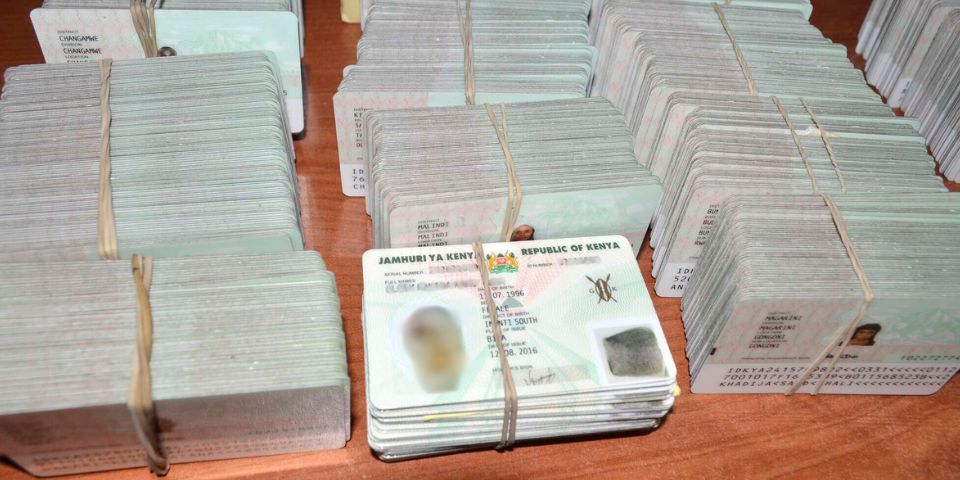
The government is turning to chiefs and assistant chiefs to track down the owners of 557,930 uncollected national identity cards, in a nationwide effort to clear the backlog before the 2027 General Election.
The exercise comes as the country prepares for the next voter registration phase, with Immigration and Citizen Services Principal Secretary Belio Kipsang telling MPs that the government wants eligible Kenyans to have their identification documents in time to register.
But the scale of the backlog, and complaints about delays in getting processed cards to local registration offices, raise questions about whether the new campaign will deliver on that promise.
Appearing before the National Assembly Departmental Committee on Administration and Internal Security on Thursday, November 5, Kipsang said nearly 400,000 of the uncollected cards had remained at registration offices for more than 10 years.
The department plans to work through National Government Administration Officers, including chiefs and assistant chiefs, who will receive lists of pending cards and help locate their owners.
The government is also considering allowing parents, guardians and other authorised people to collect cards on behalf of applicants, provided officials can verify their identity and authority.
Free IDs and SMS alerts in the new plan
Kipsang said the government had removed charges for new identity cards and replacements to make it easier for Kenyans to obtain the documents.
The previous charges were Sh300 for a first-time application and Sh1,000 for a replacement.
“We have removed all payments, including the Sh300 that used to be charged for new IDs and the Sh1,000 for replacements,” he told the committee.
The department is also finalising an electronic notification system through e-Citizen. It is expected to send applicants text messages when their cards are ready for collection.
“We are finalising the system to ensure that applicants are notified through SMS when their IDs are ready. This will help us fast-track the collection of these documents,” Kipsang said.
The government hopes the notifications will address one of the reasons cards remain uncollected: applicants may not know when their documents are ready.
However, the effectiveness of the system will depend on how quickly it is rolled out and whether applicants receive reliable notifications.
MPs question delays despite faster processing claims
The proposed campaign comes against a backdrop of complaints about delays in the distribution of identity cards, particularly in areas far from central processing facilities.
Teso South MP Uku Kaunya told the committee that more than 5,000 cards in Amagoro had reportedly taken between two and three months to reach registration stations after processing.
He questioned why applicants were still waiting for extended periods despite the government's investment in modern registration equipment.
Kaunya proposed involving village elders in tracing applicants and helping ensure that completed cards reach their owners.
Kipsang said the department had the capacity to print up to 20,000 identity cards a day. He added that the government was working towards processing and delivering applications within seven to 10 days.
He cited Busia County, where 11,000 cards had been processed over the preceding 30 days and were at different stages of completion. In Kericho, he said, 17,000 cards were being processed, with delivery expected within seven to 10 days.
“Any ID application that reaches us should be processed and delivered within seven to 10 days,” he said.
The figures, however, did not fully address the concerns raised by MPs about the time taken to move cards from processing centres to local registration offices.
Committee chairman Gabriel Tongoyo directed the PS to investigate the complaints and establish the reasons for delays in affected areas. Kipsang promised to provide Kaunya with a detailed update on pending applications in Teso South and the wider Busia County.
What the backlog means for the 2027 vote
The timing of the exercise matters because a national identity card or valid Kenyan passport is required to register as a voter.
The IEBC's voter registration rules allow eligible citizens aged 18 and above to register using either document. This means the 557,930 uncollected cards should not be treated as an equivalent number of people who are currently unable to vote. Some card owners may already have valid passports or may already be registered.
But for eligible citizens who have neither document, delays in obtaining an ID could become a real obstacle to voter registration.
Kipsang told MPs that the government wanted the backlog addressed before voter registration begins in January 2027. The IEBC, which is responsible for voter registration, issues its own notices on the timing and arrangements for registration exercises.
The Constitution guarantees eligible adult citizens the right to be registered as voters. It also requires electoral arrangements to support, rather than obstruct, that right.
The government’s challenge, therefore, is not just to print more cards. It must ensure that applicants can access the documents without unnecessary delays, wherever they live.
Government faces legal questions over decade-old cards
The department also faces a separate challenge over cards that have remained uncollected for more than a decade.
Kipsang told MPs that Section 17 of the Registration of Persons Act provides for the Cabinet Secretary to declare identity cards invalid through a notice in the Kenya Gazette. He said the government would approach the matter cautiously because identity cards are personal documents.
The law provides for people whose cards are declared invalid to present themselves for registration within 90 days of the declaration. No blanket cancellation of the uncollected cards was announced during the committee appearance.
MPs also raised concerns about expiry dates printed on newer identity cards. Kipsang said these dates relate to the technology and information stored in the card's chip, rather than the citizenship of the holder.
He compared the situation to an expired passport, explaining that the document may need renewal without affecting the holder's citizenship.
The PS also pledged to review staffing levels across the country and bring national registration and civil registration services together at common service points.
For now, the success of the ID campaign will be measured by more than the number of cards the government can print each day. It will depend on whether the people who applied actually receive their documents, and whether those still waiting can get them before the next voter registration exercise.
You may also like
Category: News
Related Video: What Dangote’s proposed Lamu oil refinery could mean for East Africa
About the Author
Maureen Onyango is a journalist passionate about storytelling, life coaching and spiritual lessons. She studied at the Kenya Institute of Management and enjoys telling stories that inform, inspire and empower communities.
 Facebook
 Twitter / X
 WhatsApp
 LinkedIn
 Telegram
 Reddit