
President William Ruto has renewed his pledge to make manufacturing account for 20 per cent of Kenya’s economy by 2030, but the latest figures show the country has a long way to go.
Manufacturing contributed 7.1 per cent of GDP in 2025, down from 7.3 per cent in 2024. The sector grew by just 2 per cent last year, compared with overall economic growth of 4.6 per cent, according to the Kenya National Bureau of Statistics (KNBS).
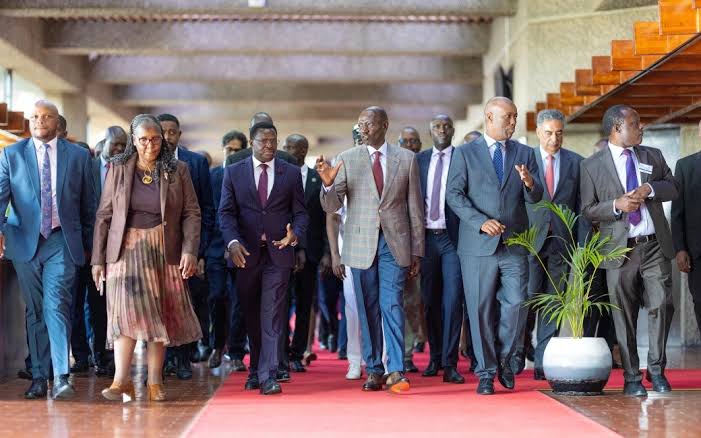
The gap between the government’s ambition and the sector’s current performance was a central theme of Ruto’s address at the Kenya Industrialisation Summit and Changamka Shopping Festival at the Kenyatta International Convention Centre (KICC) in Nairobi on Wednesday, November 4.
The President argued that Kenya must move beyond importing products it has the resources and skills to manufacture locally. He pointed to cement, steel, furniture, processed agricultural products and electric vehicles as industries with room for expansion.
“Our commitment to raise manufacturing’s contribution to 20 per cent of GDP and create one million jobs by 2030 remains firm,” Ruto said.
But achieving that target will require more than announcing new factories and imposing higher duties on imported goods. Manufacturers must also contend with the cost of electricity, borrowing, transport, taxes and access to markets.
Government bets on import levies to grow local factories
A major part of Ruto’s industrialisation strategy is to make imported products more expensive where local manufacturers can supply the same goods.
He cited the 17.5 per cent levy introduced on imported clinker in 2023 as an example. Clinker is a key ingredient in cement production.
According to the President, clinker imports fell from 148,000 tonnes in 2023 to 10,000 tonnes in 2024 following the intervention.
He said the policy had helped attract major investment proposals and projects in the cement industry.
These include a planned KSh50 billion production line by Bamburi Cement in Matuga, Kwale County, and a KSh30 billion factory being developed by Rai Cement in Kisumu. Devki Group is also developing clinker production facilities in West Pokot and Kitui.
Ruto put the combined investment in the projects at nearly KSh180 billion and said they could create about 12,000 jobs.
The government has applied a similar approach to the steel industry, introducing a 17.5 per cent levy on imported steel to encourage domestic production.
Ruto said new steel investments were under way in Taita Taveta and at Dongo Kundu, while two previously closed factories, Athi River Steel and Edmor Steel, had resumed operations.
The strategy is intended to give local manufacturers room to expand. However, import protection also carries a risk: if domestic producers cannot meet demand or keep prices competitive, businesses and consumers may face higher costs.
The long-term test will be whether the new investment results in reliable local supply, better-quality products and jobs that last beyond the construction of the factories.
Housing programme becomes a market for local industry
Ruto also presented the Affordable Housing Programme as a major source of demand for Kenyan manufacturers and small businesses.
He said 303,910 housing units were at different stages of development across the 47 counties. The projects require cement, steel, glass, tiles, timber, doors and windows.
The President said 97 per cent of materials used in the programme were sourced locally, while Jua Kali artisans had secured business opportunities through government projects.
He argued that public construction spending could help small workshops grow into larger suppliers by giving them orders, income and a reason to invest in machinery.
The government is also seeking to connect more small businesses to public procurement through the Access to Government Procurement Opportunities (AGPO) programme.
Ruto said a training initiative targeting between 600,000 and one million young people had been advertised. The programme is intended to help participants understand how to compete for government contracts.
AGPO reserves 30 per cent of public procurement opportunities for enterprises owned by young people, women and persons with disabilities.
The President also said the government was working with financial institutions to improve access to working capital for successful bidders and to ensure suppliers are paid within 60 days of verified delivery and invoicing.
Those commitments will matter to small businesses that often struggle to finance orders while waiting for government payments.
Farmers urged to move beyond raw exports
The President also challenged Kenya to earn more from agricultural products by processing and branding them locally before they reach international markets.
In coffee, he said the Coffee Cherry Advance Revolving Fund had advanced KSh15.07 billion to nearly 684,000 farmers. He cited export earnings from unroasted coffee of KSh52.1 billion in 2025, compared with KSh26.1 billion in 2021.
Ruto questioned why a country known for high-quality coffee should continue sending much of its produce abroad for roasting, grinding and packaging.
He made a similar argument about tea, saying Kenya needed to sell more blended, packaged and branded products instead of relying heavily on bulk exports.
The government is developing County Aggregation and Industrial Parks to bring processing facilities closer to farmers. Ruto said 15 of the planned parks were complete, with projects under development in 34 counties.
The wider ambition is to keep more of the value generated by Kenyan crops within the country, while creating employment in processing, packaging, transport and marketing.
Export markets offer opportunity, but factories must deliver
Ruto said Kenya was seeking to expand sales across Africa and beyond through regional and international trade agreements.
He highlighted increased exports to the East African Community and the Common Market for Eastern and Southern Africa, as well as the Kenya-European Union Economic Partnership Agreement, which provides duty-free, quota-free access for eligible Kenyan goods to the EU market.
Kenya has also secured an extension of the African Growth and Opportunity Act (AGOA) to December 31, 2028. The arrangement preserves preferential access to the United States market for eligible African exports, including Kenyan apparel. The sector supports more than 66,000 direct jobs in Kenya, according to the government.
The President said Export Processing Zones employed 104,692 Kenyans in 2025, while exports from the zones had risen to KSh136.8 billion.
But trade agreements alone cannot guarantee higher exports. Kenyan manufacturers must be able to produce at the right quality, price and volume to compete with suppliers in other countries.
That means addressing the costs Ruto acknowledged in his speech, including power, finance, transport and logistics.
Cost of living and the industrialisation challenge
The President’s call for faster industrial growth comes as households continue to feel pressure from rising prices.
KNBS reported that annual inflation increased to 7.3 per cent in October 2026, up from 6.8 per cent in September. Food and non-alcoholic beverages rose by 10.2 per cent over the year, while transport costs increased by 17.1 per cent.
The figures underline the challenge facing the government as it tries to make locally produced goods more competitive without adding to the cost burden on households and businesses.
Ruto said the government was working to expand electricity generation to 10,000 megawatts, improve infrastructure and establish a National Infrastructure Fund to support long-term investment.
He also pointed to electric mobility, renewable energy, digital infrastructure and artificial intelligence as areas where Kenya could develop new industries.
The President said incentives introduced for electric mobility had attracted investment commitments worth KSh24.6 billion and supported the local assembly of 38,201 electric bicycles, motorcycles and buses.
The test is delivery, not the size of the ambition
Ruto’s industrialisation plan rests on a clear proposition: Kenya can create more jobs and retain more wealth by making products locally instead of importing finished goods or exporting raw materials.
The challenge is turning that proposition into results that manufacturers, workers, farmers and consumers can see.
The 20 per cent GDP target is more than a numerical pledge. It requires factories to operate at scale, local suppliers to meet quality standards, workers to gain the right skills and businesses to access affordable finance and reliable power.
It also requires government policies to create a predictable environment for investors without making essential inputs and finished goods unnecessarily expensive.
Ruto told business leaders to expand factories, modernise production, train young people and source more materials locally.
His administration now faces the harder task of demonstrating that the investments and policies announced can move manufacturing beyond its current 7.1 per cent share of the economy before the 2030 deadline.
You may also like
Category: News · Related Topic: William Ruto
Related Video: Beyond Aid: How Japan Is Shaping Kenya’s SME Future | JICA Training Experience
Related Explainer: Fact Check: Did elephants save people during Nepal’s floods?
About the Author
Maureen Onyango is a journalist passionate about storytelling, life coaching and spiritual lessons. She studied at the Kenya Institute of Management and enjoys telling stories that inform, inspire and empower communities.
 Facebook
 Twitter / X
 WhatsApp
 LinkedIn
 Telegram
 Reddit