
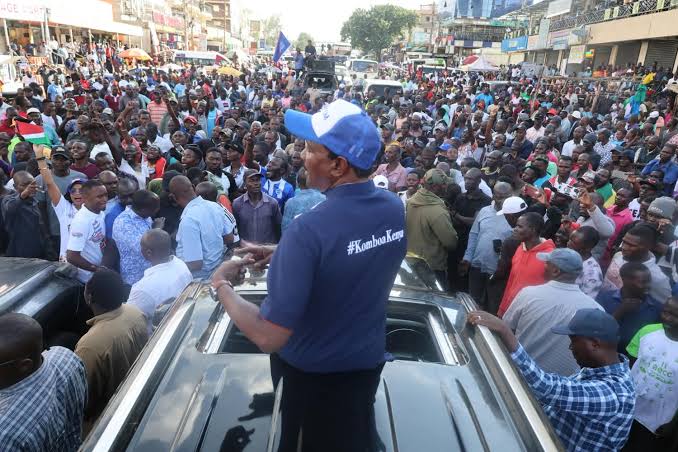
Linda Mwananchi has accused President William Ruto’s administration of encouraging political intolerance after opposition leaders were attacked during a campaign tour in Migori, warning that violence could undermine political competition ahead of the 2027 General Election.
The movement's statement, issued on Friday, November 6, followed Thursday's confrontation in Migori Town, where a group of suspected attackers reportedly pelted a convoy led by Wiper Patriotic Front leader Kalonzo Musyoka with stones.
Former Attorney-General Justin Muturi's vehicle was among those damaged, with its windscreen smashed. Police also deployed tear gas as tensions escalated around the gathering.
Linda Mwananchi, through Deputy Secretary General Pauline Njoroge, condemned the incident and accused the government of allowing political violence to intimidate opposition figures and restrict their right to campaign.
“We condemn the attacks on H.E Kalonzo’s campaign convoy and demand that those responsible be brought to book,” Njoroge said.
The movement further alleged that the violence was part of an attempt to establish political dominance in Nyanza by discouraging alternative political voices.
However, no evidence has been made public to establish that the government organised or sponsored the attack. The responsibility for the incident remains a matter for investigation.
Opposition raises alarm over political space in Nyanza
The attack comes as opposition leaders intensify efforts to build support in Nyanza, a region that has traditionally backed the Orange Democratic Movement (ODM).
Kalonzo, accompanied by Muturi, Democratic Action Party of Kenya leader Eugene Wamalwa and other opposition figures, was touring the region under the Ukombozi Alliance banner.
The leaders held public engagements in parts of Migori before the confrontation in Migori Town. Their tour is part of a wider effort to expand their political reach ahead of the next election.
Linda Mwananchi argued that the violence should not be used to portray the entire Nyanza region as hostile to rival political parties.
It said political disagreements should be settled through public debate and elections, rather than intimidation or attacks on campaign teams.
The movement also warned against attempts to create political strongholds where leaders from competing parties cannot freely address residents.
Its statement drew comparisons with the political repression experienced during the administration of former President Daniel arap Moi, arguing that intimidation and unlawful detention had failed to stop the country's struggle for democratic reforms.
Njoroge urged young people to resist being drawn into political and ethnic divisions as the country moves towards the 2027 polls.
She warned that violence could create an atmosphere in which political participation is restricted and electoral malpractice becomes easier.
Kalonzo and Muturi condemn the attack
Kalonzo described the incident as an attempt to intimidate opposition leaders and questioned the police decision to use tear gas during the confrontation.
He said a group of about 10 people had thrown stones at his convoy, putting the safety of those travelling with him at risk.
“Stones and teargas could not stop us from addressing the great people of Migori,” he said, insisting that the opposition would continue with its public engagements.
Muturi also condemned the incident and accused Suna East MP Junet Mohamed of sponsoring the people who disrupted the gathering.
That is a serious allegation, and the reports reviewed do not provide independent evidence establishing his involvement. Junet's response was not available in the coverage reviewed.
The opposition leaders have called on security agencies to investigate the attack and identify those responsible.
Police had already warned against political goonism
The Migori incident comes just days after Inspector General of Police Douglas Kanja directed senior officers to take stronger action against criminal gangs and politically motivated goons ahead of the 2027 election.
Speaking at a security preparedness conference in Ngong on October 30, Kanja warned that commanders who failed to deal with such groups in their areas could face consequences.
He called for intelligence-led operations rather than waiting for violence to break out before responding.
The warning raises an important question about enforcement: whether the police can prevent politically charged gatherings from turning violent and ensure that those responsible are held accountable, regardless of their political connections.
The National Police Service's position on the specific Migori incident was not available in the reports reviewed. There was also no confirmed public account of arrests or charges arising from the confrontation.
A warning ahead of the 2027 election
Linda Mwananchi said the government should allow opposition parties to organise and campaign freely across the country, regardless of the political support enjoyed by rival formations in particular regions.
Njoroge accused the Ruto administration of using political divisions to maintain power and warned against turning the country into competing political enclaves.
“The outgoing regime is behaving typically like a caged animal, having obviously acknowledged it is living in its last days in office,” she said.
She also urged the President not to deepen divisions through political intimidation.
“We reject the violence and put Ruto on notice; do not divide the country in your desperation!” she said.
The accusations add to the political tension surrounding opposition mobilisation as parties begin positioning themselves for 2027.
But beyond the competing political claims, the central issue is whether candidates and their supporters can campaign without fear of attack.
For the police, the Migori incident presents a test of the Inspector General's earlier commitment to deal with political goonism. For political leaders, it is a reminder that disagreements over support and party loyalties must not be allowed to turn into violence.
Those responsible for the attack must be identified through a credible investigation, rather than political accusations being treated as proof.
You may also like
Category: Politics · Related Topic: William Ruto
Related Video: Murkomen Says Kenya Is Safe: “Stop Creating a Crisis” | Political Goons & Security Under Scrutiny
About the Author
Maureen Onyango is a journalist passionate about storytelling, life coaching and spiritual lessons. She studied at the Kenya Institute of Management and enjoys telling stories that inform, inspire and empower communities.
 Facebook
 Twitter / X
 WhatsApp
 LinkedIn
 Telegram
 Reddit