
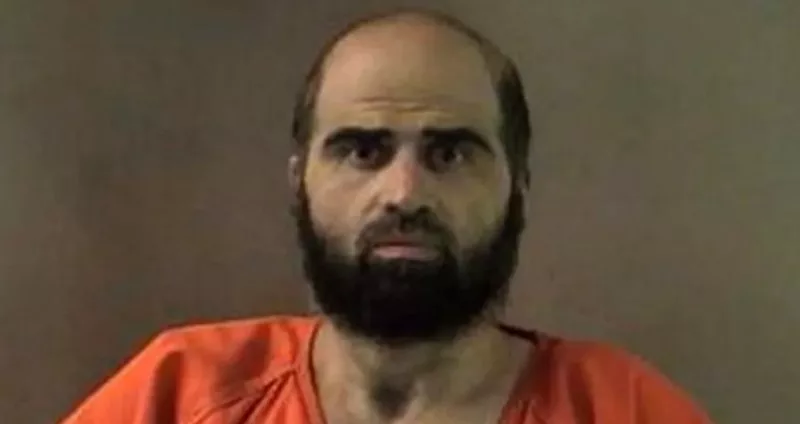
The US government plans to livestream the execution of former Army Major Nidal Hasan, a decision that is drawing international scrutiny over whether a state execution should be broadcast to the public.
The Pentagon confirmed on Thursday that Hasan’s execution by firing squad will be livestreamed. It is scheduled for 3 December at Fort Hood, Texas, where he carried out the 2009 shooting that killed 13 people and wounded 32.
The decision goes beyond the choice of execution method. It opens a debate over whether broadcasting a death sentence can improve public understanding of capital punishment or turn a government-sanctioned killing into a spectacle.
US Defence Secretary Pete Hegseth has defended making the execution public, saying people should understand the consequences of such crimes.
“We’ll make sure that people are able to watch it, that it’s public,” Hegseth said in an interview with conservative broadcaster Real America’s Voice.
He added that people needed to understand there were “serious consequences for these types of things”.
The Pentagon has said further details of the broadcast will be released. The White House referred questions about the livestream to the Defence Department and has not publicly clarified whether President Donald Trump separately endorsed the decision to broadcast the execution.
Execution scheduled for December
Trump approved Hasan’s death sentence on 2 October, following the completion of the military appeals process, according to the US Army. Acting Army Secretary Adam Telle subsequently set the execution date for 3 December at 1pm Central Standard Time.
If carried out as scheduled, it would be the first US military execution since 1961. It would also be the first execution by a US military firing squad since 1945.
However, the date could still change. Legal experts say Hasan could pursue further court action seeking to delay the execution, even after his military appeals have concluded.
The planned livestream is also unusual. Public executions have largely disappeared from modern practice in the United States, where executions are generally conducted privately, with only authorised witnesses present.
The Pentagon has not yet provided all the details of how the broadcast will work or who will be able to access it.
The Fort Hood shooting that led to the death sentence
Hasan was an Army psychiatrist when he opened fire inside a medical facility at Fort Hood on 5 November 2009. Soldiers were waiting for medical checks before deployment when the attack began.
Thirteen people were killed, including 12 active-duty soldiers and one retired serviceman. Another 32 people were wounded.
A military jury convicted Hasan in 2013 of multiple counts of premeditated murder and attempted premeditated murder. He was sentenced to death.
During the trial, Hasan said he had acted to protect Muslims from US military operations in Afghanistan and other Muslim-majority countries. The court did not accept that as a legal defence.
Hasan was wounded by police during his arrest and has been paralysed from the waist down.
The planned execution would bring a long-running military justice case to its final stage, provided no further legal challenge delays the process.
Human rights groups question the livestream
The decision to broadcast the execution has drawn criticism from human rights advocates, who say public access does not automatically justify turning an execution into a televised event.
Amnesty International Australia has urged the Australian government to press Washington to reconsider the livestream.
Kyinzom Dhongdue, a campaign manager for the organisation, said the proposal showed a disregard for human dignity and warned that broadcasting the execution could make an already cruel punishment more degrading.
Some legal experts, however, argue that allowing the public to see how executions are carried out could encourage greater scrutiny of capital punishment.
Deborah Denno, a law professor at Fordham University who studies the death penalty, told the Associated Press that a broadcast could make the process more transparent at a time when questions have been raised about how executions are conducted.
Other experts have questioned the legal and ethical basis for a government-organised livestream, including how the broadcast would be controlled and what safeguards would apply.
The disagreement highlights a central issue: whether public visibility makes a punishment more accountable or simply increases its spectacle.
International concerns over violent online content
The planned broadcast has also prompted concern beyond the United States.
New Zealand’s Classification Office said it could not pre-emptively block access to a livestream of the execution under its existing legal framework. The office said decisions on harmful content must balance the risk of harm with freedom of expression.
The issue carries particular weight in New Zealand, where a gunman livestreamed the 2019 attacks on two Christchurch mosques, killing 51 people. The country has since worked with international partners to limit the spread of violent online material.
Public executions remain rare globally. Amnesty International recorded at least 17 in 2025: 11 in Iran and six in Afghanistan.
Those figures concern executions known to have been carried out publicly. Hasan’s case would be different in one key respect: the US government has announced plans to livestream the event itself.
The planned broadcast therefore raises questions that go beyond Hasan’s case, including how governments should handle violent content online and whether an execution should be treated as a public information exercise.
For now, the US military has set the date and the Pentagon says the execution will be livestreamed. Whether the plan proceeds as announced will depend in part on any further legal action, while the wider argument over transparency, punishment and human dignity is already under way.
You may also like
Category: International
Related Video: What Dangote’s proposed Lamu oil refinery could mean for East Africa
About the Author
Maureen Onyango is a journalist passionate about storytelling, life coaching and spiritual lessons. She studied at the Kenya Institute of Management and enjoys telling stories that inform, inspire and empower communities.
 Facebook
 Twitter / X
 WhatsApp
 LinkedIn
 Telegram
 Reddit