
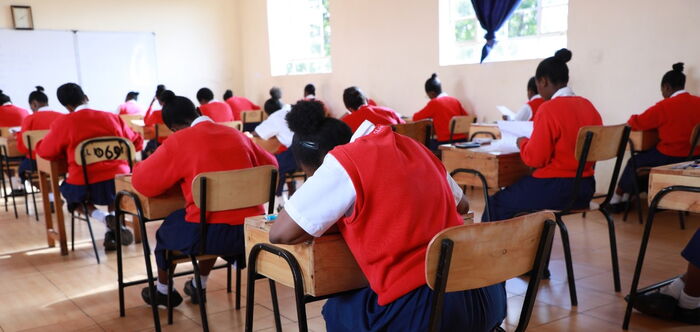
Twelve candidates at Kitonyini High School in Machakos County have reportedly been stopped from sitting their remaining Kenya Certificate of Secondary Education (KCSE) papers after they were allegedly found with mobile phones during the examination period.
The incident, reported on Friday, November 13, has raised fresh questions about the strict rules governing Kenya’s national examinations and the consequences candidates face for breaking them.
Kenyans.co.ke reported that the students were suspended from the remaining papers after the alleged discovery of the phones. However, it remains unclear whether the devices were found inside an examination room or elsewhere within the school compound.
Neither the precise circumstances of the incident nor the final action taken against the candidates had been independently confirmed by examination authorities at the time of publication.
What KNEC rules say about mobile phones
The Kenya National Examinations Council (KNEC) has made it clear that mobile phones and other electronic communication devices are prohibited at examination centres.
Its 2026 KCSE examination instructions state that any candidate found in possession of a mobile phone or another electronic communication device will have their examination results cancelled.
The rules also prohibit candidates from keeping books, notes, loose papers or other unauthorised materials in their possession or within their reach during an examination.
Where calculators are permitted, candidates must use approved non-programmable models without covers. Their use is restricted to subjects specified by KNEC.
Candidates risk losing more than the remaining papers
The consequences may extend beyond being prevented from sitting the remaining papers.
Section 32 of the Kenya National Examinations Council Act provides for the disqualification of a candidate from an entire examination if they are found, during an examination, in possession of an electronic device or other material in the examination room without lawful authority.
Any examination paper already taken may also be cancelled. The law further allows KNEC to prohibit a candidate from sitting another examination for up to three years.
The distinction between the reported suspension at Kitonyini and a final examination sanction is important. The full circumstances of the incident and the formal decision by KNEC have yet to be made public.
Government maintains tough stance on examination malpractice
The incident comes amid heightened efforts by the government and KNEC to prevent examination irregularities during the 2026 KCSE season.
Education Cabinet Secretary Julius Ogamba has warned candidates, teachers and examination officials against engaging in malpractice.
Speaking during the launch of the national examinations season, Ogamba said the government would not tolerate anyone found compromising the integrity of the examinations.
"We will have no mercy on anyone who will be found engaging in any form of malpractice," he said.
KNEC has also tightened restrictions on electronic devices at examination centres. The directive applies not only to candidates but also to examination officials and other personnel working within the centres.
Phones belonging to authorised personnel must be switched off and secured outside examination rooms during examination sessions.
The council has also introduced additional security measures, including personalised examination papers and electronic monitoring of examination material, as part of efforts to prevent leaks and unauthorised access.
With the 2026 KCSE examinations scheduled to run until November 20, the Kitonyini incident serves as a reminder to candidates that even possession of a prohibited device can put their examination results at risk.
You may also like
Category: Education
Related Video: What Dangote’s proposed Lamu oil refinery could mean for East Africa
Related Explainer: Kiharu Technical College September Intake 2026: Courses, Skills and New Opportunities
About the Author
Maureen Onyango is a journalist passionate about storytelling, life coaching and spiritual lessons. She studied at the Kenya Institute of Management and enjoys telling stories that inform, inspire and empower communities.
 Facebook
 Twitter / X
 WhatsApp
 LinkedIn
 Telegram
 Reddit