
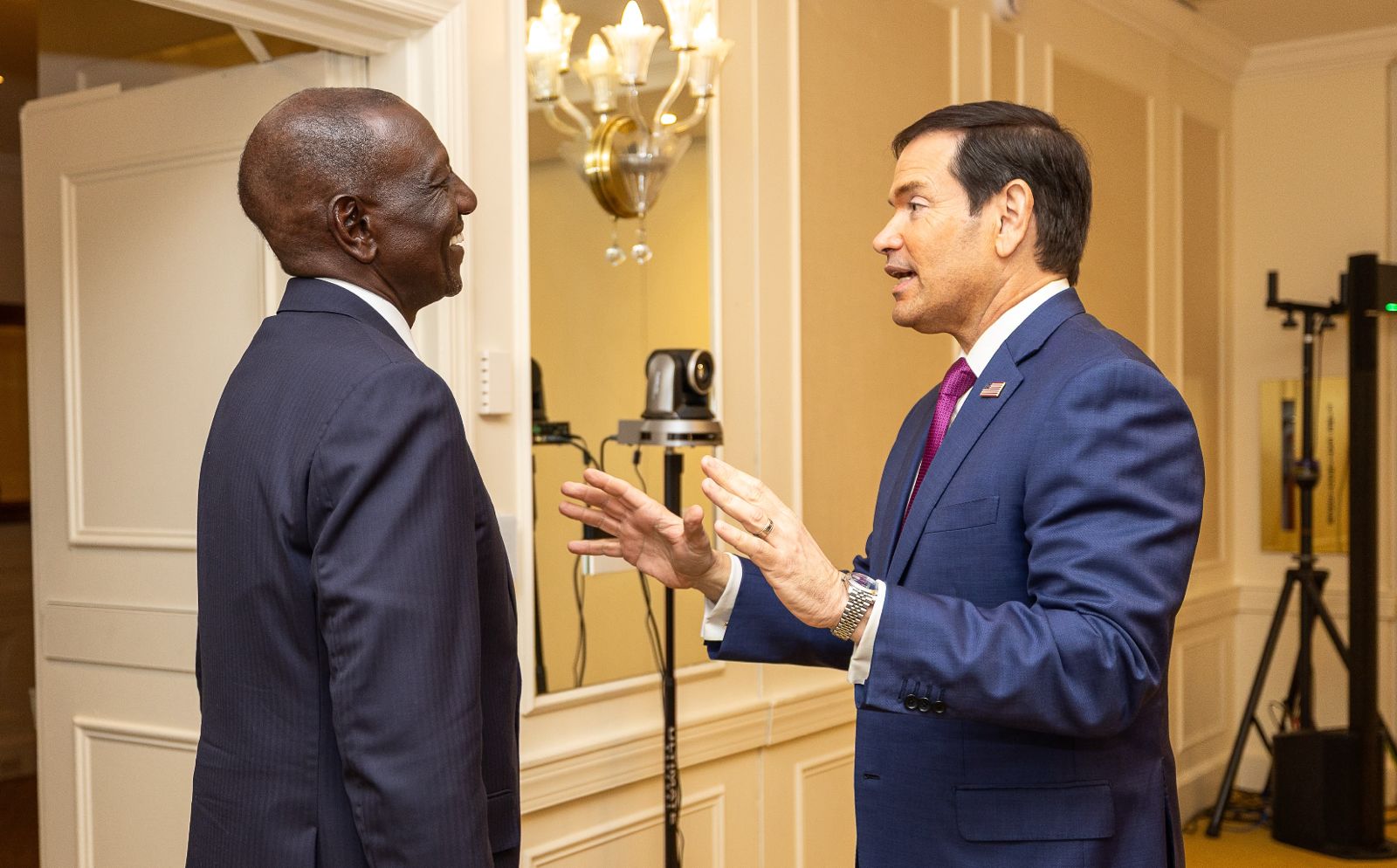
President William Ruto's meeting with US Secretary of State Marco Rubio in New York has put Kenya's largely untapped mineral wealth into a much bigger geopolitical contest involving China, artificial intelligence, advanced manufacturing and the future of global supply chains.
Ruto met Rubio on the sidelines of the 81st United Nations General Assembly, with discussions covering trade, artificial intelligence, critical minerals, nuclear energy and security challenges in Somalia, Haiti and Sudan.
But critical minerals stand out because the conversation is no longer theoretical.
The United States said earlier this month that it would help Kenya develop its mineral-processing industry, while Ruto said in June that the two countries were nearing an agreement covering critical minerals.

The question is why Washington is so interested.
The answer begins thousands of kilometres from Kenya, in the increasingly intense economic competition between the United States and China.
China controls a dominant share of the global processing and production of rare-earth materials. Reuters reports that it accounts for more than 85% of refining and production of rare-earth metals, giving Beijing enormous influence over materials needed for modern technology.
Critical minerals are used in products ranging from electric vehicles and renewable-energy technologies to electronics, advanced manufacturing and defence systems.
They are also increasingly intertwined with the AI race.
Artificial intelligence requires enormous data centres, semiconductor manufacturing and electricity infrastructure, all of which depend on complex mineral supply chains.
The United States is consequently trying to diversify where it obtains strategic minerals and where they are processed.
Kenya sees an opportunity.
The country has deposits associated with minerals including rare earths, niobium, graphite, lithium, copper and nickel. Ruto has argued that Kenya should not simply dig up valuable minerals and export them in raw form.
He wants more processing and value addition to happen locally.
Mrima Hill becomes strategically important
One site attracting particular attention is Mrima Hill in Kwale County.
The deposit is associated with rare earth elements and niobium and has attracted interest from companies seeking development rights.
US officials have said Washington wants to help Kenya establish a transparent mineral sector that includes local processing and benefits communities. Two US-based consortia are among companies reported to be pursuing the Mrima Hill opportunity.
That distinction between mining and processing matters.
African countries have historically exported raw commodities before buying higher-value manufactured products back from industrial economies.
Kenya is arguing for a different model: extract minerals, process more of them locally and retain a greater share of the economic value.
Whether that happens will depend on the eventual investment agreements, infrastructure, environmental safeguards and commercial viability.
AI and minerals increasingly converge
Ruto's Rubio meeting also brought AI into the same conversation.
The President said the two countries were expanding cooperation in artificial intelligence, including potential applications in healthcare, education and financial services.
They also discussed responsible AI governance.
That follows Ruto's push at UNGA for developing and middle-income countries to have greater control over the infrastructure underlying AI, including computing capacity, data, energy and talent.
The mineral discussion consequently fits into a broader argument about technological sovereignty.
Countries supplying the physical materials on which advanced technologies depend increasingly want to participate in the industries built from those materials.
AGOA and security remain on the table
Trade was another major part of the meeting.
Ruto welcomed the extension of the African Growth and Opportunity Act, describing it as important for expanding economic opportunities and US-Africa trade.
Security discussions covered Somalia, Haiti and Sudan.
Kenya remains an important US security partner in East Africa and has played a prominent international role in Haiti.
Rubio also acknowledged Kenya's partnership with Washington on its global health strategy.
The relationship is therefore expanding beyond its traditional foundations of security, health assistance and trade.
Minerals, AI and energy are becoming more prominent.
For Kenya, the opportunity is potentially substantial.
But the real measure of any minerals partnership will not be the value of what lies underground.
It will be how much processing, technology transfer, employment and industrial value Kenya retains once those minerals come out of the ground.
You may also like
Category: Business · Related Topic: William Ruto
Related Video: Gachagua’s explosive Ruto scorecard: Debt, taxes, State capture and a government ‘that has failed’
Related Explainer: EXPLAINER: How can one mother give birth to five babies? The science behind Kenya’s rare quintuplets
 Facebook
 Twitter / X
 WhatsApp
 LinkedIn
 Telegram
 Reddit