
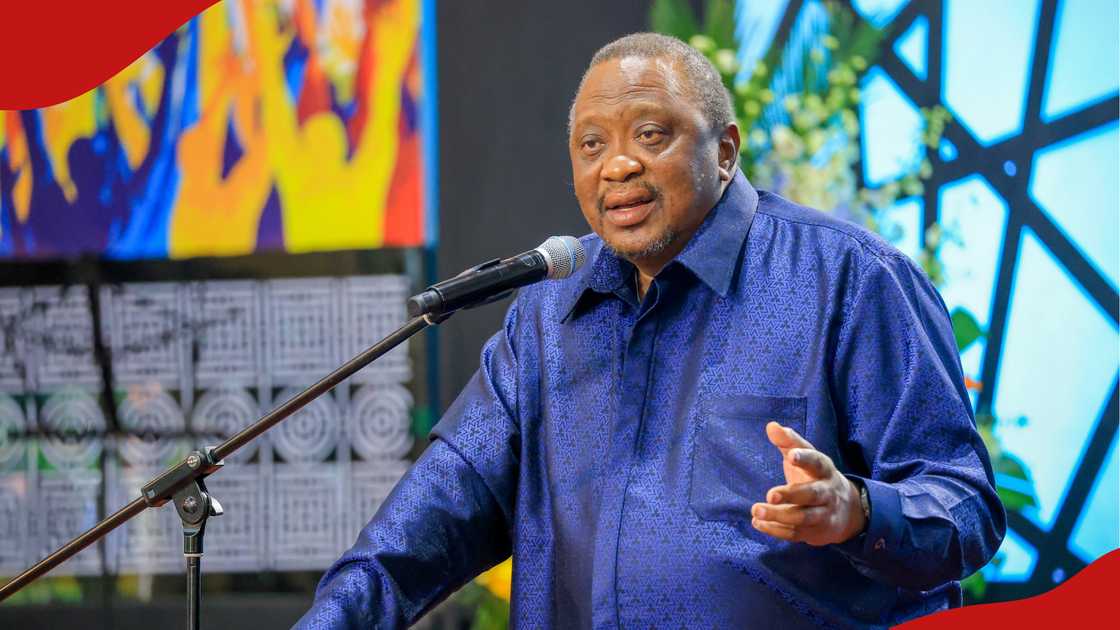
Former President Uhuru Kenyatta has delivered one of his most direct political responses to President William Ruto since leaving office, accusing his successor of spending four years blaming him for the government's difficulties while declaring that Jubilee will organise for the 2027 election under former Interior Cabinet Secretary Fred Matiang’i.
In a wide-ranging, largely Swahili speech at Jubilee Party headquarters in Nairobi on Tuesday, Kenyatta confronted several issues that have defined his increasingly bitter exchanges with Ruto: the 2022 election, the “dynasty versus hustler” campaign, accusations that he finances the opposition, and Ruto’s recent description of him as a “rebel leader”.
But behind the sharp language was a more consequential political message.
Kenyatta effectively began reorganising Jubilee for 2027, proposed Matiang’i to take over his leadership role pending approval by the party's National Delegates Convention, and instructed the party to recruit candidates across the country and work with other opposition parties.

“I want us as Jubilee to continue with the work of uniting with other Kenyans,” he told supporters. “There is no need to boast that it is me, me, me. Let us unite with everybody else and organise ourselves to know what Kenya will look like going forward.”
It was perhaps the clearest indication yet that while Kenyatta is prepared to move from Jubilee’s frontline leadership, he is not retiring from the politics surrounding Ruto’s bid for another term.
Current reporting confirms that Matiang’i has accepted the proposed leadership transition, which remains subject to Jubilee's NDC.
‘After four years, it is still Uhuru this, Uhuru that’
The most politically potent section of Kenyatta's speech came when he turned directly to Ruto's repeated criticism of his administration.
Kenyatta recalled that after the disputed 2022 presidential election went to court, his administration accepted the Supreme Court's decision and transferred power peacefully.
Then he asked why, nearly four years later, the government was still talking about him.
“Baada ya miaka nne bado wanasema Uhuru huu, Uhuru hii, Uhuru... Kwani jamani ulipewa uongozi ndio uendelee kuongea juu ya Uhuru hapa ama ulipewa uongozi uende ufanye?”
Loosely translated: “After four years they are still saying Uhuru this, Uhuru that... Were you given leadership so that you could continue talking about Uhuru, or were you given leadership so that you could go and work?”
That attack goes to the centre of a political argument likely to become more important as the August 2027 election approaches.
Ruto has repeatedly compared his administration's performance with Kenyatta's and blamed some of the challenges facing his government on what it inherited. He has cited debt and unfinished programmes while arguing that his administration has performed better in areas including affordable housing and universal health coverage.
But Kenyatta's counterargument is increasingly simple: Ruto has been president since September 2022 and must now be judged on his own record.
The former president described continued references to his administration as an “excuse” when things are not working.
That framing could become one of the central arguments of the coming campaign: when does an incumbent government cease being able to blame its predecessor?
‘They call me sponyo’
Kenyatta then confronted one of Ruto's newest lines of attack.
In recent weeks, the President has repeatedly accused his predecessor of sponsoring opposition politicians seeking to remove him from office. In Migori last week, Ruto portrayed Kenyatta as a “rebel leader” rather than a retired statesman.
Kenyatta responded directly.
“Bado huko wananiita majina huko... sponyo, aka rebel sijui nini. Kwani kuongea haki yako kwa nchi ambayo ni demokrasia ni mbaya?”
“They are still calling me names... ‘sponyo’, aka rebel, I don't know what. Is exercising your right to speak in a democratic country wrong?”
He then drew a distinction between political activity and rebellion.
“Kuna mtu mimi nimewaambia kwenda kuchukua silaha? ... Si kila mtu ako na uhuru wa kuamua?”
“Have I told anyone to go and take up arms? ... Doesn't everyone have the freedom to make their own decision?”
The description of Kenyatta as an opposition “sponsor” is a political allegation made by Ruto and his allies; publicly available reporting does not establish that Kenyatta finances the opposition as a whole.
Ruto has nevertheless repeatedly returned to the allegation. Last week he warned opposition politicians about being used by an “angry sponsor”, in remarks widely understood to refer to Kenyatta.
The former president had previously responded more playfully, referring to himself as “sponyo” during a recent appearance in Murang'a.
Tuesday's response was different. He turned the label into an argument about his constitutional right to participate in politics.
A court judgment has complicated Ruto's argument
The timing is significant.
On Monday, the High Court declared unconstitutional Section 6 of the Presidential Retirement Benefits Act, which restricted a retired president from holding political-party office more than six months after leaving office.
Justice Bahati Mwamuye held that leaving the presidency ends the constitutional authority attached to that office but does not extinguish a former president's rights as a citizen.
The judgment came amid a complicated legal dispute over Kenyatta's continued leadership of Jubilee.
Yet Kenyatta used Tuesday's meeting to move in a different direction anyway.
He said he would remain in Jubilee but proposed becoming a senior adviser while Matiang’i assumes greater responsibility.
“I cannot leave Jubilee. Where would I go? Do I have another home?” he asked supporters.
He then proposed his new role:
“Mimi niende huku hiyo ingine ya juu niwe kama hapo senior adviser.”
He would move “upstairs”, as he put it, and become a senior adviser while the party's new leadership takes charge.
That arrangement potentially gives Kenyatta something politically useful: distance from Jubilee's day-to-day leadership without removing him from its strategic decision-making.
Then came Matiang’i
Kenyatta left little doubt about whom he wants to take over.
He described Matiang’i as wise, hardworking and someone he believes served Kenyans rather than an ethnic constituency.
The former president's praise was explicitly political.
“Naona kuna huyu kijana wa Mkisii kule... anaitwa Matiang’i. Mtu ambaye ana hekima... ni mtu ambaye anapenda Wakenya, ni mtu ya kazi.”
He also described Matiang’i as someone he does not consider corrupt — an assessment made by Kenyatta, rather than an independently established conclusion.
At the end of the meeting, Kenyatta asked Jubilee members directly to approve the transition.
“Mkubali mumpokee Fred Okengo Matiang’i achukue nafasi yangu.”
“Accept Fred Okengo Matiang’i to take my place.”
The crowd responded by raising their hands.
Matiang’i subsequently accepted the proposal, while the formal transition is expected to be confirmed through the party's NDC.
For Kenya's emerging opposition, the significance extends beyond Jubilee.
Kenyatta is effectively giving Matiang’i an established party structure from which to negotiate with other opposition figures.
‘Let him work with the other leaders’
That may be the most important forward-looking passage in the entire speech.
Kenyatta did not tell Jubilee to isolate itself.
He told Matiang’i to engage other leaders.
“Yeye sasa ashikane na viongozi wale wengine, wafanye kazi pamoja... tuwe kitu kimoja na twende tuungane na watu wengine huko.”
“Let him now join hands with the other leaders, let them work together... let us become one and unite with others.”
That language points towards coalition politics rather than a Jubilee-only presidential campaign.
It also puts Matiang’i into a crowded opposition space in which Kalonzo Musyoka and other leaders are pursuing their own political strategies.
Whether those interests can eventually be reconciled around one presidential candidate remains unresolved.
Kenyatta himself acknowledged that negotiation will be necessary. He said Jubilee needs a candidate who can “go and talk with the others” as parties organise themselves ahead of 2027.
That is a revealing formulation.
It suggests Matiang’i's immediate value to Jubilee is not simply as a declared presidential candidate but as its representative in the bargaining that will shape opposition alliances.
Uhuru reopens the most sensitive argument of 2022
Kenyatta also went much further than usual in revisiting the presidential election that ended his administration.
He claimed Raila Odinga won.
“Tulifanya yote na kura akapewa. Na mimi mpaka wa leo najua ya kwamba yeye ndio alishinda hiyo kura.”
“We did everything and he was given the votes. To this day, I know that he is the one who won that election.”
He questioned how Azimio could have lost the presidency while winning large numbers of other elective seats.
“Tulikuwa na maseneta wengi... Tulikuwa na magavana wengi... Hii ingine tumepoteza namna gani? Tusidanganywe.”
He added: “Tunajua vile mambo ilienda na hatutaki iende hivyo tena” — “We know how things went and we don't want it to happen that way again.”
That assertion needs an important factual qualification.
The official result remains that Ruto won the 2022 presidential election. The Independent Electoral and Boundaries Commission declared him elected with 50.49% of the vote against Odinga's 48.85%, and the Supreme Court unanimously upheld the result after considering challenges to the election.
Kenyatta's statement is therefore a political claim, not the legally established result.
But its appearance in Tuesday's speech is politically consequential.
It shows that the unresolved grievances of 2022 are likely to feed directly into the politics of 2027.
The old ‘hustler versus dynasty’ argument returns
Kenyatta also revisited the political narrative that helped Ruto win the presidency.
Ruto's 2022 campaign successfully framed the election partly as a contest between ordinary “hustlers” and established political “dynasties”.
Kenyatta reminded supporters of that argument before posing a pointed question.
“Wakazunguka na uongo na uongo na uongo... siku ya leo mimi najiuliza mahasla wa kweli ni nani na madynasty ni nani.”
“They went around with lies and lies and lies... today I ask myself: who are the real hustlers and who are the dynasties?”
The statement suggests that Jubilee may attempt to turn one of Ruto's strongest 2022 political messages back against him in 2027.
Whether that argument resonates with voters will depend on current economic conditions, perceptions of the government's performance and how rival campaigns frame those conditions.
Uhuru also defended the handshake
Kenyatta used his speech to defend another defining decision of his presidency: the 2018 handshake with Raila.
He portrayed the rapprochement not as elite political deal-making but as an attempt to prevent recurrent election-related conflict.
“Tukaenda kuwatafuta, njooni jameni tuungane, tupeleke Kenya mbele... tukakuwa na handshake na tukakuwa na amani.”
He said the objective was to pursue “umoja na amani ya taifa letu la Kenya” — unity and peace for Kenya.
He similarly defended the Building Bridges Initiative, saying it was intended to address political conflict and the distribution of national resources.
Those interpretations remain contested. BBI's critics argued that it would expand political offices and benefit political elites, while supporters argued that it offered institutional responses to Kenya's recurrent political divisions.
But Kenyatta's decision to revisit the handshake, BBI, “dynasty” politics and the 2022 election suggests Jubilee may try to rehabilitate parts of his political legacy as the campaign approaches.
The battle for Mt Kenya
There is another dimension that neither Ruto nor Kenyatta can ignore: Mt Kenya.
Ruto overwhelmingly defeated Kenyatta's preferred candidate across much of the region in 2022.
That result demonstrated a fundamental limitation on presidential endorsements: Kenyatta could support Raila, but he could not simply transfer Central Kenya's voters to him.
The political landscape is now more fragmented.
Ruto's fallout with former Deputy President Rigathi Gachagua has introduced another centre of opposition politics in the region. Other political actors are also competing for influence.
Kenyatta's re-emergence therefore does not automatically mean the region will return to him politically.
But it does give the opposition another experienced political organiser with historic relationships across the region.
And Ruto's repeated attacks on Kenyatta have an unintended consequence: they keep the former president relevant.
The President himself has helped place Uhuru back at the centre of the political conversation by repeatedly describing him as the financier or organiser behind his opponents.
‘Kura si soko’
Kenyatta ended with perhaps the most concise political line of his speech.
“Kura si soko. Kura ni maono.”
“A vote is not a market. A vote is a vision.”
He urged Jubilee politicians to sell policies rather than insults.
“Uza sera,” he said — sell your policies.
He then laid out what amounts to an election mobilisation programme.
Jubilee, he said, must find candidates for MCA, governor, Senate and National Assembly seats before identifying the person it will support to lead the country.
“Twende tutafute MCA wale ambao watasimama na tikiti yetu... tutafute magavana... maseneta... MP... Twende tutafute rais ambaye atatuongoza kama nchi.”
That is why Tuesday's speech matters beyond another Ruto-Uhuru confrontation.
Kenyatta did not announce a comeback as a candidate. In fact, he explicitly acknowledged that the Constitution limits a president to two terms and stressed the importance of respecting it.
Instead, he outlined a different role.
He will remain in Jubilee. He wants Matiang’i to take over its leadership. He wants the party to recruit candidates nationally. And he wants its leadership talking to other political formations.
The emerging picture is therefore not necessarily of Uhuru Kenyatta trying to become opposition leader.
It is of a former president positioning himself as an influential organiser and adviser in a much broader attempt to construct the political alternative that will face Ruto in 2027.
That makes Ruto's “sponsor” label politically intriguing.
The President has been trying to use the word to portray his opponents as proxies of the former president.
Kenyatta is now appropriating the label, rejecting its negative implication while openly helping Jubilee organise for the election.
The more consequential question is no longer whether Uhuru is politically active. Tuesday's speech makes that clear.
It is how much influence he can translate into an opposition that remains fragmented, and whether the voters who rejected his preferred succession plan in 2022 will listen to him differently in 2027.
For now, Kenyatta's message to Jubilee was unambiguous:
“Twende kujipanga kazi ya 2027.”
“Let us go and organise for the work of 2027.”
You may also like
Category: Politics · Related Topic: William Ruto
Related Video: Dolly Parton’s Family Announces Her Passing in Emotional Tribute
 Facebook
 Twitter / X
 WhatsApp
 LinkedIn
 Telegram
 Reddit